Game feel for 2D: shake, hit-stop and a follow camera
0.23 CPU ms
Still
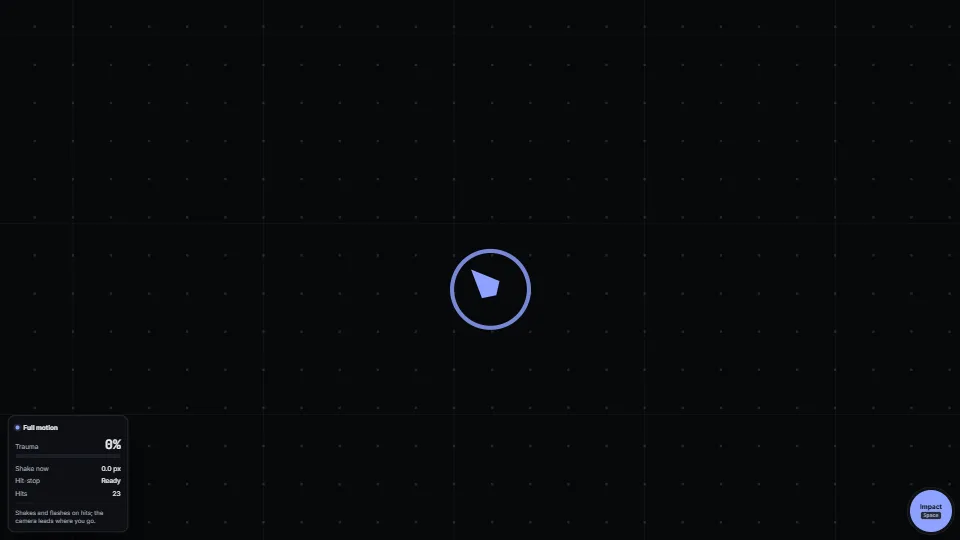
The live demo starts when it’s in view.Move with WASD, the arrow keys or a press on the arena · Space or Impact hits everything near · sliders change the feel
Three small pieces that make hits land in a 2D action game.
A trauma shake: knocks add trauma, which decays, and the offset is its square on a smooth sum of sines, so small knocks stay small and big ones shudder; it stops entirely when motion is reduced. A hit-stop: a few hundredths of a second where the simulation holds while effects, sound and camera run on. A camera that follows with a lead toward where the player heads or aims, eases in, stays inside the world and snaps on a new round.
Measured 21 November 2026 on RTX 4060 Laptop, 13th Gen Intel(R) Core(TM) i9-13900H, Chrome 157, 1920×1080 at 1×. 600 frames × 3 rounds, median kept (rounds ranged CPU 0.21–0.23 ms). What ran: Alone, with the player circling the arena on its own and an impact every 0.7 s: the shake, the hit-stop and the follow camera each frame over a plain grid with the impact rings, in Canvas 2D. Phones: tiers are being measured next.
How steadily it runs on RTX 4060 Laptop · 13th Gen Intel(R) Core(TM) i9-13900H · reference
Typical frame ?
16.86 ms
1% low ?
52 fps
Varies by ?
±0.53 ms
All metricsRTX 4060 Laptop · 13th Gen Intel(R) Core(TM) i9-13900H · referenceHow long each frame took. Most frames sit in the tall bars; a long tail to the right is hitching.
Frames run on a 60 Hz timer (a page demo), so most frames take about one tick, 16.7 ms: the spread around it is what matters.
Frames
Median (p50) ?
16.86 ms
p95 ?
17.97 ms
p99 ?
18.63 ms
Slowest ?
20.25 ms
Mean ?
16.91 ms
Standard deviation ?
0.53 ms
1% low ?
52 fps
0.1% low ?
49 fps
Hitches ?
0 of 600
Over budget ?
0 of 600
Main thread
Long tasks ?
0
Long frames ?
0
Event-loop delay ?
0.1 / 0.8 / 1.3 ms
Input
No input during this run.
Memory
JavaScript heap ?
33.8 → 35.9 MB
Growth ?
+2.15 MB
Browser
JavaScript a frame ?
0.35 ms
All tasks a frame ?
0.91 ms
Layout / style ?
0.08 / 0.02 ms
Main thread busy ?
5%
Garbage collection
Collections ?
2 (2 minor, 0 major)
Pauses ?
2.0 ms in all, longest 1.3
What it needs
Renders with
Canvas 2DA 2D canvas: every current browser.
Your browser
Runs hereNo WebGPU needed
Depends on
NothingNo other packages
With an agent
install("game-feel-2d")Your coding agent reads its pitfalls and installs it through the library’s MCP server. Set it up
What it’s for
Twin-stick, swarm and arena games
Platformers and brawlers that need hits to land
A camera that leads the player in a scrolling 2D world
A calm mode that keeps the game but drops the shaking
Top-down maps and boards that follow a selection
Pitfalls, in brief
Reduced motion must stop the shake, not soften it: pass motion as the page’s live Motion switch (or the reduced-motion preference), read every frame.
Kick small: trauma is squared, so 0.1 to 0.2 is a nudge, 0.3 a blast, 0.7 a boss.
The shake is a screen offset in pixels: add it after the camera’s transform (a translate on the canvas), not to the camera’s world position, or it scales with zoom and the follow eases it away.
Hit-stop holds the simulation, not the frame: keep drawing, effects, sound and the camera running, or it reads as a stall.
Run the simulation on the dt that take() gives back.
2 more in brief
The lead is in world units: scale it from movement or aim (a unit vector times 60 to 120), and ease it, or the view jumps when the stick flicks.
A camera whose bounds are smaller than the view along an axis centres on them: that is right for a small arena, but give a scrolling world bounds at least the view’s size.
7 pitfalls in full, the hook-up guide, the module source and its tests come with the part.
Where it comes from
From another of the maker’s apps. Fully custom code.
Squirrel Eiserloh, “Juicing your cameras with math” (GDC 2016): Trauma that decays, with the shake as its square. The idea, not code.
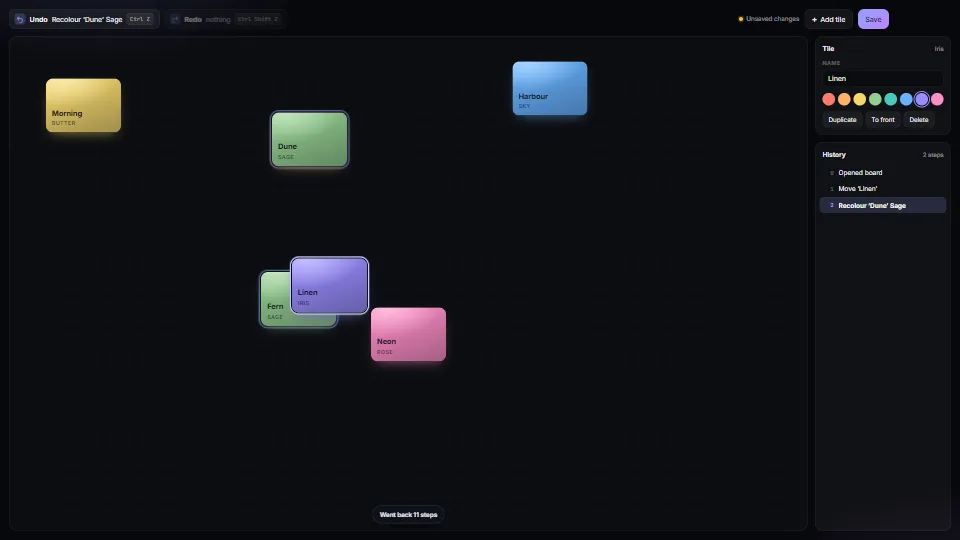
An undo/redo history whose steps carry a few words, so the buttons say “Undo Move ‘Dune’”; one drag or one typing session is one step, and so is a drag of a…
 Systems & toolingNew
 Systems & toolingNew
 Systems & toolingNew
 Systems & toolingNew