 Systems & tooling
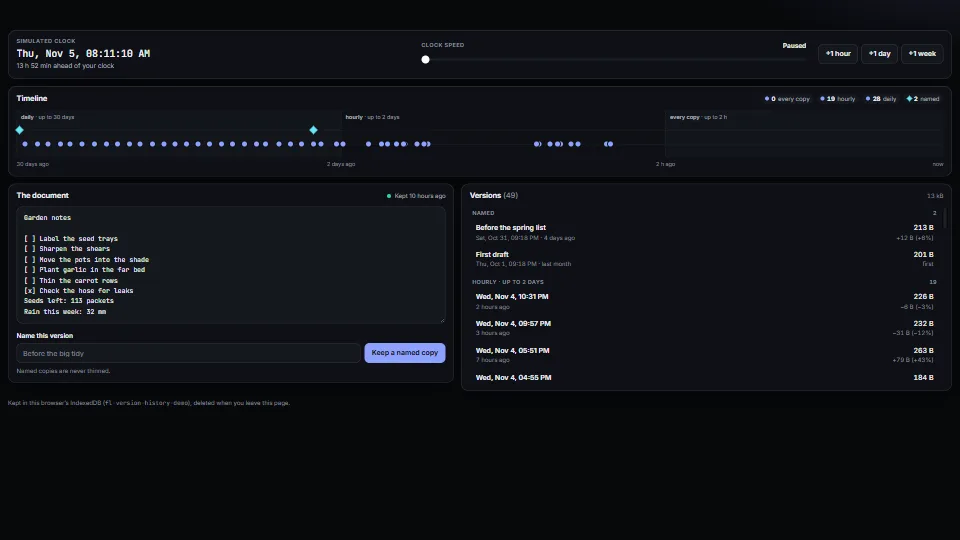
Automatic version history, thinned with age
A copy of a document kept by itself a few minutes into each stretch of changes, and named copies on demand; thinned as they age (every copy for two hours…
0.05 CPU ms
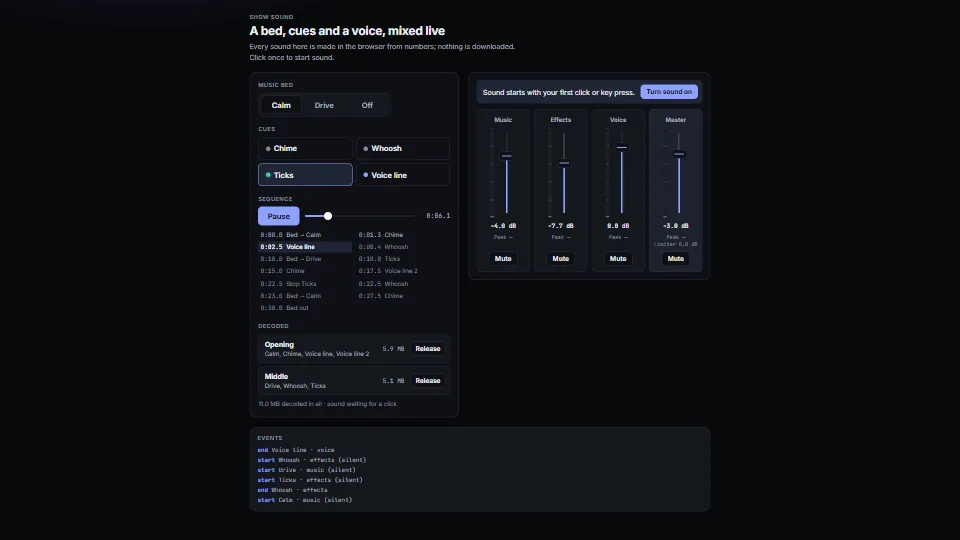
Sound for a live show or an app, with Web Audio only.
Measured 7 November 2026 on 13th Gen Intel(R) Core(TM) i9-13900H, Chrome 156, 1920×1080 at 1×. 600 frames × 3 rounds, median kept. What ran: Measured with the demo exercising itself: the 32-second sequence plays on a loop (beds crossfading, cues, ducking, a chased loop) and a fader moves every 30 frames. The bench run has no click, so the browser keeps audio locked: the engine runs its silent model on the same schedule, and what is timed is the main thread (the scheduler waking every half second, the demo’s own readouts, the mixer’s writes). Mixing runs on the audio thread, outside the frame; meters read nothing while silent. Phones: tiers are being measured next.
| Machine | GPU ms | CPU ms | CPU p95 |
|---|---|---|---|
| unknown GPU · 13th Gen Intel(R) Core(TM) i9-13900Hreference · measuring tool | not timed | 0.05 | 0.11 |
| apple · Apple A19 Proin a browser tab · 16 November 2026 | not timed | 0.02 | 0.10 |
| Intel Arc 140V (Xe2-LPG) · Intel Core Ultra 7 258Vin a browser tab · 15 November 2026 | not timed | 0.04 | 0.10 |
Bars against one 16.7 ms frame. A browser-tab run is timed in a visible tab without the tool’s scripted input, so read it as close, not exact.
idle seconds with nothing playing the AudioContext is suspended, so the audio thread and the device rest; the next sound wakes it within a few milliseconds.Written for the library. Fully custom code.
Web Audio API (W3C): sample-accurate start and stop, AudioParam automation, AudioBufferSourceNode loop points, and the DynamicsCompressorNode’s make-up gain, which the limiter undoes
Chris Wilson, “A Tale of Two Clocks” (2013): the look-ahead scheduler: a coarse timer hands events to the audio clock a little ahead of time. Written here from the idea, waking only when a cue is near
WAI-ARIA Authoring Practices Guide (W3C): the slider pattern, vertical, for the faders; written here from scratch
George Marsaglia, “Xorshift RNGs” (2003): the xorshift32 generator behind the stand-in sounds’ noise and variation
Julius O. Smith III, Introduction to Digital Filters: the two-pole resonator that shapes the whoosh and the speech-like line
Systems & toolingA copy of a document kept by itself a few minutes into each stretch of changes, and named copies on demand; thinned as they age (every copy for two hours…
 Systems & tooling
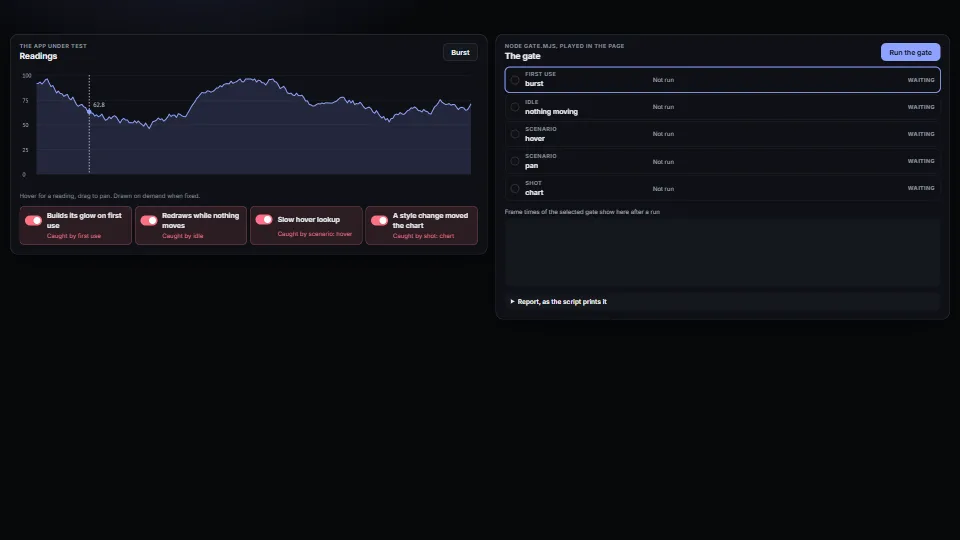
A gate an app copies, with no packages: one Node script opens the app in headless Chrome on a fresh profile at an exact viewport and fails the run when a budget breaks.
 Systems & tooling
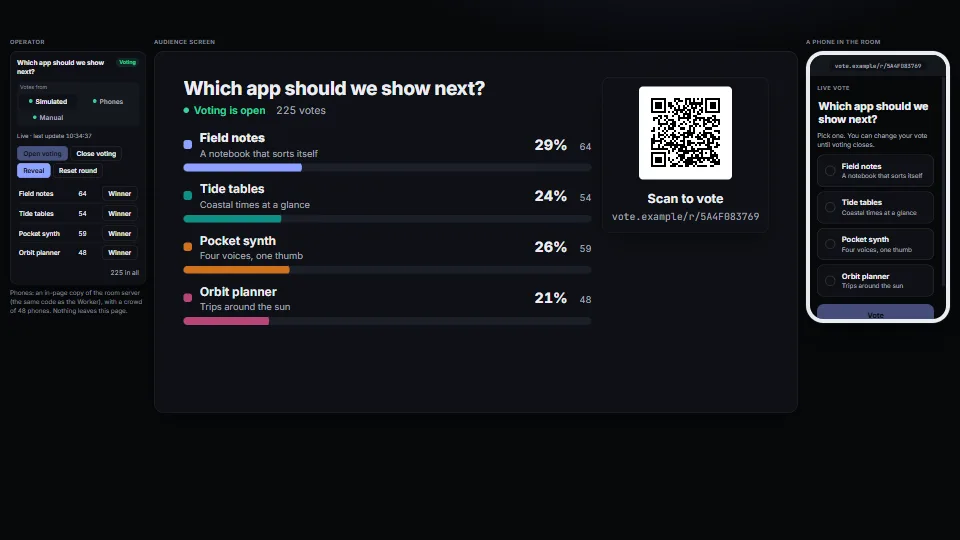
The room votes on their phones and the stage shows a live tally (bars or a ring) and an awards-style reveal: nominee cards, a drum roll, the winner, ties handled.
 Systems & tooling
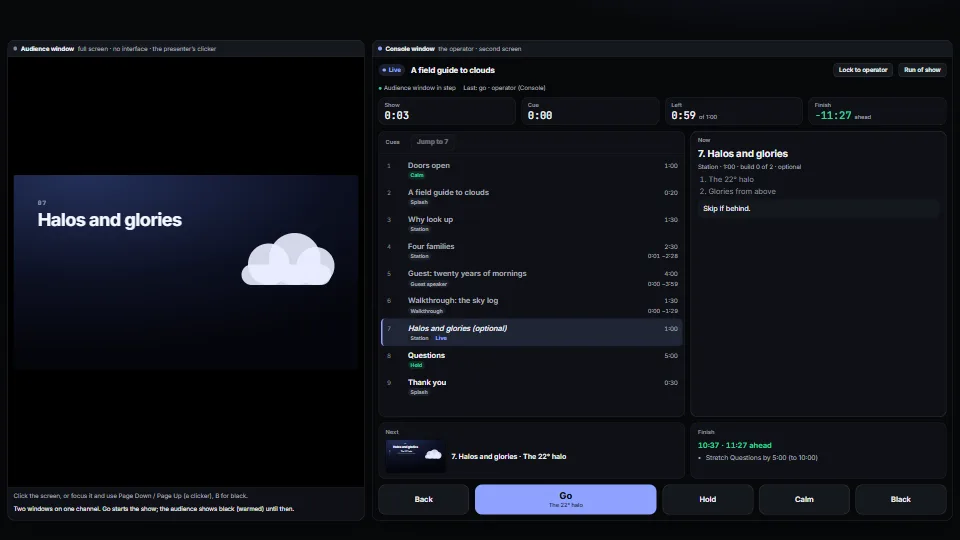
Runs a live presentation from a cue list: go, back, jump, hold, calm and black, with builds inside a cue, from any clicker, the keyboard or the console.