 Surfaces & materials
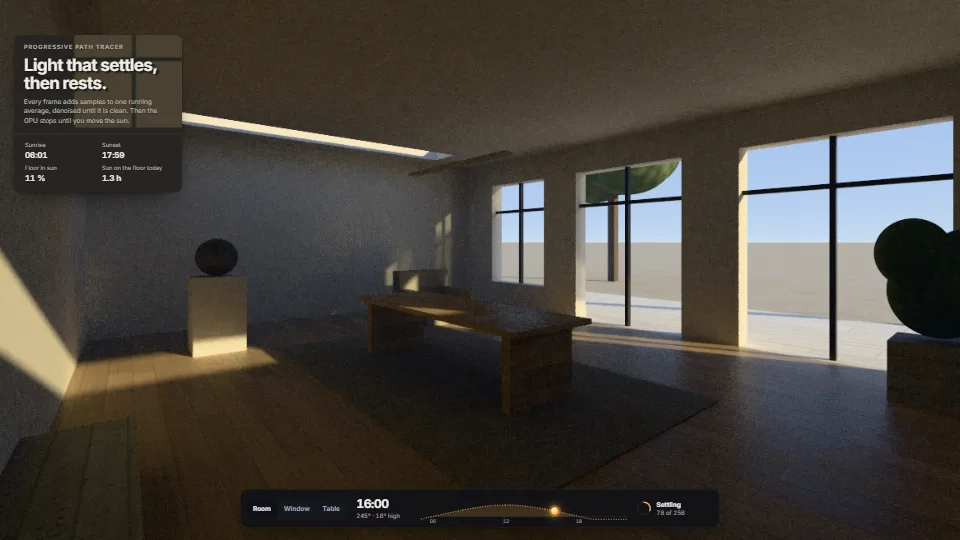
Progressive path tracer with a sun slider
A WebGPU compute path tracer for rooms and buildings made of boxes and ellipsoids, lit by the real sun for any day, hour and latitude, a sky and lamps.
4.46 GPU · 0.12 CPU ms
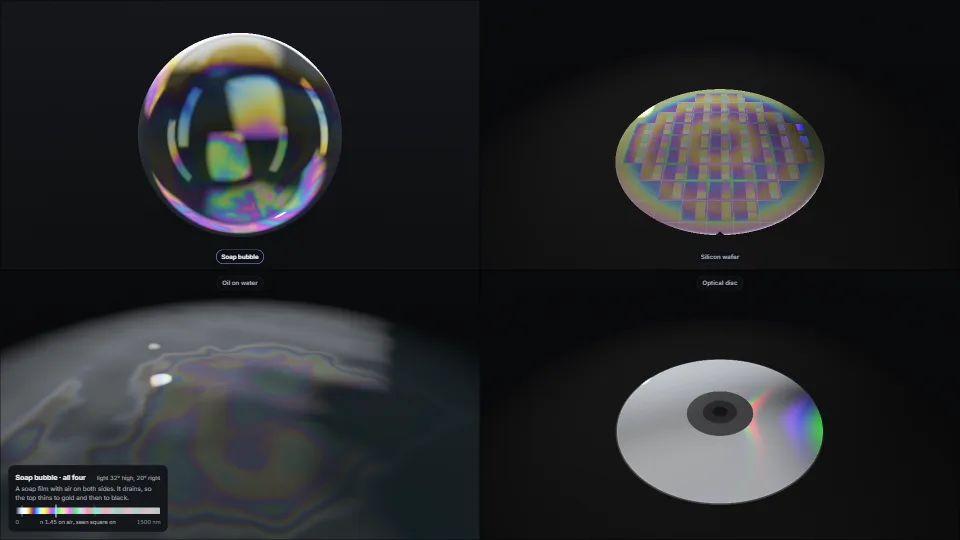
The rainbow sheen of a soap bubble, oil on water, a silicon wafer, an optical disc and a beetle’s shell, worked out across the spectrum.
Measured 11 November 2026 on 13th Gen Intel(R) Core(TM) i9-13900H, Chrome 157, 1920×1080 at 1×. 600 frames × 3 rounds, median kept. What ran: All four surfaces side by side with the films flowing and the light swinging: one full-screen pass, each film summed over 12 wavelengths, timed with its own timestamp queries. Phones: tiers are being measured next.
| Machine | GPU ms | CPU ms | CPU p95 |
|---|---|---|---|
| unknown GPU · 13th Gen Intel(R) Core(TM) i9-13900Hreference · measuring tool | 4.40 | 0.11 | 0.30 |
| apple · Apple A19 Proin a browser tab · 16 November 2026 | 6.93 | 0.14 | 0.84 |
| Intel Arc 140V (Xe2-LPG) · Intel Core Ultra 7 258Vin a browser tab · 15 November 2026 | 1.11 | 0.19 | 0.42 |
Bars against one 16.7 ms frame. A browser-tab run is timed in a visible tab without the tool’s scripted input, so read it as close, not exact.
From SpaciousPro. Fully custom code.
Chris Wyman, Peter-Pike Sloan & Peter Shirley, Simple Analytic Approximations to the CIE XYZ Color Matching Functions (2013): cieRgb is their multi-lobe fit of the 1931 observer, turned to linear sRGB with the standard matrix.
Airy’s formula for a thin film, with Fresnel’s coefficients: filmReflectance is the textbook single-layer sum (as in Born & Wolf, Principles of Optics), for s-polarised light.
The grating equation: grating solves sin θi + sin θo = mλ/d for each of the first three orders.
Mark Jarzynski & Marc Olano, Hash Functions for GPU Rendering (2020): Their pcg3d hashes the demo scene’s value noise, in place of the original’s sin hash.
Surfaces & materialsA WebGPU compute path tracer for rooms and buildings made of boxes and ellipsoids, lit by the real sun for any day, hour and latitude, a sky and lamps.
 Surfaces & materials
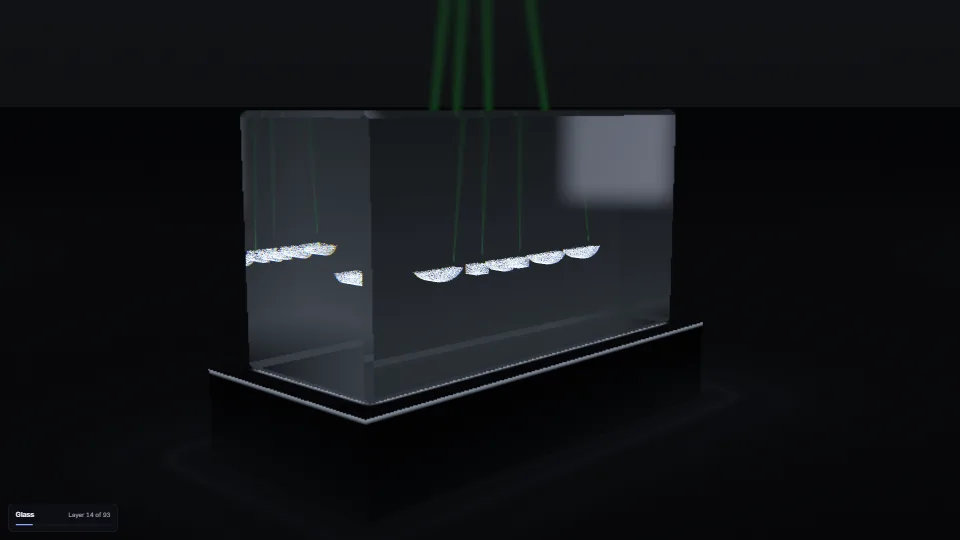
Laser engraving inside a block of glass: any word or mask becomes a cloud of tiny fractures, written by the laser layer by layer from the bottom up, seen…
 Surfaces & materials
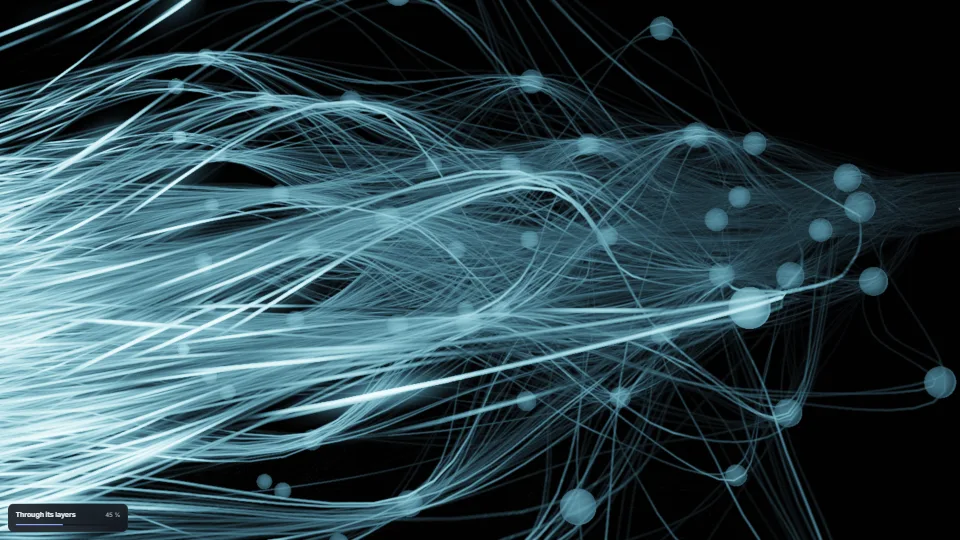
Light racing through glass fibres: a laser lights a bundle’s polished face, the light’s front runs down thousands of fibres, out through a network of glass…
 Surfaces & materials