 Surfaces & materials
Fibre light
Light racing through glass fibres: a laser lights a bundle’s polished face, the light’s front runs down thousands of fibres, out through a network of glass…
5.68 GPU · 0.15 CPU ms
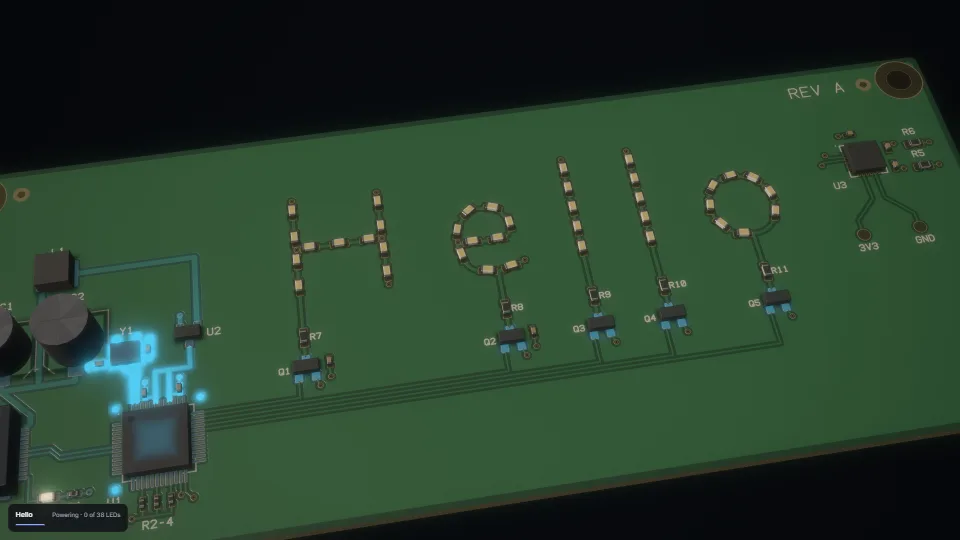
Any word becomes a real-looking circuit board.
Measured 11 November 2026 on 13th Gen Intel(R) Core(TM) i9-13900H, Chrome 157, 1920×1080 at 1×. 600 frames × 3 rounds, median kept. What ran: The word "Hello" (about 70 parts, 40 LEDs) powering up over 9 s, framed on the word, medium quality (1080p, 4× MSAA), the camera drifting, then held lit for a second and run again: the board quad, its edges, the instanced parts, a five-level bloom and the tone map; timed with its own timestamp queries. Phones: tiers are being measured next.
| Machine | GPU ms | CPU ms | CPU p95 |
|---|---|---|---|
| unknown GPU · 13th Gen Intel(R) Core(TM) i9-13900Hreference · measuring tool | 5.71 | 0.15 | 0.23 |
| apple · Apple A19 Proin a browser tab · 16 November 2026 | 6.89 | 0.40 | 0.50 |
| Intel Arc 140V (Xe2-LPG) · Intel Core Ultra 7 258Vin a browser tab · 15 November 2026 | 1.70 | 0.29 | 0.52 |
Bars against one 16.7 ms frame. A browser-tab run is timed in a visible tab without the tool’s scripted input, so read it as close, not exact.
textMask 100 px or more (default 120).draw returns false when the last frame is still on the GPU: keep the view marked dirty and draw again next frame, or a final moment can be missed.From SpaciousPro. Fully custom code.
T. Y. Zhang & C. Y. Suen, A Fast Parallel Algorithm for Thinning Digital Patterns (1984): The letters are thinned to one-pixel centrelines by their two-pass algorithm before they are traced into lines.
Gunilla Borgefors, Distance Transformations in Digital Images (1986): The 3-4 chamfer distance gives each centreline point the stroke’s width there, which decides which spurs to prune.
Edsger W. Dijkstra, A Note on Two Problems in Connexion with Graphs (1959): Each letter’s distances along its lines from where the current enters are shortest paths.
Mark Jarzynski & Marc Olano, Hash Functions for GPU Rendering (2020): Their PCG hash (from Melissa O’Neill’s PCG family) seeds the board’s design and the shaders’ noise and dither, in place of the source’s generators.
Walter et al., Microfacet Models for Refraction through Rough Surfaces (2007); Christophe Schlick (1994): The GGX distribution with a Smith visibility, and Schlick’s Fresnel approximation, light the copper, the gold, the mask’s coat and the parts.
Marius Bjørge, Bandwidth-Efficient Rendering (SIGGRAPH 2015): The bloom is his dual filter: five-tap halvings, then eight-tap tents back up.
Surfaces & materialsLight racing through glass fibres: a laser lights a bundle’s polished face, the light’s front runs down thousands of fibres, out through a network of glass…
 Surfaces & materials
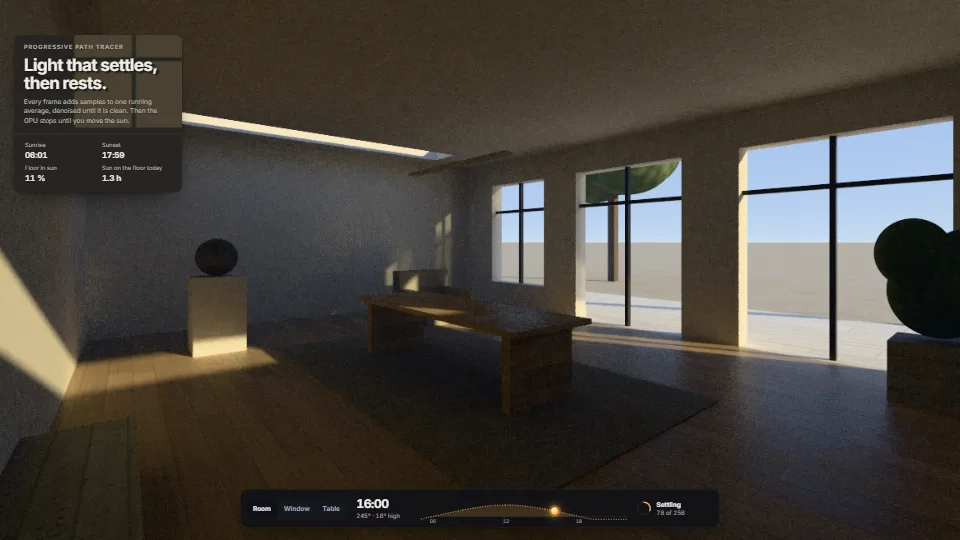
A WebGPU compute path tracer for rooms and buildings made of boxes and ellipsoids, lit by the real sun for any day, hour and latitude, a sky and lamps.
 Surfaces & materials
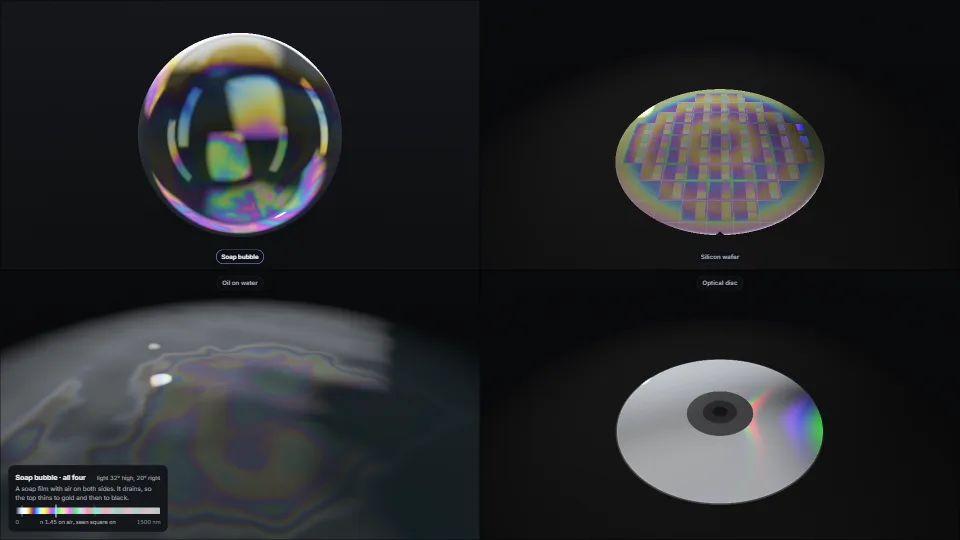
The rainbow sheen of a soap bubble, oil on water, a silicon wafer, an optical disc and a beetle’s shell, worked out across the spectrum.
 Surfaces & materials
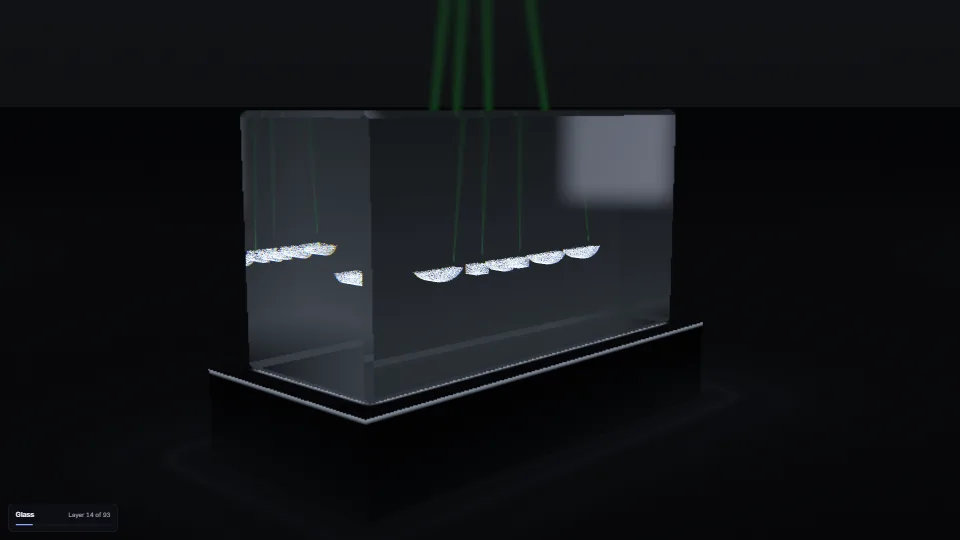
Laser engraving inside a block of glass: any word or mask becomes a cloud of tiny fractures, written by the laser layer by layer from the bottom up, seen…