 Surfaces & materials
A living skin the page steers
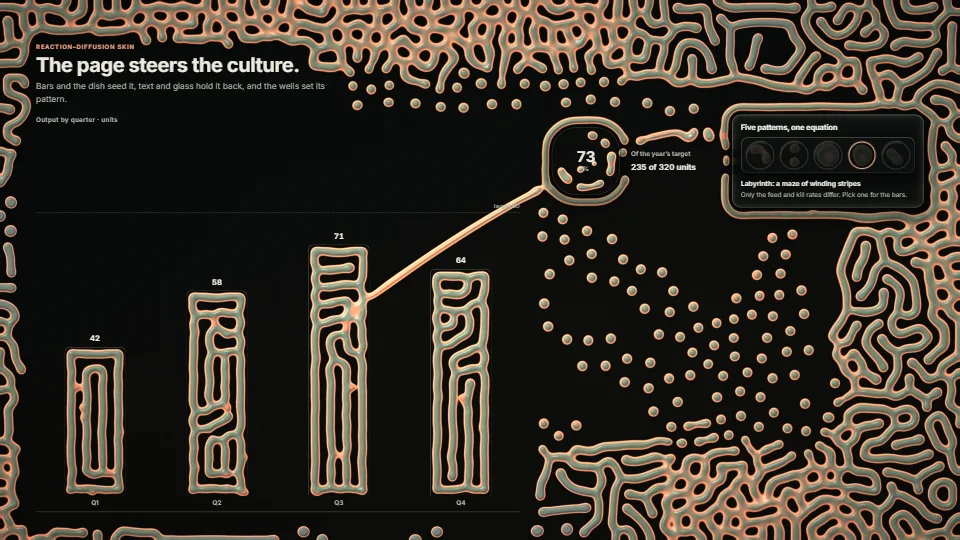
A Gray–Scott reaction–diffusion culture under a page, in raw WebGPU, steered by the DOM.
2.95 GPU · 0.28 CPU ms
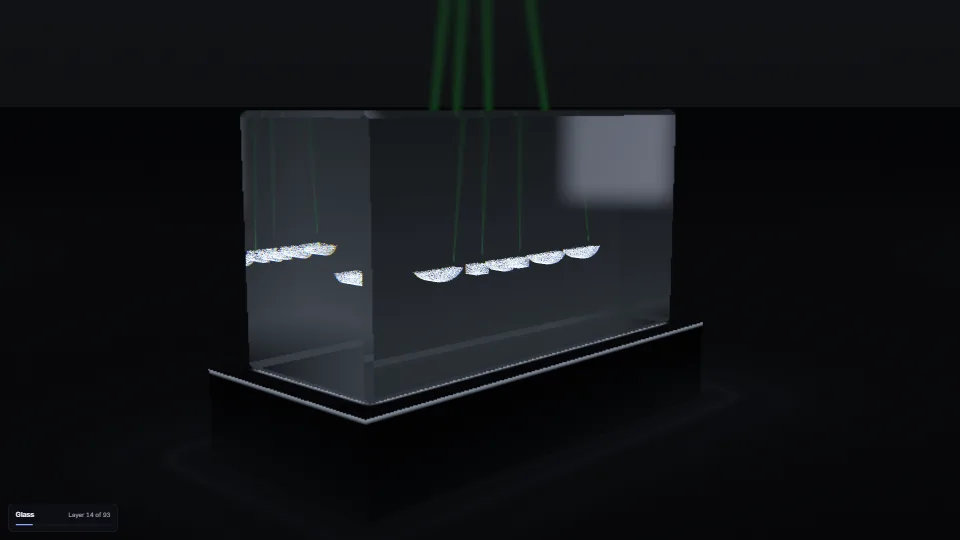
Laser engraving inside a block of glass: any word or mask becomes a cloud of tiny fractures, written by the laser layer by layer from the bottom up, seen…
Measured 11 November 2026 on 13th Gen Intel(R) Core(TM) i9-13900H, Chrome 157, 1920×1080 at 1×. 600 frames × 3 rounds, median kept. What ran: The block turning at 9°/s while the word is engraved over and over (low quality, 60k points): the points and their mirror images splatted in one compute pass, the studio traced through the glass with dispersion, one composite pass; timed with its own timestamp queries. Phones: tiers are being measured next.
| Machine | GPU ms | CPU ms | CPU p95 |
|---|---|---|---|
| unknown GPU · 13th Gen Intel(R) Core(TM) i9-13900Hreference · measuring tool | 3.60 | 0.20 | 0.29 |
| apple · Apple A19 Proin a browser tab · 16 November 2026 | 1.89 | 0.56 | 0.68 |
| Intel Arc 140V (Xe2-LPG) · Intel Core Ultra 7 258Vin a browser tab · 15 November 2026 | 4.39 | 0.39 | 0.54 |
Bars against one 16.7 ms frame. A browser-tab run is timed in a visible tab without the tool’s scripted input, so read it as close, not exact.
From SpaciousPro. Fully custom code.
Pedro Felzenszwalb & Daniel Huttenlocher, Distance Transforms of Sampled Functions (2012): The signed distance the cloud keeps its points inside the walls by is their 1D squared-distance transform, run along columns then rows.
Mark Jarzynski & Marc Olano, Hash Functions for GPU Rendering (2020): Their PCG hash (from Melissa O’Neill’s PCG family) replaces the original shader’s and the cloud’s generators.
Marching squares: The outlines are traced the classic way, the 2D case of Lorensen & Cline’s marching cubes (1987), with the saddle cells resolved by their middle.
Fresnel equations, Snell’s law and the method of images: Textbook optics: unpolarised reflectance, the bend through each face solved by Newton’s method, and the walls’ reflections drawn as a lattice of mirrored copies of the block.
Surfaces & materialsA Gray–Scott reaction–diffusion culture under a page, in raw WebGPU, steered by the DOM.
 Surfaces & materials
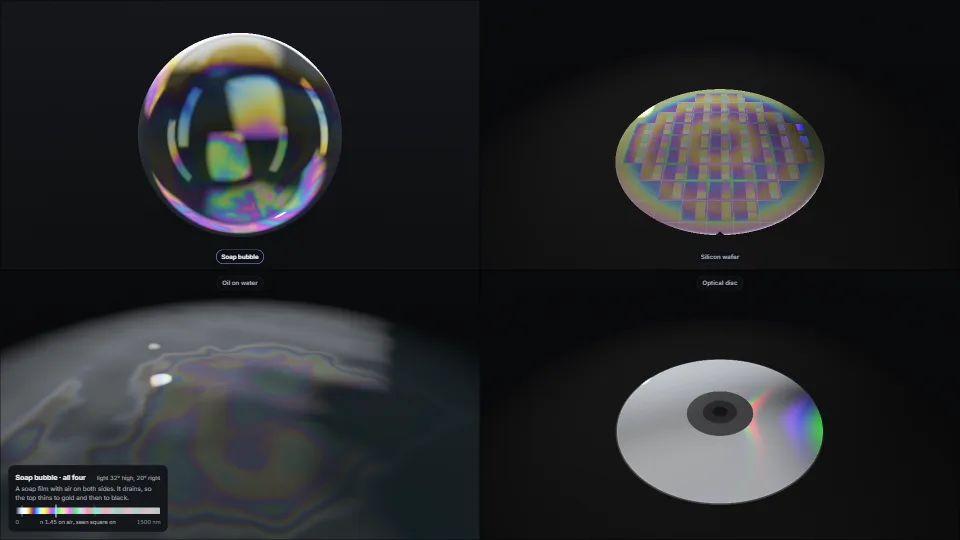
The rainbow sheen of a soap bubble, oil on water, a silicon wafer, an optical disc and a beetle’s shell, worked out across the spectrum.
 Surfaces & materials
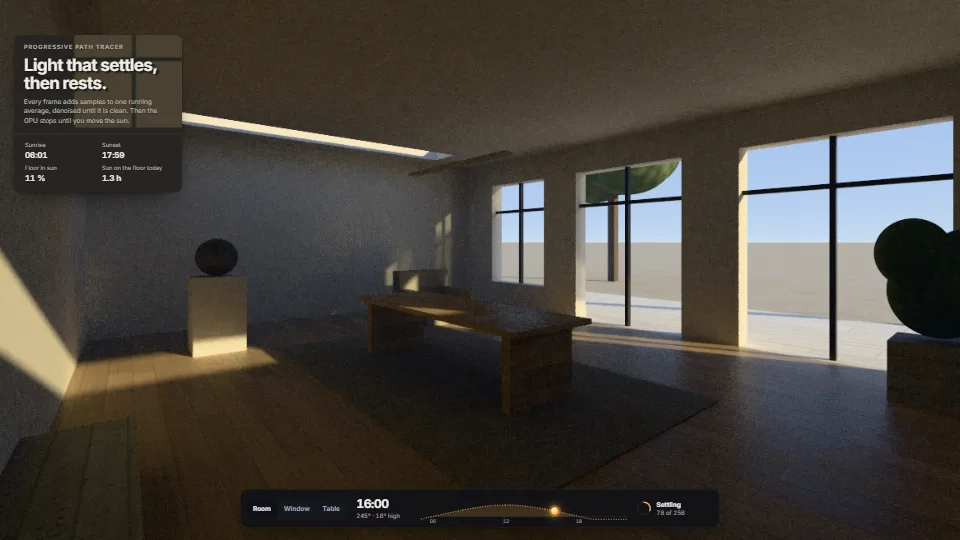
A WebGPU compute path tracer for rooms and buildings made of boxes and ellipsoids, lit by the real sun for any day, hour and latitude, a sky and lamps.
 Surfaces & materials
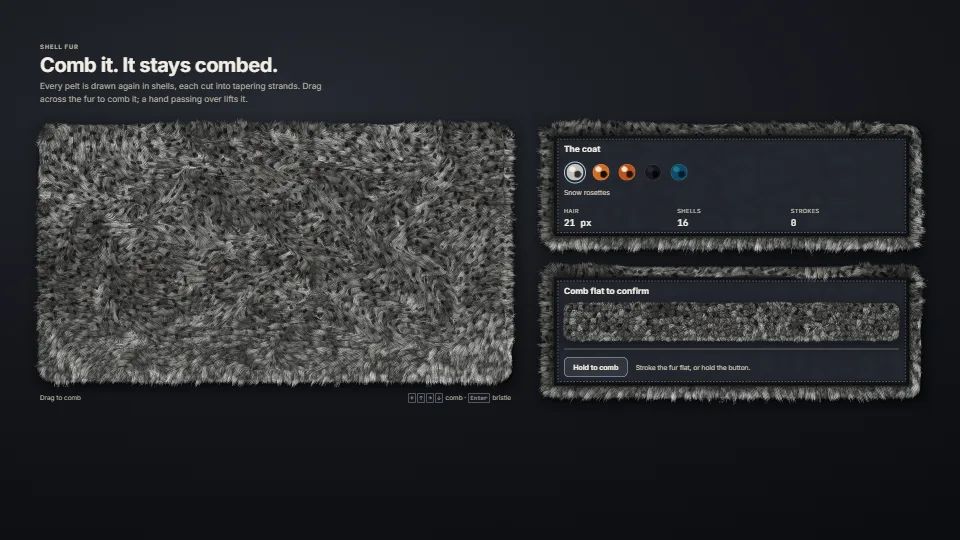
Fur on the page’s own panels, in raw WebGPU (a WebGL2 twin draws the same fur where WebGPU is missing).