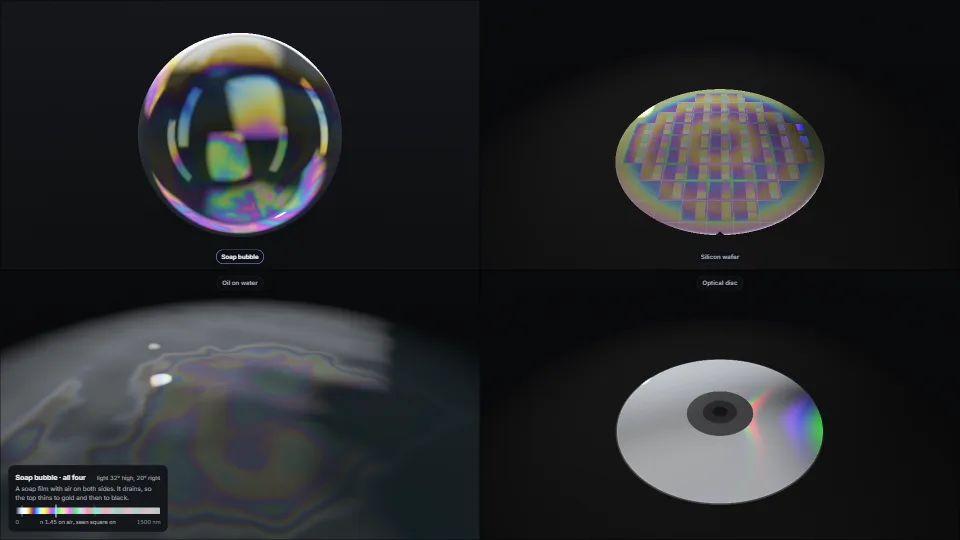
 Surfaces & materials
Thin films and gratings
The rainbow sheen of a soap bubble, oil on water, a silicon wafer, an optical disc and a beetle’s shell, worked out across the spectrum.
4.40 GPU · 0.11 CPU ms
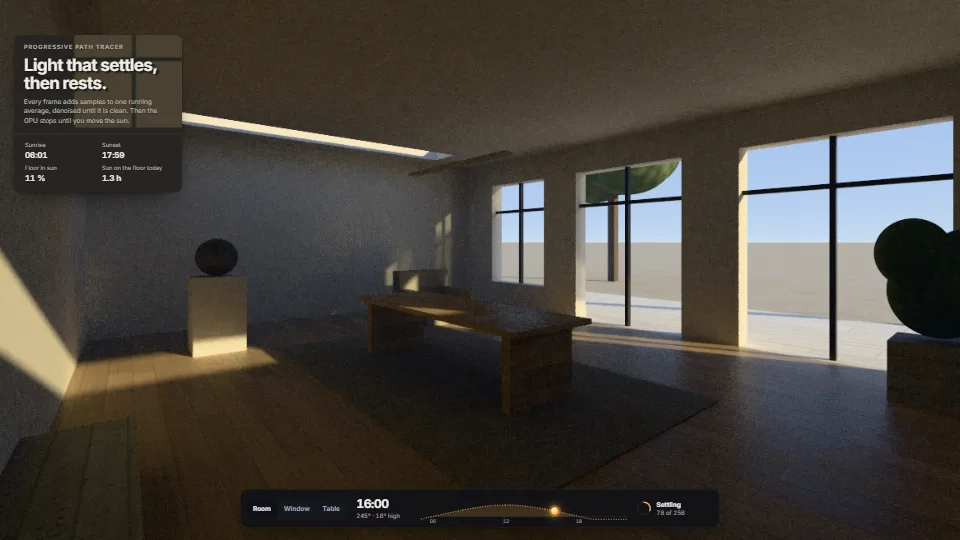
A WebGPU compute path tracer for rooms and buildings made of boxes and ellipsoids, lit by the real sun for any day, hour and latitude, a sky and lamps.
Measured 13 November 2026 on RTX 4060 Laptop, 13th Gen Intel(R) Core(TM) i9-13900H, Chrome 157, 1920×1080 at 1×. 600 frames × 3 rounds, median kept (rounds ranged GPU 4.10–4.58, CPU 0.10–0.13 ms). What ran: Measured exercising itself: once the light has settled and the sun times are baked, the sun sweeps back and forth across the day every 12 s, so every frame shows live direct sun on baked light (a shadow ray a pixel, the composite and the denoiser) at render scale 0.6 of the stage. Settling after a change costs 4–6 ms a frame for a few seconds; resting costs nothing. Phones: tiers are being measured next.
| Machine | GPU ms | CPU ms | CPU p95 |
|---|---|---|---|
| RTX 4060 Laptop · 13th Gen Intel(R) Core(TM) i9-13900Hreference · measuring tool | 4.46 | 0.12 | 0.26 |
| apple · Apple A19 Proin a browser tab · 16 November 2026 | 8.32 | 0.24 | 0.74 |
| Intel Arc 140V (Xe2-LPG) · Intel Core Ultra 7 258Vin a browser tab · 15 November 2026 | 8.06 | 0.17 | 0.28 |
Bars against one 16.7 ms frame. A browser-tab run is timed in a visible tab without the tool’s scripted input, so read it as close, not exact.
From HaTac. Fully custom code.
Mark Jarzynski & Marc Olano, Hash Functions for GPU Rendering (2020): The PCG hash behind every random number, the noise of the materials and the dither (it replaces the source’s sine hash in the display).
Holger Dammertz et al., Edge-Avoiding À-Trous Wavelet Transform for Fast Global Illumination Filtering (2010); Christoph Schied et al., Spatiotemporal Variance-Guided Filtering (2017): The denoiser: an à-trous filter on demodulated lighting, guided by normals, depth and a local variance.
Bruce Walter et al., Microfacet Models for Refraction through Rough Surfaces (2007): The GGX distribution, with Smith’s masking and Schlick’s Fresnel approximation (1994).
Tom Duff et al., Building an Orthonormal Basis, Revisited (JCGT 2017): The basis around a normal for sampling.
Martin Roberts, The Unreasonable Effectiveness of Quasirandom Sequences (2018): The R2 and Kronecker sequences for the first bounce, rotated per pixel (Cranley & Patterson 1976).
Zina Cigolle et al., A Survey of Efficient Representations for Independent Unit Vectors (JCGT 2014): Octahedral encoding of the normals in the G-buffer.
Khronos PBR Neutral tone mapper (Khronos Group, 2024): The display’s tone curve, written from its published specification.
Steven Worley, A Cellular Texture Basis Function (1996): The cellular noise in the charred timber and travertine.
Fritz Kasten, air mass formula (1965): How much air the sunlight crosses near the horizon: the sun’s colour and strength in sun.ts.
Surfaces & materialsThe rainbow sheen of a soap bubble, oil on water, a silicon wafer, an optical disc and a beetle’s shell, worked out across the spectrum.
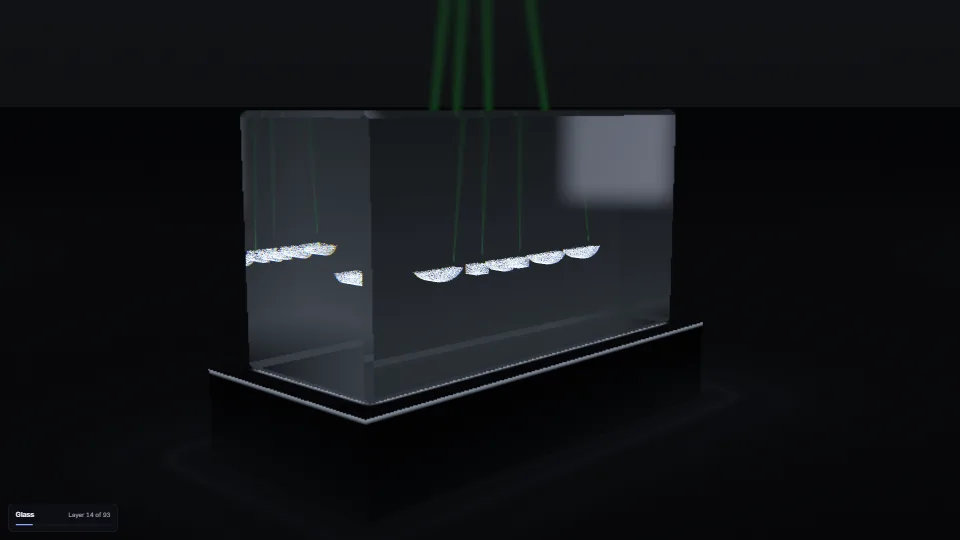 Surfaces & materials
Laser engraving inside a block of glass: any word or mask becomes a cloud of tiny fractures, written by the laser layer by layer from the bottom up, seen…
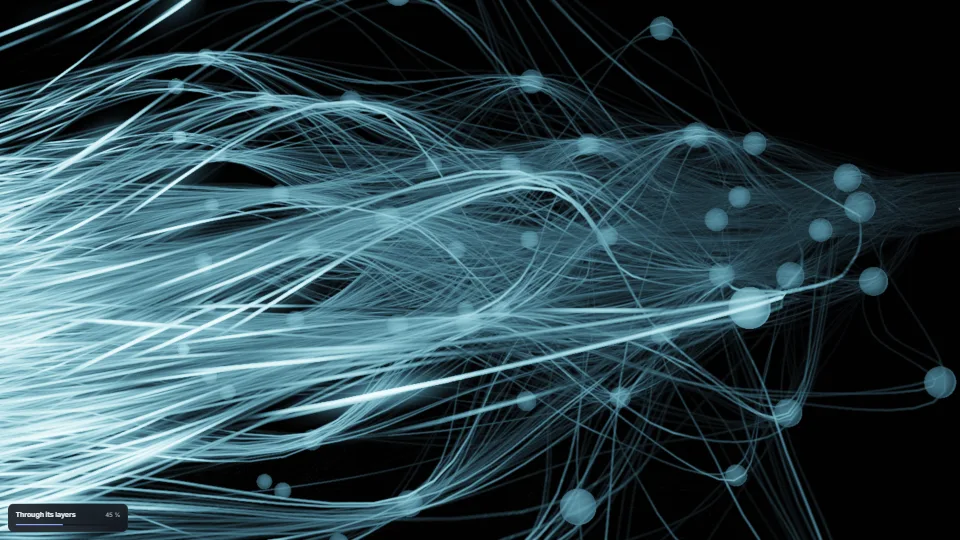 Surfaces & materials
Light racing through glass fibres: a laser lights a bundle’s polished face, the light’s front runs down thousands of fibres, out through a network of glass…
 Surfaces & materials