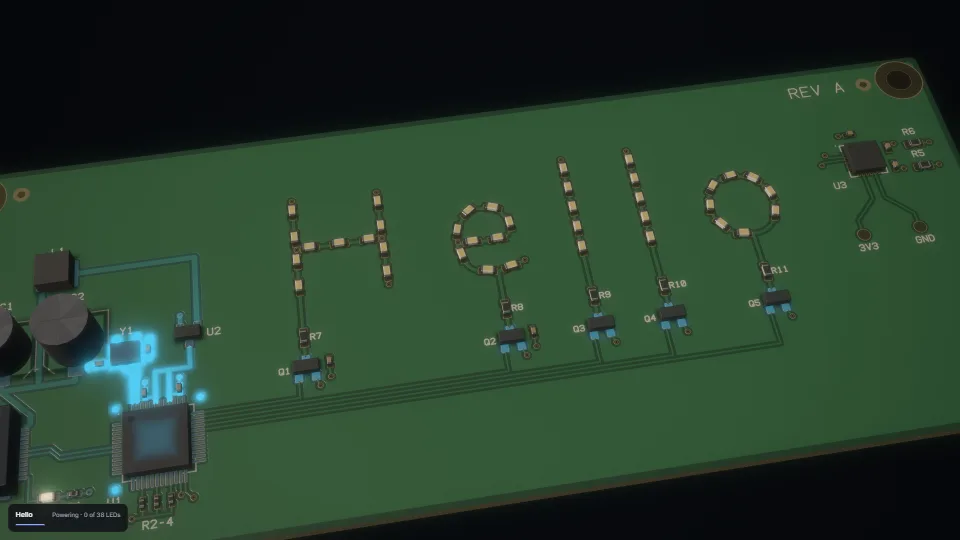
 Surfaces & materials
Fibre light
5.68 GPU · 0.15 CPU ms
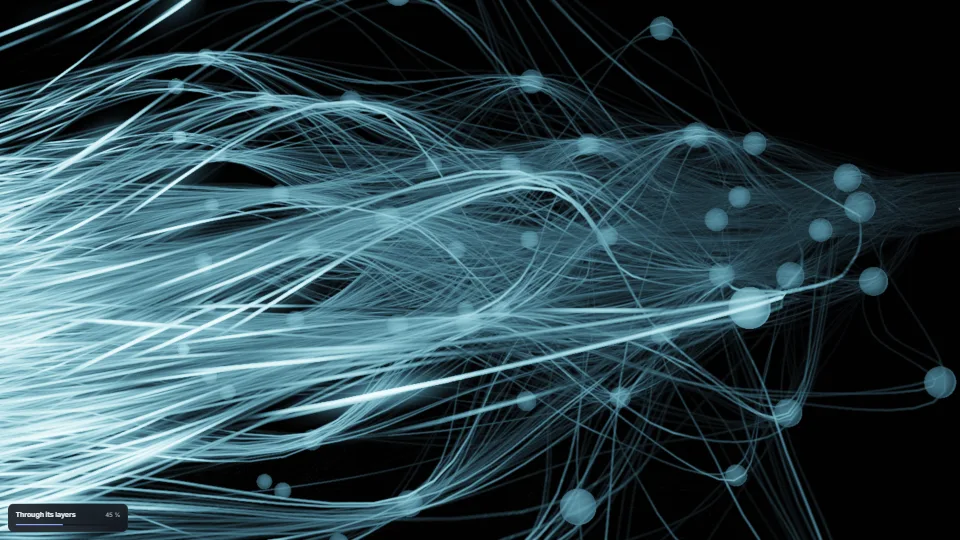
Still
The live demo starts when it’s in view.Drag or use the arrow keys to look around · Enter to replay · Escape to reset the view
Light racing through glass fibres: a laser lights a bundle’s polished face, the light’s front runs down thousands of fibres, out through a network of glass…
What it costs a frame
5.68 ms
0.15 ms
- GPU
- 5.68 ms
- CPU, median
- 0.15 ms
- CPU, 95th pct
- 0.26 ms
- Draw calls
- 0
- Weight
- Heavy
Measured 11 November 2026 on 13th Gen Intel(R) Core(TM) i9-13900H, Chrome 157, 1920×1080 at 1×. 600 frames × 3 rounds, median kept. What ran: The whole show played over and over at Effect speed 1 (medium quality, about 3,000 fibres at 84 segments each, 63 beads): the room traced, the fibres and beads blended by weight, the plate, a quarter-size bloom and the composite; timed with its own timestamp queries. Phones: tiers are being measured next.
| Machine | GPU ms | CPU ms | CPU p95 |
|---|---|---|---|
| unknown GPU · 13th Gen Intel(R) Core(TM) i9-13900Hreference · measuring tool | 5.68 | 0.15 | 0.26 |
| apple · Apple A19 Proin a browser tab · 16 November 2026 | 6.32 | 0.40 | 0.50 |
| Intel Arc 140V (Xe2-LPG) · Intel Core Ultra 7 258Vin a browser tab · 15 November 2026 | 3.80 | 0.34 | 0.55 |
Bars against one 16.7 ms frame. A browser-tab run is timed in a visible tab without the tool’s scripted input, so read it as close, not exact.
What it needs
- Renders with
- WebGPUNeeds WebGPU: current Chrome and Edge, Safari 26+, Firefox 141+ on Windows.
- Your browser
- Checking…Looking for WebGPU
- Depends on
- NothingNo other packages
What it’s for
- Title cards and splash screens
- The opening of a talk or a live show
- A hero section about networks, data or signals
- Loading moments with a progress to show
- A held, calm moment on a stage that stays alive
Pitfalls, in brief
- Planning the fibres is CPU work (tens of ms for a few thousand): call setEngraving once per change of words, never per frame, and debounce typing.
- The thoughts run on the view’s time: give the same time for the same frame (a show stays deterministic), and move it on only while the hold should stay alive.
- Draw at the canvas’s own width and height: size it (CSS size × devicePixelRatio) before drawing, or it draws at 300 × 150.
- draw returns false while the last frame is still on the GPU: keep the change pending and draw again next frame, or the last moment may be missed.
- Every fibre is one instance of segments × 6 vertices; the high quality is several million vertices a frame.
3 more in brief
- The engraving is drawn with the font you name: wait for the page’s fonts (document.fonts.ready) first, or the letters are planned in a fallback font.
- The camera is fitted to the canvas’s shape (tourAt, fitLens): a narrow canvas draws back to keep the 16:9 width; a camera of your own needs the same care on a phone.
- Without WebGPU createFibreLight returns null: draw drawFibreStill on a 2D canvas instead.
8 pitfalls in full, the hook-up guide, the module source and its tests come with the part.
Where it comes from
From SpaciousPro. Fully custom code.
Morgan McGuire & Louis Bavoil, Weighted Blended Order-Independent Transparency (2013): The fibres’ and beads’ glass is accumulated by weight and resolved in one pass, in any order (the weight function is the module’s own).
Edwin Catmull & Raphael Rom, A Class of Local Interpolating Splines (1974): Each fibre is a Catmull–Rom curve through its control points, evaluated in the vertex shader.
Mark Jarzynski & Marc Olano, Hash Functions for GPU Rendering (2020): Their PCG hash (from Melissa O’Neill’s PCG family) replaces the original shader’s sine hashes and the plan’s generator.
Krzysztof Narkowicz, ACES Filmic Tone Mapping Curve (2016): His fit of the ACES curve tone maps the composite (as in the source).
Christophe Schlick, An Inexpensive BRDF Model for Physically-based Rendering (1994): Schlick’s approximation of the Fresnel term on the fibres, the beads and the plate.
Helmut Vogel, A better way to construct the sunflower head (1979): The beads of each layer are spread on Vogel’s sunflower (the golden angle), even but never a grid.
Near it in the frame
Surfaces & materials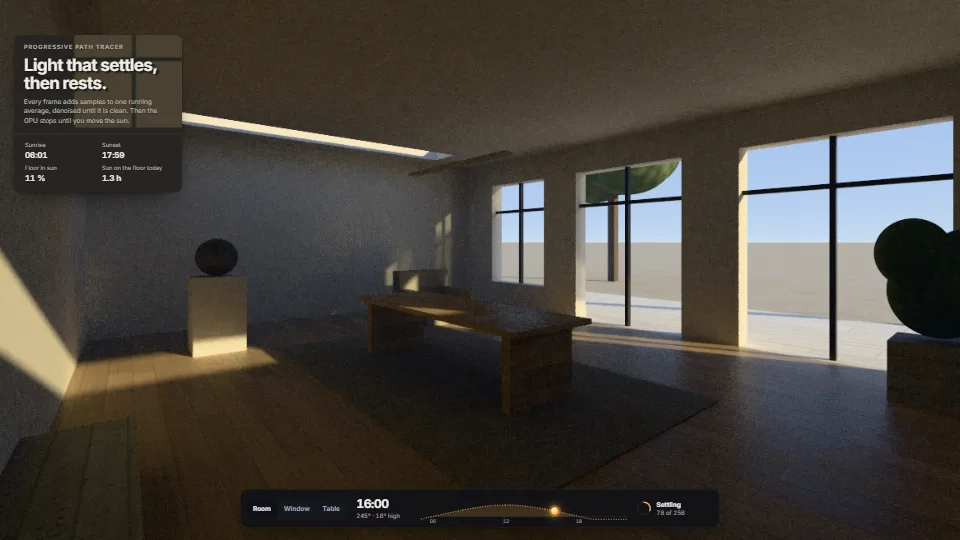 Surfaces & materials
Progressive path tracer with a sun slider
A WebGPU compute path tracer for rooms and buildings made of boxes and ellipsoids, lit by the real sun for any day, hour and latitude, a sky and lamps.
4.46 GPU · 0.12 CPU ms
 Surfaces & materials
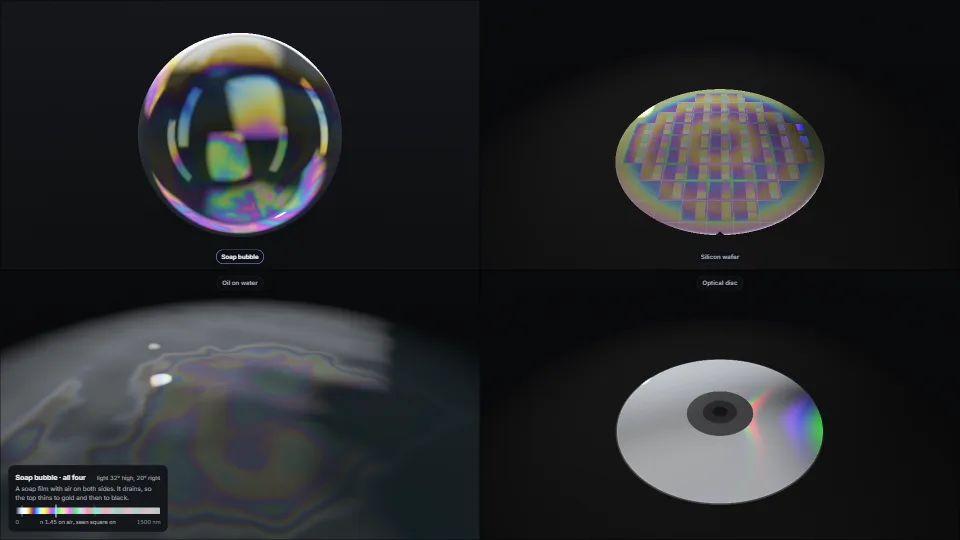
Thin films and gratings
The rainbow sheen of a soap bubble, oil on water, a silicon wafer, an optical disc and a beetle’s shell, worked out across the spectrum.
4.40 GPU · 0.11 CPU ms
 Surfaces & materials
Glass engraving
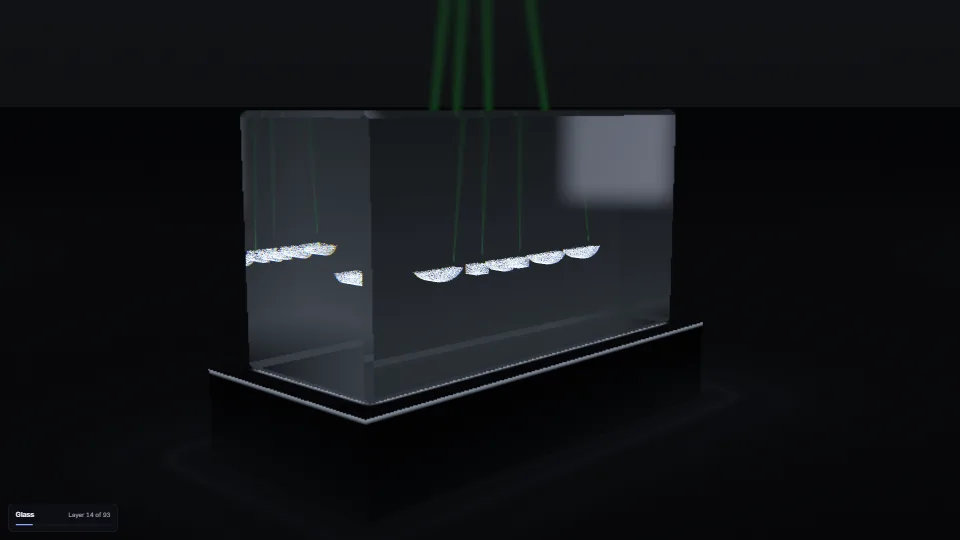
Laser engraving inside a block of glass: any word or mask becomes a cloud of tiny fractures, written by the laser layer by layer from the bottom up, seen…
3.60 GPU · 0.20 CPU ms