 UI & interaction
Loading, empty and error states
The states every view needs, done calmly: a tiny state machine (idle → loading → slow → ready | empty | error) with a grace delay so fast loads never flash a…
0.05 CPU ms
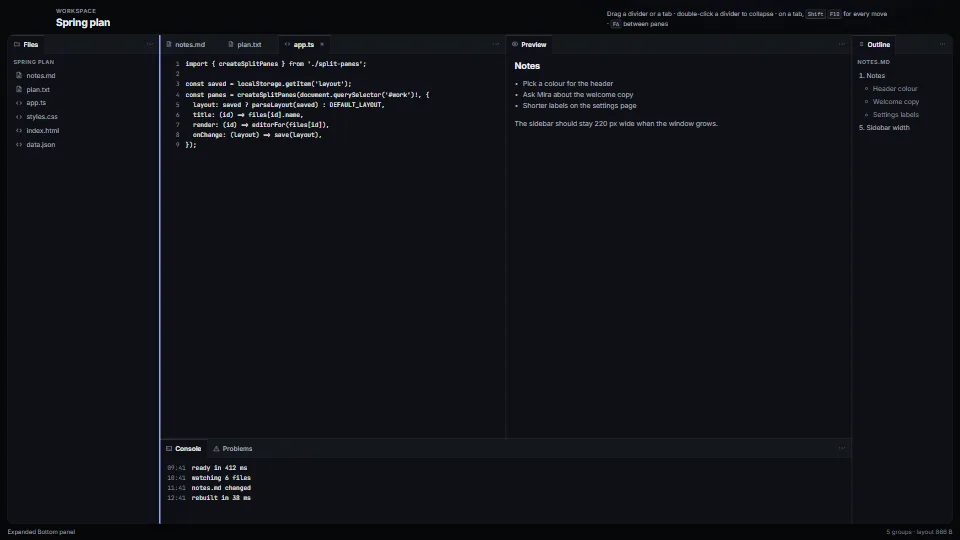
The layout of every editor, from a JSON tree you can save and restore.
Measured 7 November 2026 on 13th Gen Intel(R) Core(TM) i9-13900H, Chrome 156, 1920×1080 at 1×. 600 frames × 3 rounds, median kept. What ran: Measured with the demo driving itself on the editor layout: for two seconds of every three the Files divider is dragged back and forth with real pointer events (one measure of the tree and only the changed flex-grow writes per frame), then the Preview tab is docked into the editor group and split back out beside it, and the bottom panel collapses and expands. Nothing runs between steps: at rest the panes cost nothing. Phones: tiers are being measured next.
| Machine | GPU ms | CPU ms | CPU p95 |
|---|---|---|---|
| unknown GPU · 13th Gen Intel(R) Core(TM) i9-13900Hreference · measuring tool | not timed | 0.05 | 0.13 |
| apple · Apple A19 Proin a browser tab · 16 November 2026 | not timed | 0.02 | 0.10 |
| Intel Arc 140V (Xe2-LPG) · Intel Core Ultra 7 258Vin a browser tab · 15 November 2026 | not timed | 0.04 | 0.10 |
Bars against one 16.7 ms frame. A browser-tab run is timed in a visible tab without the tool’s scripted input, so read it as close, not exact.
Written for the library. Fully custom code.
WAI-ARIA Authoring Practices Guide (W3C): The window splitter pattern (role=separator with aria-valuenow, -min, -max and aria-controls; the arrows, Home, End, Enter to collapse and restore, F6 between panes), and the tabs pattern for each group (one Tab stop, the arrows, Home, End, Delete to close). Written here from scratch.
CSS Flexible Box Layout (W3C): How the room is shared within minimums and maximums: the freeze-and-share-again loop follows the spec’s resolution of flexible lengths.
UI & interactionThe states every view needs, done calmly: a tiny state machine (idle → loading → slow → ready | empty | error) with a grace delay so fast loads never flash a…
 UI & interaction
 UI & interaction
A drop zone with a real button, folders walked, paste from the clipboard, and checks by type, size, count and duplicates (by content.
 UI & interaction
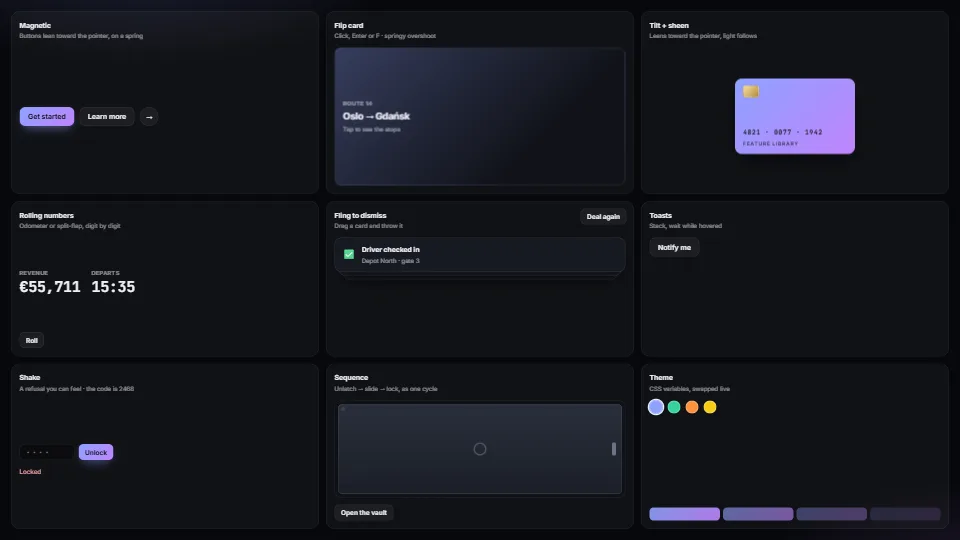
Magnetic buttons, springy flip cards, tilt with sheen, rolling and split-flap numbers, fling-to-dismiss, toasts, toasts that hang on a string and swing to…