 UI & interaction
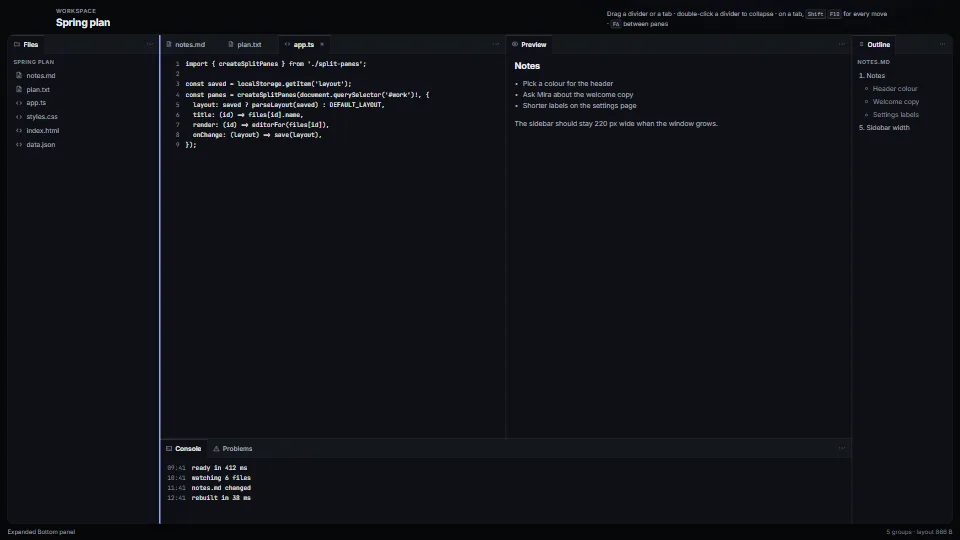
Split panes and docking tab groups
The layout of every editor, from a JSON tree you can save and restore.
0.05 CPU ms
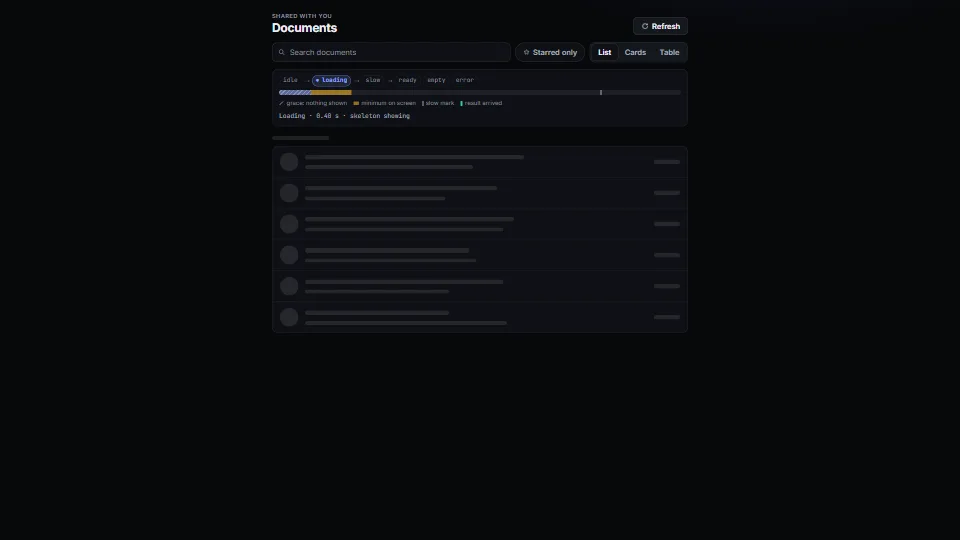
The states every view needs, done calmly: a tiny state machine (idle → loading → slow → ready | empty | error) with a grace delay so fast loads never flash a…
Measured 7 November 2026 on 13th Gen Intel(R) Core(TM) i9-13900H, Chrome 156, 1920×1080 at 1×. 600 frames × 3 rounds, median kept. What ran: Measured with the demo reloading itself cold every 2.6 s on the 2 s network and cycling list, cards and table, so most frames show a sweeping skeleton and every few seconds one is swapped for content. The per-frame script is only the teaching timeline; the sweep is one CSS animation and costs no script at all. Phones: tiers are being measured next.
| Machine | GPU ms | CPU ms | CPU p95 |
|---|---|---|---|
| unknown GPU · 13th Gen Intel(R) Core(TM) i9-13900Hreference · measuring tool | not timed | 0.05 | 0.09 |
| apple · Apple A19 Proin a browser tab · 16 November 2026 | not timed | 0.04 | 0.10 |
| Intel Arc 140V (Xe2-LPG) · Intel Core Ultra 7 258Vin a browser tab · 15 November 2026 | not timed | 0.06 | 0.14 |
Bars against one 16.7 ms frame. A browser-tab run is timed in a visible tab without the tool’s scripted input, so read it as close, not exact.
Written for the library. Fully custom code.
WAI-ARIA 1.2 (W3C): aria-busy on the region while it loads, the progressbar role and its values, and a polite live region for what arrives. Written here from scratch.
Skeleton screens (Luke Wroblewski, 2013): The idea of placeholders in the shape of the coming content instead of a spinner. No code.
Delayed, minimum-duration busy indicators (React’s Suspense design): The idea of a delay before a busy indicator appears and a minimum once it has (busyDelayMs and busyMinDurationMs in its 2019 experiments). The machine here is written from scratch.
UI & interactionThe layout of every editor, from a JSON tree you can save and restore.
 UI & interaction
 UI & interaction
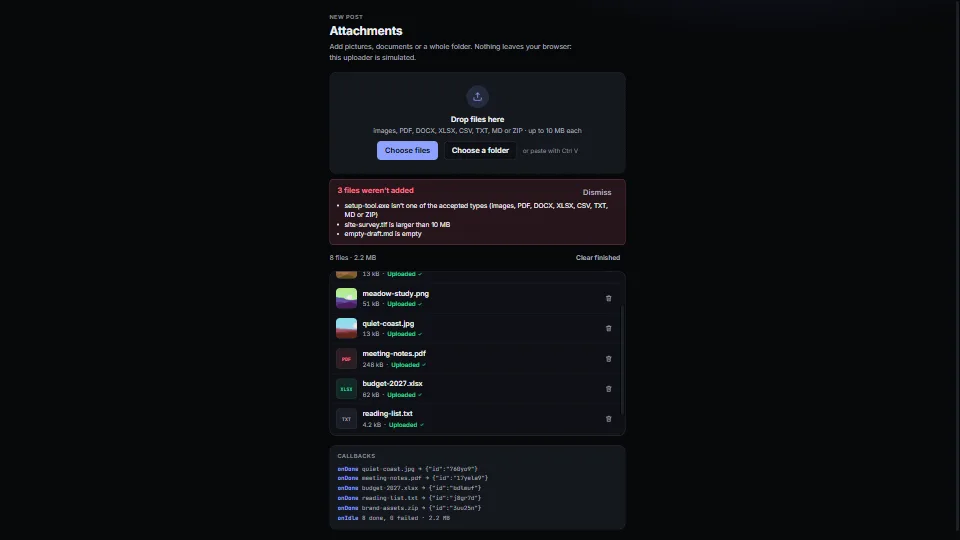
A drop zone with a real button, folders walked, paste from the clipboard, and checks by type, size, count and duplicates (by content.
 UI & interaction
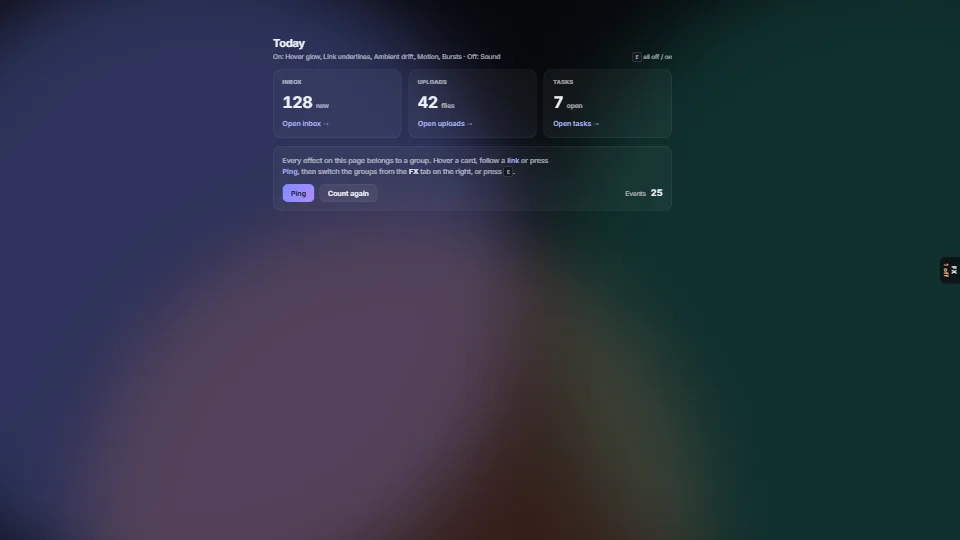
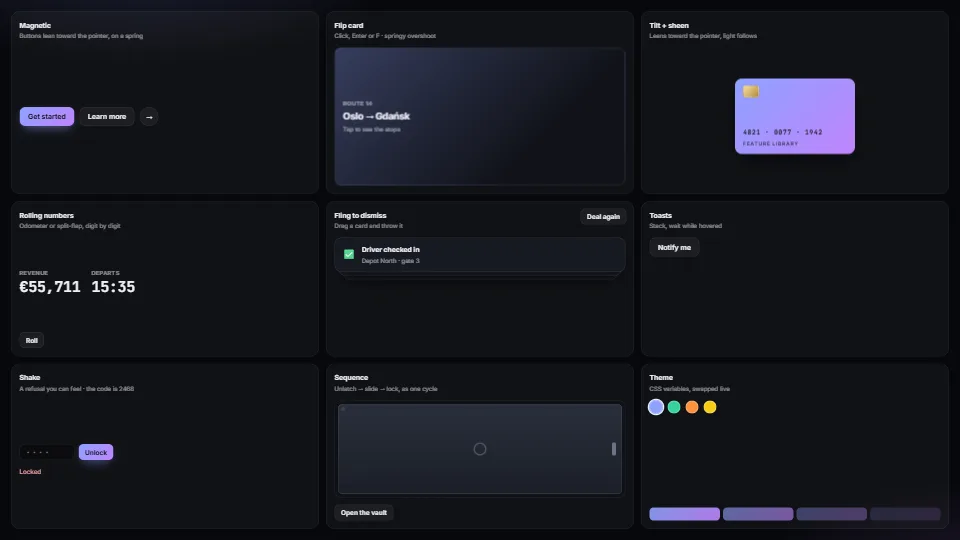
Magnetic buttons, springy flip cards, tilt with sheen, rolling and split-flap numbers, fling-to-dismiss, toasts, toasts that hang on a string and swing to…