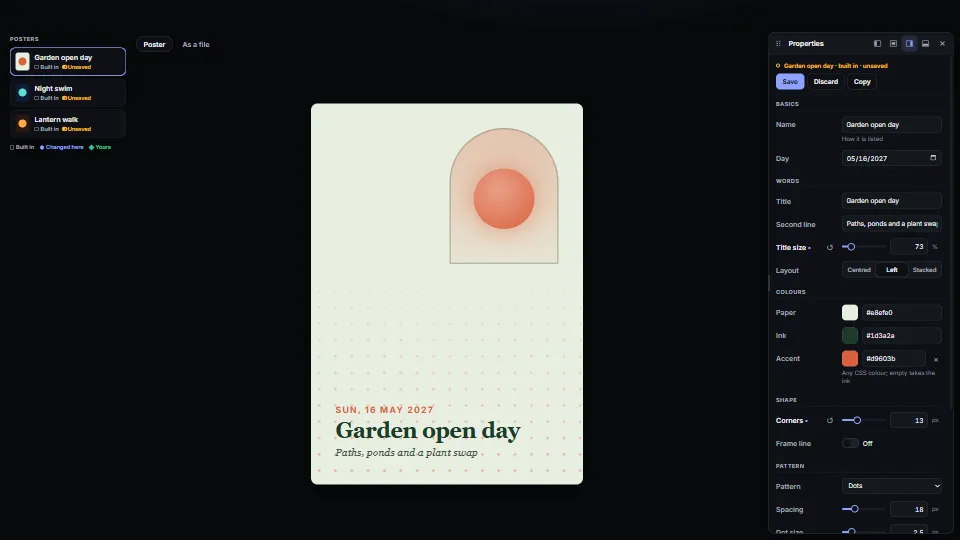
Property panel from a schema, in a dockable window
0.55 CPU ms
Still
The live demo starts when it’s in view.Pick a poster · change it in the properties: a dot marks what differs from built in · Save, Copy or Revert · drag the window’s title bar to a side to dock it · As a file shows the export
An inspector built from a description of the settings.
What it costs a frame
CPU
0.55 ms
02468101216.7 ms
GPU
not used
CPU, median
0.55 ms
CPU, 95th pct
0.73 ms
Draw calls
0
Weight
Moderate
Measured 13 November 2026 on RTX 4060 Laptop, 13th Gen Intel(R) Core(TM) i9-13900H, Chrome 157, 1920×1080 at 1×. 600 frames × 3 rounds, median kept (rounds ranged CPU 0.54–0.57 ms). What ran: Measured exercising itself: each frame types a step into Title size and Corners through the panel (store, refresh, the poster redrawn), and every 40 frames another poster is opened (its fields rebuilt). Idle, nothing runs. Phones: tiers are being measured next.
apple · Apple A19 Proin a browser tab · 16 November 2026
not timed
0.72
0.96
Intel Arc 140V (Xe2-LPG) · Intel Core Ultra 7 258Vin a browser tab · 15 November 2026
not timed
1.02
1.64
Bars against one 16.7 ms frame. A browser-tab run is timed in a visible tab without the tool’s scripted input, so read it as close, not exact.
What it needs
Renders with
DOM and CSSPlain DOM and CSS: every current browser.
Your browser
Runs hereNo WebGPU needed
Depends on
NothingNo other packages
What it’s for
Inspectors in design tools and editors
Settings of a layer, an effect or a chart, described once
Presets that ship built in and can be changed, reverted or copied
Turning what someone made in an editor into a source file
Tool windows people move, dock and resize
A panel that becomes a sheet on a phone
Pitfalls, in brief
Import property-panel.base.css, then property-panel.css (or your own look instead): the base places the window and its resize handle, keeps hidden parts hidden and draws the changed mark as a shape.
The panel never keeps its own copy: commit writes to your store and you call refresh().
Stored copies are untrusted: overrideStore leaves out any that fail the checks when it reads them, and a later copy of the same id wins.
When an id can be edited (a copy of your own), check it against the ids taken before saving: save() keeps one copy per id, so a copy renamed to a built-in’s id replaces that one, and to another of yours, loses it.
Save must refuse, not clamp: an imported or hand-edited definition can hold values the fields would never let through (a size of 400, 30 February).
6 more in brief
A field whose key is a path ("pattern.spacing") is written with withValue, which copies each object on the way: never change the stored object in place, or the comparison with the built-in one sees no change.
When a choice picks a kind from a catalog, replace that part of the value with the kind’s make() rather than keeping the old kind’s settings: they would be exported with it and mean nothing.
An image is kept in the value as a JPEG data URL, scaled to maxSide (1100 px by default): a few hundred kB in localStorage at most.
The window lives in a positioned container and fits itself to it (a ResizeObserver refits it).
Docked windows should push the work aside, not cover it: read where it is from onPlace and pad your layout by its width (or height at the foot).
The window is non-modal (role dialog, aria-modal false): focus is not trapped and Esc closes it.
11 pitfalls in full, the hook-up guide, the module source and its tests come with the part.
Where it comes from
From SpaciousPro. Fully custom code.
WAI-ARIA Authoring Practices Guide (W3C): the switch, radio group and tabs patterns, and the non-modal dialog for the window
GOV.UK Design System: the error summary in the demo, linking each problem to its field, as inspiration (no code)
 UI & interaction
 UI & interaction
 UI & interaction
 UI & interaction