 Data & layout
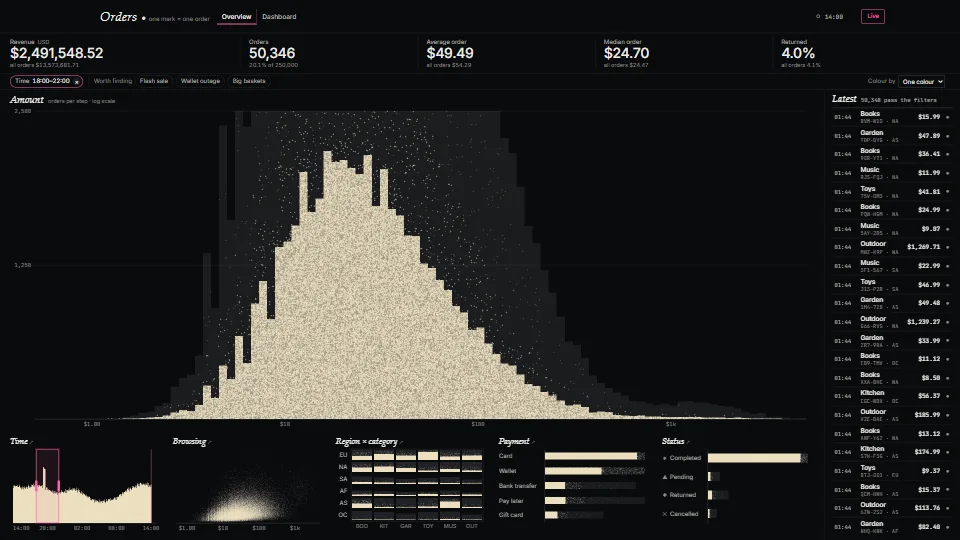
One mark per record
A cross-filtered dashboard where every record is one mark on one WebGPU canvas, up to a million of them.
1.37 GPU · 0.13 CPU ms
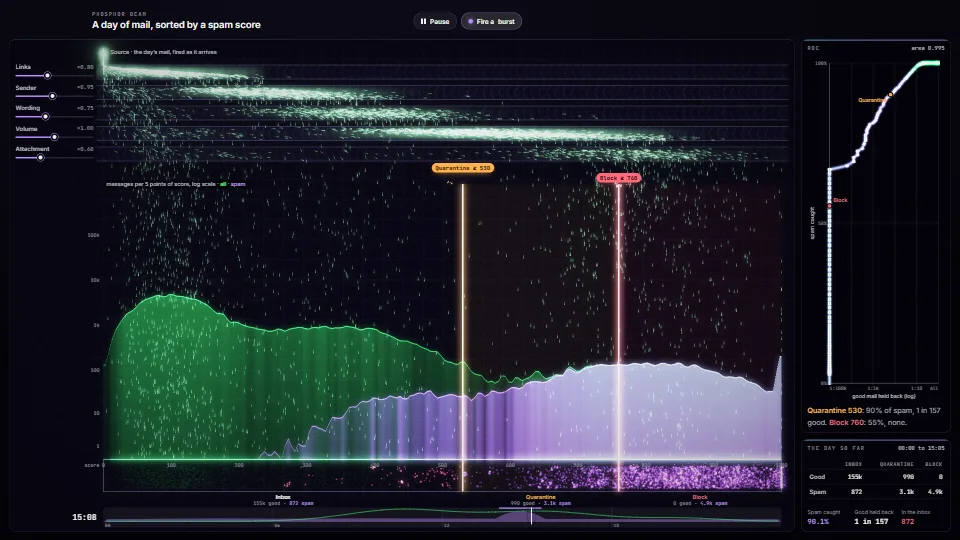
A classifier's scores drawn as a particle beam.
Measured 14 November 2026 on RTX 4060 Laptop, 13th Gen Intel(R) Core(TM) i9-13900H, Chrome 157, 1920×1080 at 1×. 600 frames × 3 rounds, median kept (rounds ranged GPU 0.73–1.69, CPU 0.20–0.33 ms). What ran: The day plays at 20 minutes a second with the beam at 1,200 particles a second at the busiest hour (32,768 particles, 16,384 sparks, five fields, bloom at a quarter size), a burst fired every 4 s and the quarantine gate swept back and forth, so the gates spark and the histograms ease; the ROC canvas is drawn in the same frame. Timed with its own timestamp queries. At rest (paused, or reduced motion) a frame costs nothing. Phones: tiers are being measured next.
| Machine | GPU ms | CPU ms | CPU p95 |
|---|---|---|---|
| RTX 4060 Laptop · 13th Gen Intel(R) Core(TM) i9-13900Hreference · measuring tool | 1.38 | 0.33 | 3.20 |
| apple · Apple A19 Proin a browser tab · 16 November 2026 | 0.53 | 0.48 | 4.48 |
| Intel Arc 140V (Xe2-LPG) · Intel Core Ultra 7 258Vin a browser tab · 15 November 2026 | 1.77 | 0.45 | 2.46 |
Bars against one 16.7 ms frame. A browser-tab run is timed in a visible tab without the tool’s scripted input, so read it as close, not exact.
From HaTac. Fully custom code.
Mark Jarzynski & Marc Olano, Hash Functions for GPU Rendering (2020): The PCG hash, the same in TypeScript and WGSL: every shot, spark and the demo's made-up day.
Tom Fawcett, An introduction to ROC analysis (Pattern Recognition Letters, 2006): The ROC as one point per threshold, and its area by trapezoids.
WAI-ARIA Authoring Practices Guide (W3C): The slider pattern for the gates (arrows, Page Up and Down, Home and End, a value text).
Data & layoutA cross-filtered dashboard where every record is one mark on one WebGPU canvas, up to a million of them.
 Data & layout
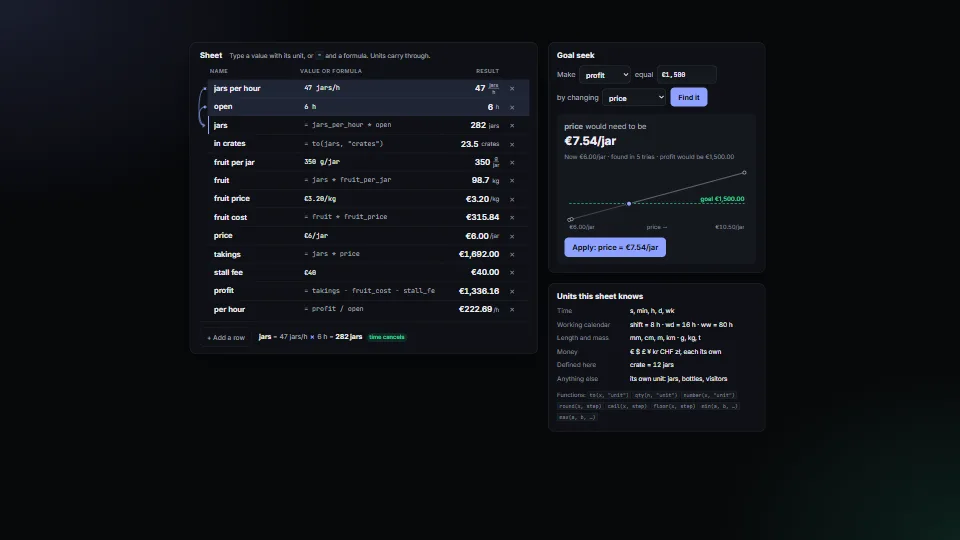
Numbers that keep their units through every step.
 Data & layout
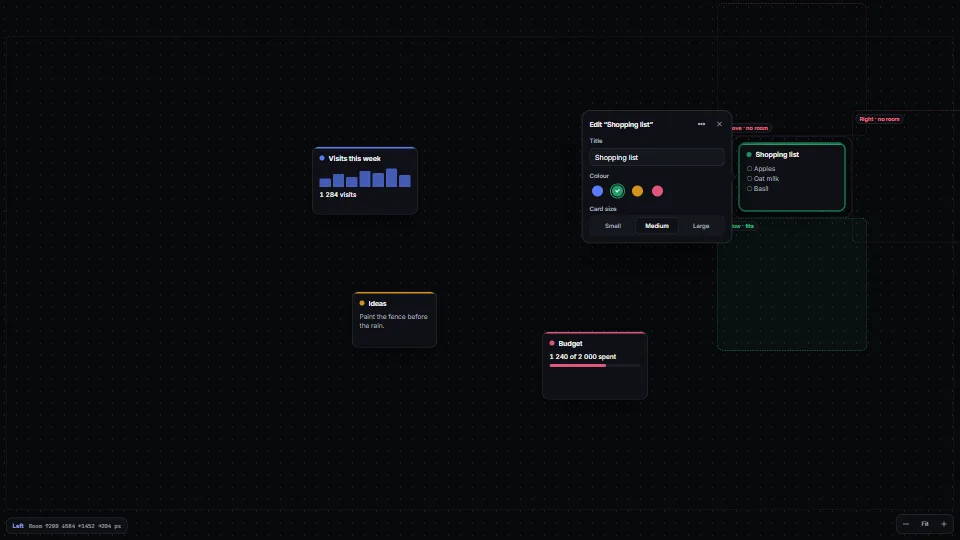
Puts an editor, popover or inspector beside the item it edits, never on top of it.
 Data & layout
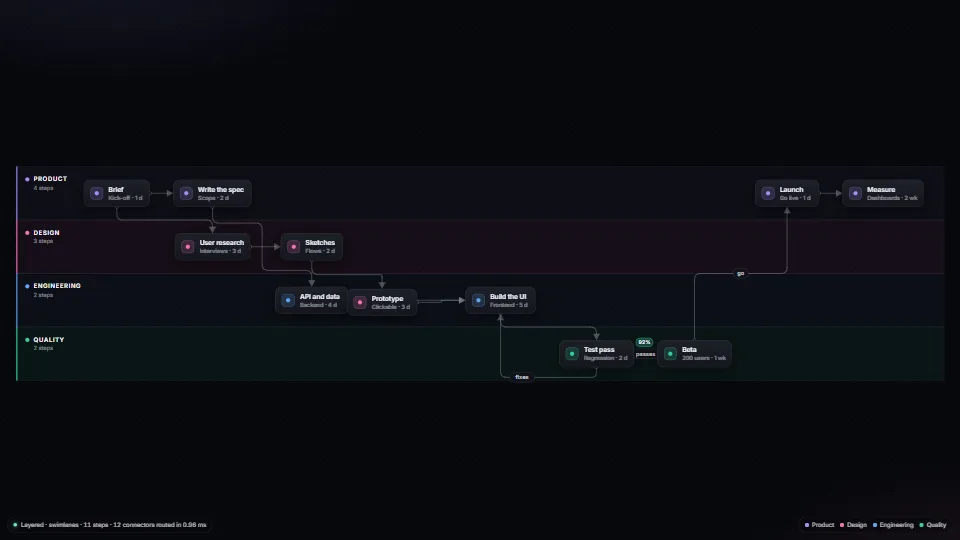
Orthogonal connectors routed round every box by A* over a sparse grid, with a bend cost and a tie-break that keeps elbow corners from flipping as things move…