Feature Library

Meeting scheduler: a year across time zones

<0.01 CPU ms
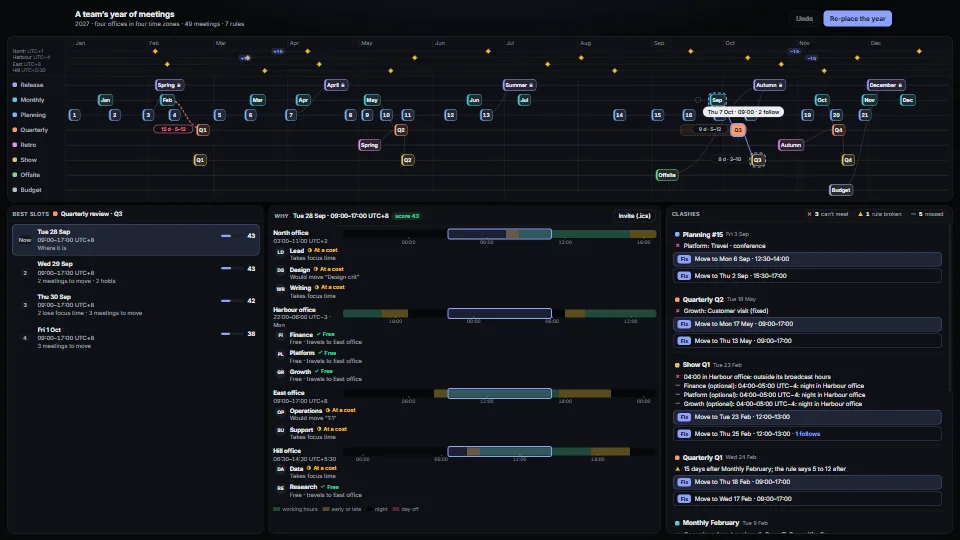
A still of the Meeting scheduler: a year across time zones demo
Still
The live demo starts when it’s in view.Pick a meeting for its ranked slots · drag one along its lane and watch the linked ones follow · apply a fix · Re-place the year

A pure, tested scheduling core for a team spread over offices and time zones.

What it costs a frame

<0.01 ms
GPU
not used
CPU, median
<0.01 ms
CPU, 95th pct
1.99 ms
Draw calls
0
Weight
Light

Measured 15 November 2026 on RTX 4060 Laptop, 13th Gen Intel(R) Core(TM) i9-13900H, Chrome 157, 1920×1080 at 1×. 600 frames × 3 rounds, median kept (rounds ranged CPU <0.01–<0.01 ms). What ran: Measured with the demo driving itself from its first frame: every eighth frame it drags the March monthly numbers a day further (a find for the day and a ripple through the rules, then the loom, threads and windows redrawn), and every 48 frames it picks the next meeting (six ranked slots with their reasons, each with its own ripple, and the time-zone beam). Phones: tiers are being measured next.

On every machine it was measured on
MachineGPU msCPU msCPU p95
RTX 4060 Laptop · 13th Gen Intel(R) Core(TM) i9-13900Hreference · measuring toolnot timed<0.011.99
apple · Apple A19 Proin a browser tab · 16 November 2026not timed<0.013.48
Intel Arc 140V (Xe2-LPG) · Intel Core Ultra 7 258Vin a browser tab · 15 November 2026not timed<0.011.95

Bars against one 16.7 ms frame. A browser-tab run is timed in a visible tab without the tool’s scripted input, so read it as close, not exact.

What it needs

Renders with
DOM and CSSPlain DOM and CSS: every current browser.
Your browser
Runs hereNo WebGPU needed
Depends on
NothingNo other packages

What it’s for

  1. Finding a meeting time for people in several time zones, with the reason each slot costs what it does
  2. Planning a year of recurring meetings that depend on each other (a review after the numbers, a town hall after the review)
  3. Showing what else has to move when one meeting moves, before anyone commits
  4. A clash list where every problem comes with a fix that can be applied in one click
  5. Writing calendar invites that every client accepts, from any planner or booking tool
  6. Testing time-zone code against real clock changes without a date library

Pitfalls, in brief

  1. Never hard-code clock-change dates.
  2. A clock changes at a time of day, not at midnight: Europe at 01:00 UTC, North America at 02:00 local.
  3. world.slotOf() asks for an offset twice: once at the day’s, then at the offset of the slot it lands on.
  4. A long video call across far-apart zones can fit for half the year only.
  5. Rules count days in the home office’s calendar.
11 more in brief
  1. The scheduler adds up costs from prefix sums made when it is created.
  2. A quorum lets a required person be missed only if they are outside its must-list: they cost 10 and show as “can be missed”, and the meeting is refused when fewer than min can come.
  3. ripple() mends only what its move breaks: rules that were already broken are left alone, or dragging one meeting quietly moves others somewhere else in the year. repair() on its own mends everything.
  4. solve() places the series in order, then repair() (greedy: the one move that leaves the fewest hard rules broken, again and again), then settle() (a bounded search: each meeting of a broken rule’s chain, its two ends and their neighbours, tried on the days that would keep the rule, with repair() carrying the rest), then up to three restarts with the series in other orders.
  5. A named series keeps its order: evaluate() refuses a slot that puts the October monthly after the November one (the mock-up’s repair could, by moving a meeting past its partner).
  6. In-person days with everyone required are the hardest to place: one person’s trip or leave closes the day.
  7. An iCalendar parameter value (a CN) is never backslash-escaped: one with a comma, colon or semicolon goes in double quotes, and a double quote cannot be in it at all (paramValue()).
  8. Fold at 75 octets, not 75 characters, and never inside a character: a line of accented or emoji text folded by length splits a UTF-8 sequence.
  9. Keep the UID when a meeting moves and raise SEQUENCE on every change to a sent invite; a new UID makes a second meeting in everyone’s calendar, and an unchanged SEQUENCE is ignored.
  10. Under a strict Content Security Policy, offer the .ics through a data: URL on an <a download> (icsDataUrl()), or show the text to copy.
  11. Generated calendars are for trying it: they keep leave and trips off the days a locked meeting needs (so the sample year can be placed) and grow thinner after the first months.
16 pitfalls in full, the hook-up guide, the module source and its tests come with the part.

Where it comes from

From HaTac, and in the planner showcase. Fully custom code.

Mark Jarzynski & Marc Olano, Hash Functions for GPU Rendering (JCGT, 2020): The PCG hash behind every seeded calendar.

Howard Hinnant, chrono-compatible low-level date algorithms: days_from_civil and civil_from_days, in the date maths copied from the date-picker entry.

RFC 5545, Internet Calendaring and Scheduling (iCalendar), and RFC 5546 (iTIP): Content lines, folding, TEXT escaping, quoted parameter values and METHOD:REQUEST.

IANA Time Zone Database, through ECMA-402 Intl: Every office’s clock and its daylight saving.

schedulingcalendarmeetingstime zonesintldaylight savingutcconstraintslinked seriesripplerepairsolverrankingexplanationsclashesquorumicalendaricsrfc 5545invitesdragkeyboardlive regionseeded

Near it in the frame