Feature Library

Low-poly props

0.34 GPU · 0.26 CPU ms
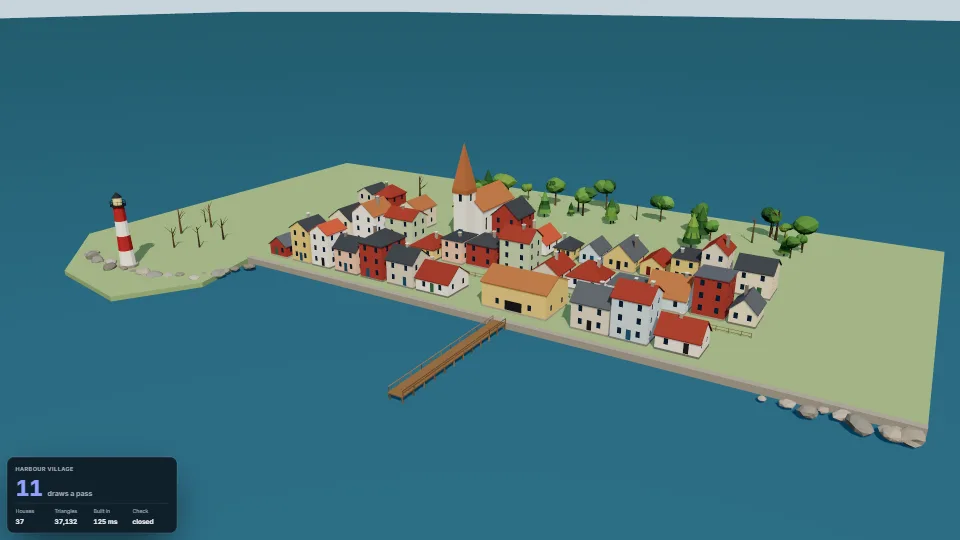
A still of the Low-poly props demo
Still
The live demo starts when it’s in view.Drag to look round the harbour · change the seed, the number of houses and the trees · turn night on to light the windows and the lantern

Coastal and village set dressing in one faceted low-poly style, each prop from a few numbers and a seed.

Coastal and village set dressing in one faceted low-poly style, each prop from a few numbers and a seed: houses (footprint, storeys, roof type and pitch, windows a storey, a door, a chimney, lit windows), a church with a spire, a pier on posts with rails, a lighthouse in bands with a gallery and a lantern that glows, rocks, fences along a path, and cheap trees (conifer, broadleaf, palm, dead), plus rows of houses along a street or a quay. Built on the shape kit’s core, so every part is closed, wound outward and UV’d in metres; colour rides on the vertices from one palette with seeded variation, so a whole harbour village is about ten draws at forty houses or two hundred and fifty, and builds in about a tenth of a second (a third at 250 houses). A night switch lights the lamps and windows without building a shader.

What it costs a frame

0.34 ms
0.26 ms
GPU
0.34 ms
CPU, median
0.26 ms
CPU, 95th pct
0.39 ms
Draw calls
24
Weight
Light

Measured 19 November 2026 on RTX 4060 Laptop, 13th Gen Intel(R) Core(TM) i9-13900H, Chrome 157, 1920×1080 at 1×. 600 frames × 3 rounds, median kept (rounds ranged GPU 0.34–0.50, CPU 0.24–0.26 ms). What ran: The default village (seed 7, about forty houses, a church, a shed, a pier, a lighthouse, 26 rocks, a fence and 32 trees), built once at start, by day, with sun shadows (the library’s sun-shadow: a 2,048-px map fitted to the view each frame, the tent filter). The frame cost is drawing it: about a dozen draws a pass, and the shadow pass. Phones: tiers are being measured next.

How steadily it runs on RTX 4060 Laptop · 13th Gen Intel(R) Core(TM) i9-13900H · reference

Typical frame ?
3.12 ms
1% low ?
140 fps
Varies by ?
±0.90 ms
All metricsRTX 4060 Laptop · 13th Gen Intel(R) Core(TM) i9-13900H · reference
p50p95p990.10 ms6.96 ms +
How long each frame took. Most frames sit in the tall bars; a long tail to the right is hitching.

Frames run back to back, each starting once the GPU has finished the last, so frame times show the work itself. They have a floor of about 4–5 ms from the browser’s own scheduling: GPU and CPU ms stay the measure of cost.

Frames

Median (p50) ?
3.12 ms
p95 ?
5.39 ms
p99 ?
6.49 ms
Slowest ?
8.09 ms
Mean ?
3.60 ms
Standard deviation ?
0.90 ms
1% low ?
140 fps
0.1% low ?
124 fps
Hitches ?
6 of 600
Over budget ?
0 of 600

Main thread

Long tasks ?
0
Long frames ?
0
Event-loop delay ?
0.0 / 0.3 / 0.3 ms

Input

No input during this run.

Memory

JavaScript heap ?
75.7 → 73.4 MB
Growth ?
-2.31 MB

Browser

JavaScript a frame ?
0.01 ms
All tasks a frame ?
0.45 ms
Layout / style ?
0.00 / 0.00 ms
Main thread busy ?
13%

Garbage collection

Collections ?
2 (2 minor, 0 major)
Pauses ?
1.5 ms in all, longest 0.9

What it needs

Renders with
WebGPU or WebGLWebGPU where there is one, WebGL2 where there is not.
Your browser
Runs hereNo WebGPU needed
Depends on
three.js 0.187.0No other packages
With an agent
install("low-poly-props")Your coding agent reads its pitfalls and installs it through the library’s MCP server. Set it up

What it’s for

  1. A harbour town, a village or a coast made in code, loaded at once with no model files
  2. Background buildings and set dressing for a game, a map or a weather view
  3. Seeded scenery: the same seed gives the same town on every visit
  4. An agent building a scene from a description, with closed geometry guaranteed

Pitfalls, in brief

  1. Merge, don’t add one by one: a prop is a shape, and a scene of shapes built together (merge(), or createKitScene().add()) is one draw per slot.
  2. Vertex colours carry the palette: the materials need vertexColors: true (createPropMaterials() sets it).
  3. The colours are linear RGB, as vertex colours are: turn sRGB hex colours with linear() when you make a palette, or the colours come out pale.
  4. A house stands on y = 0 with its front to +z; its plinth goes 0.6 m into the ground for uneven ground.
  5. Gable and shed roofs need a rectangular footprint (houses are rectangles); for other shapes, build from the shape kit.
4 more in brief
  1. The trees are set dressing: a few hundred triangles, no wind.
  2. Night lights the "lamp" slot by its emissive strength; a bloom pass makes the windows glow, without one they are simply bright.
  3. The kit’s core in module/ is a copy of shape-kit’s; keep the two at the same version if you use both, or use one copy.
  4. Building is CPU work at load: about 90 ms for a forty-house village and 330 ms for 250 houses in the browser.
9 pitfalls in full, the hook-up guide, the module source and its tests come with the part.

Where it comes from

Written for the library. Fully custom code.

Tommy Ettinger, mulberry32: the small seeded random generator behind every prop

procedurallow polypropsbuildingshousesvillageharbourlighthousepierrockstreesfenceseededvertex coloursdraw callsset dressingthree.jswebgpuwebglno dependencies

Near it in the frame