 UI & interaction
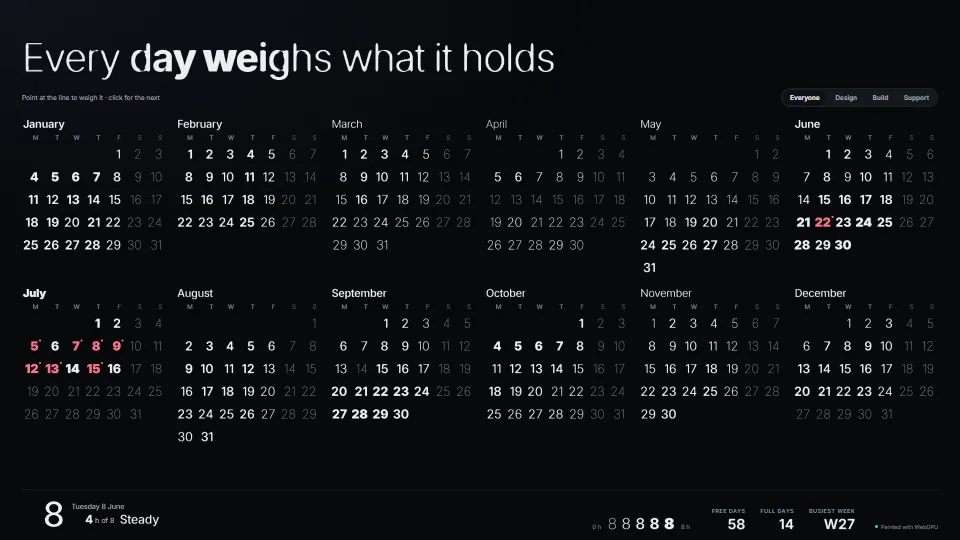
Weight glyphs: type that carries the data
One distance-field atlas holds a thin and a black cut of a typeface in its red and green channels, every glyph in the same fixed cell, so mixing the channels…
0.06 GPU · 0.69 CPU ms
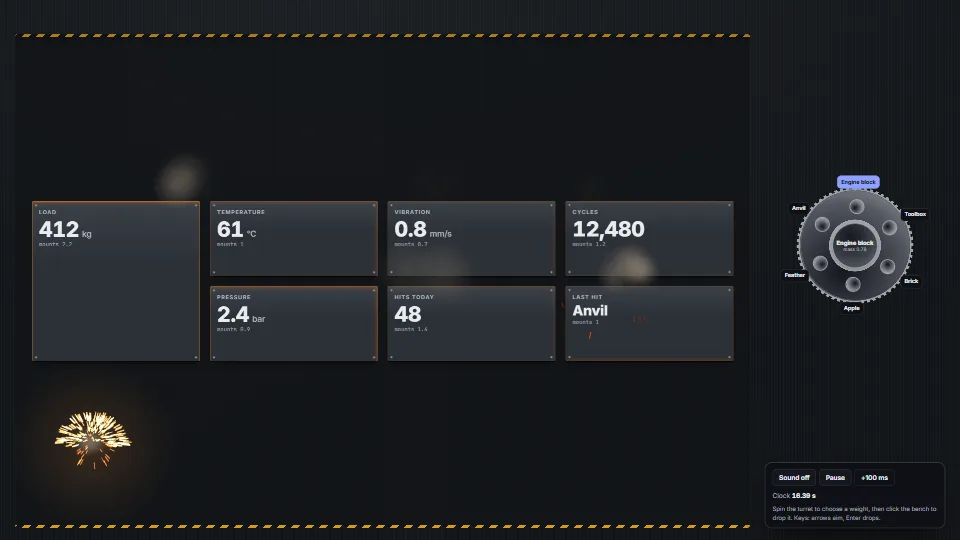
One event, felt everywhere: impact({ x, y, mass }) makes every [data-body] element dip, rock and ring down on its shock mounts by its distance and its own…
Measured 14 November 2026 on RTX 4060 Laptop, 13th Gen Intel(R) Core(TM) i9-13900H, Chrome 157, 1920×1080 at 1×. 600 frames × 3 rounds, median kept (rounds ranged CPU 0.68–0.81 ms). What ran: Measured with the demo dropping weights by itself from its first frame and every 0.35 s after, hot hits from brick to anvil at seeded spots, so through the whole run plates ring on their springs, hundreds of sparks bounce off their edges, dust spreads, rims glow and the turret turns to each weight. The system is stepped from the demo’s update(), so the CPU time is all of it: the clock, the springs’ transform writes, the spark simulation and the Canvas 2D drawing. No GPU of its own. Phones: tiers are being measured next.
| Machine | GPU ms | CPU ms | CPU p95 |
|---|---|---|---|
| RTX 4060 Laptop · 13th Gen Intel(R) Core(TM) i9-13900Hreference · measuring tool | not timed | 0.70 | 1.24 |
| apple · Apple A19 Proin a browser tab · 16 November 2026 | not timed | 0.76 | 1.60 |
| Intel Arc 140V (Xe2-LPG) · Intel Core Ultra 7 258Vin a browser tab · 15 November 2026 | not timed | 1.29 | 2.10 |
Bars against one 16.7 ms frame. A browser-tab run is timed in a visible tab without the tool’s scripted input, so read it as close, not exact.
From HaTac. Fully custom code.
UI & interactionOne distance-field atlas holds a thin and a black cut of a typeface in its red and green channels, every glyph in the same fixed cell, so mixing the channels…
 UI & interaction
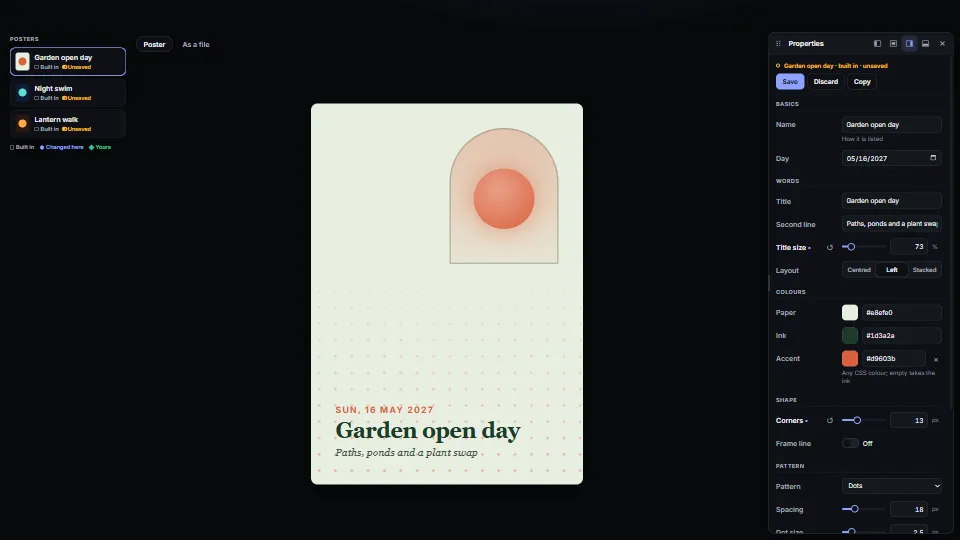
An inspector built from a description of the settings.
 UI & interaction
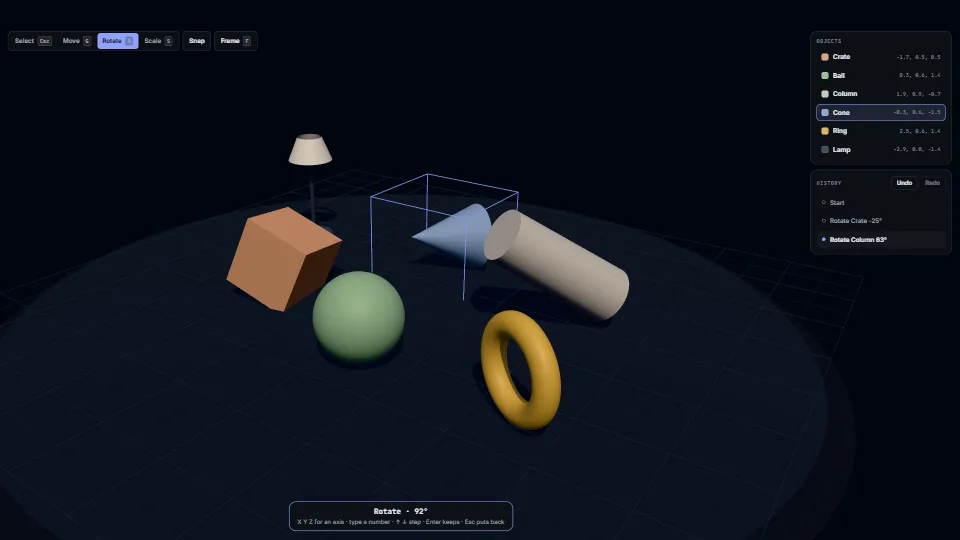
Click an object to pick it, then move, turn or size it with the gizmo or the Blender way.
 UI & interaction