 Simulation
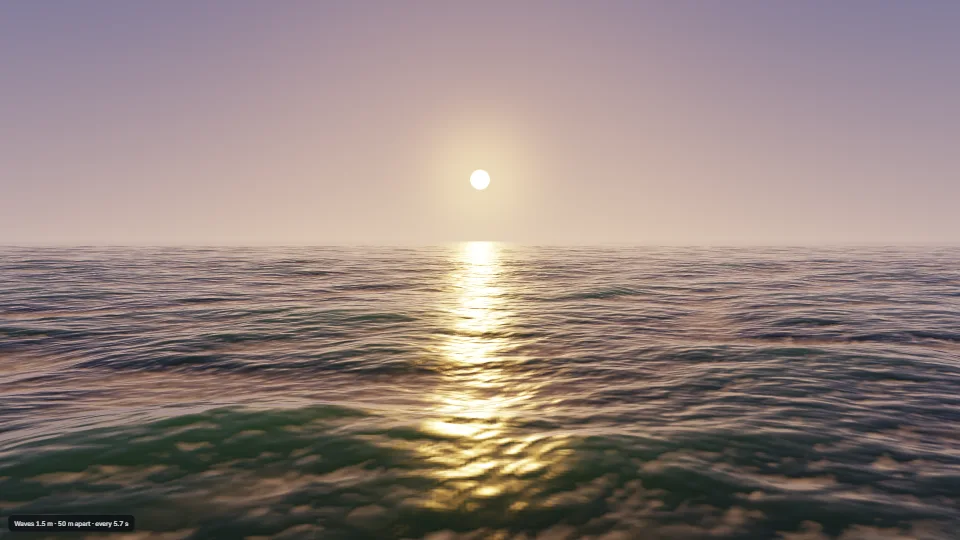
FFT ocean
An open sea from a wind-wave spectrum (Tessendorf), summed back to heights, choppy sideways push and folds by a Stockham FFT on the GPU every frame, into…
4.77 GPU · 0.11 CPU ms
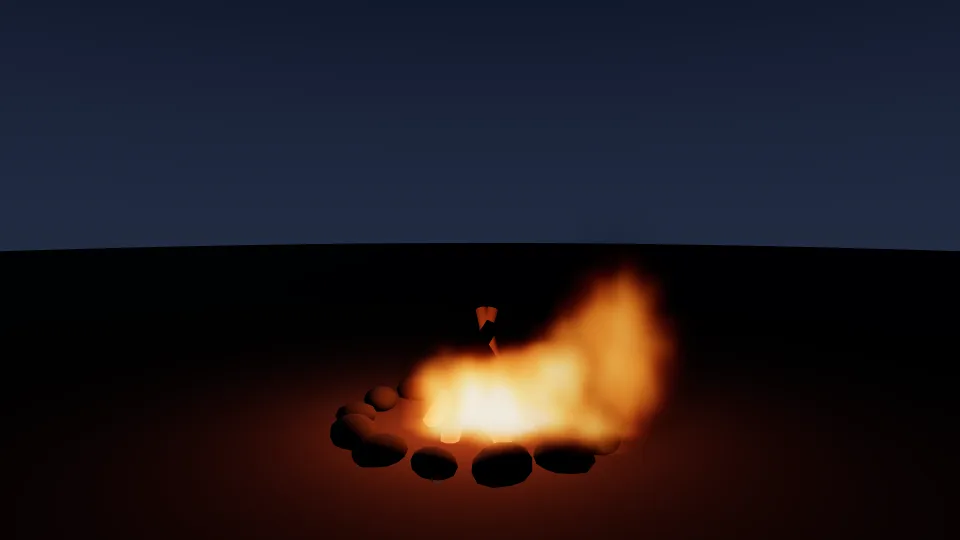
A box of air over burning ground stepped on the GPU every frame (advection, buoyancy, curl, a pressure solve) and drawn by marching each pixel’s ray through it.
Measured 3 November 2026 on RTX 4060 Laptop, 13th Gen Intel(R) Core(TM) i9-13900H, Chrome 156, 1920×1080 at 1×. 600 frames × 3 rounds, median kept. Phones: tiers are being measured next.
| Machine | GPU ms | CPU ms | CPU p95 |
|---|---|---|---|
| RTX 4060 Laptop · 13th Gen Intel(R) Core(TM) i9-13900Hreference · measuring tool | 5.05 | 0.23 | 0.39 |
| apple · Apple A19 Proin a browser tab · 16 November 2026 | 5.50 | 0.06 | 0.12 |
| Intel Arc 140V (Xe2-LPG) · Intel Core Ultra 7 258Vin a browser tab · 15 November 2026 | 38.5 | 0.82 | 1.13 |
Bars against one 16.7 ms frame. A browser-tab run is timed in a visible tab without the tool’s scripted input, so read it as close, not exact.
renderer to createFire (or build FireVolumeGL yourself): three’s WebGL2 backend has no compute or storage buffers, so fire-volume-gl.ts steps the same cells as full-screen passes into float render targets, the box’s z slices laid side by side in a 2D texture, and the march reads two filtered slices a sample and mixes them where WebGPU reads one 3D texture.tier (low: half the ray steps, one detail octave, fewer pressure iterations, the march at half the canvas each way): the march is nearly all the cost.low now marches at half the canvas each way (scale, into its own target in update, which then needs the camera) and skips the shading of empty samples (sparse).From HaTac. Fully custom code.
Jos Stam, Stable Fluids (1999): The step is the stable-fluids scheme: semi-Lagrangian advection and a Jacobi pressure projection. The algorithm, not code.
SimulationAn open sea from a wind-wave spectrum (Tessendorf), summed back to heights, choppy sideways push and folds by a Stockham FFT on the GPU every frame, into…
 Simulation
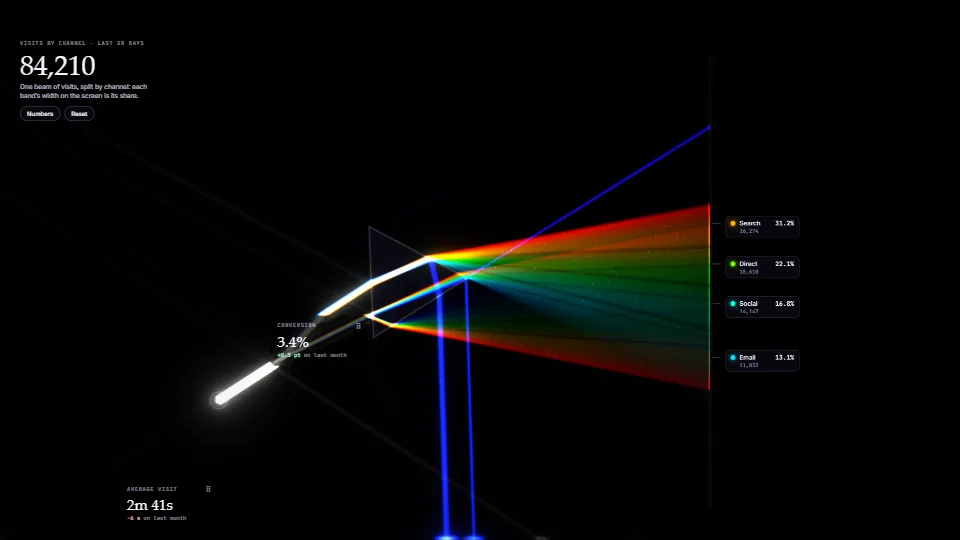
Spectral 2D light transport in WebGPU compute.
 Simulation
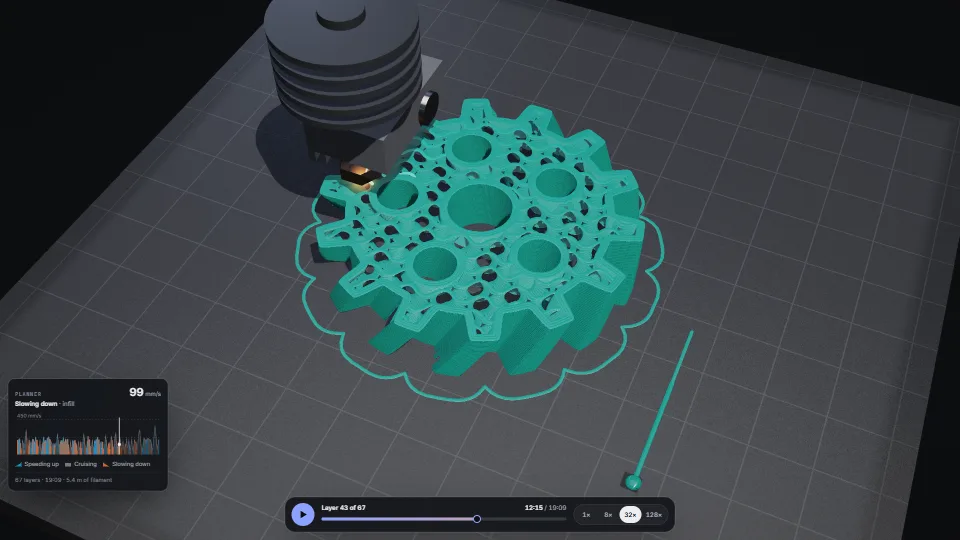
A 3D printer’s slicer and motion planner, with the print drawn as it is laid.
 Simulation