 Simulation
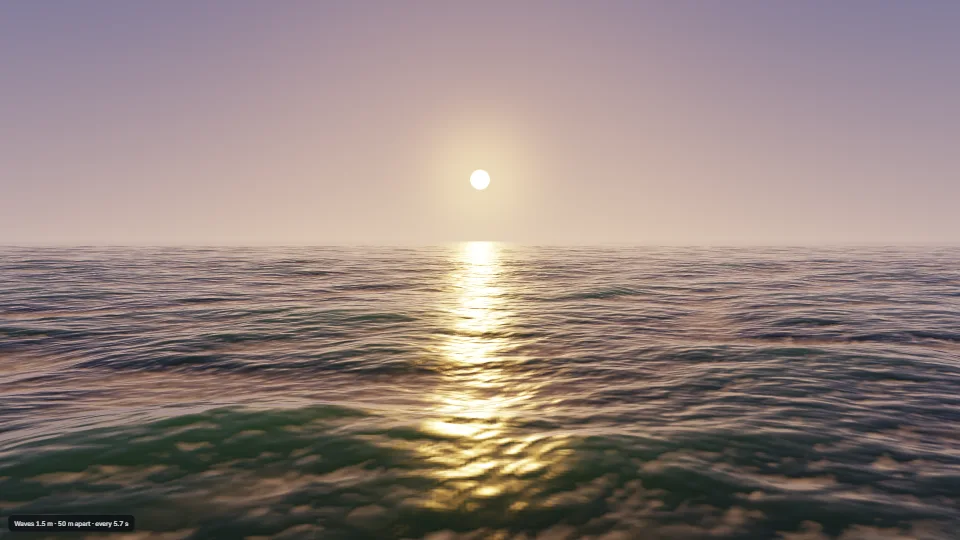
FFT ocean
An open sea from a wind-wave spectrum (Tessendorf), summed back to heights, choppy sideways push and folds by a Stockham FFT on the GPU every frame, into…
4.77 GPU · 0.11 CPU ms
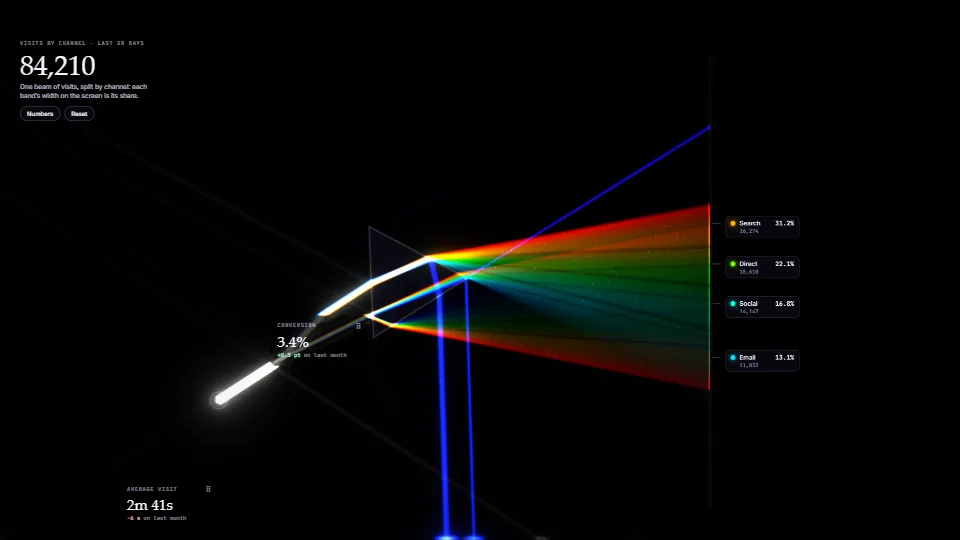
Spectral 2D light transport in WebGPU compute.
Measured 13 November 2026 on RTX 4060 Laptop, 13th Gen Intel(R) Core(TM) i9-13900H, Chrome 157, 1920×1080 at 1×. 600 frames × 3 rounds, median kept (rounds ranged GPU 2.05–4.95, CPU 0.28–0.30 ms). What ran: The data spectrum through chart glass at 8,192 rays a frame (65,536 beam segments drawn into a half-size HDR buffer), the prism swinging slowly and a glass card swept through the beam, so it never rests; haze, dust and the frosted cards composed at full size; timed with its own timestamp queries. At rest it draws nothing. Phones: tiers are being measured next.
| Machine | GPU ms | CPU ms | CPU p95 |
|---|---|---|---|
| RTX 4060 Laptop · 13th Gen Intel(R) Core(TM) i9-13900Hreference · measuring tool | 4.39 | 0.28 | 0.49 |
| apple · Apple A19 Proin a browser tab · 16 November 2026 | 10.4 | 0.57 | 0.92 |
| Intel Arc 140V (Xe2-LPG) · Intel Core Ultra 7 258Vin a browser tab · 15 November 2026 | 4.19 | 0.47 | 0.71 |
Bars against one 16.7 ms frame. A browser-tab run is timed in a visible tab without the tool’s scripted input, so read it as close, not exact.
Frames run on a 60 Hz timer (a page demo), so most frames take about one tick, 16.7 ms: the spread around it is what matters.
time: hold time still while resting, or the picture never settles.From HaTac. Fully custom code.
Augustin-Louis Cauchy, Cauchy’s dispersion equation (1836): n(λ) = A + B ÷ λ²: the real glasses’ index on the GPU and the CPU.
Wolfgang Sellmeier, the Sellmeier equation (1871), with Schott AG’s published coefficients for N-BK7, F2 and N-SF11: cauchyFit puts Cauchy’s two terms through each glass’s Sellmeier index at the F, d and C lines.
Chris Wyman, Peter-Pike Sloan & Peter Shirley, Simple Analytic Approximations to the CIE XYZ Color Matching Functions (2013): The measured colour of light: their multi-lobe fit of the 1931 observer, to linear sRGB with the IEC 61966-2-1 matrix.
Alvy Ray Smith, Color gamut transform pairs (SIGGRAPH 1978), smoothed as in Inigo Quilez’s “smooth HSV”: The even colour of light is the mock-up’s hue ramp in that form, its brightness flattened so no band of a chart looks smaller than it is.
Inigo Quilez, 2D distance functions: The rounded box distance the cards’ frosted glass is drawn with.
Jorge Jimenez, Next generation post processing in Call of Duty: Advanced Warfare (SIGGRAPH 2014): The 13-tap downsample and tent upsample of the small glow pyramid round bright beams.
Christophe Schlick, An inexpensive BRDF model for physically-based rendering (1994): The Fresnel reflectance each ray tosses a coin against at every face.
Mike Cyrus & Jay Beck, Generalized two- and three-dimensional clipping (1978): A ray against a convex polygon: the latest entry and the earliest exit over its edges.
Mark Jarzynski & Marc Olano, Hash Functions for GPU Rendering (2020): PCG: the rays’ random numbers, the haze, the dust and the grain.
Martin Roberts, The Unreasonable Effectiveness of Quasirandom Sequences (2018): The R2 step that shifts each frame’s rays across the beam.
Benedikt Bitterli, Tantalum (2015): Prior art for 2D spectral light transport drawn as additive lines; no code from it is used.
WAI-ARIA Authoring Practices Guide (W3C): The toggle button pattern for the bands (aria-pressed) and the disclosure for the table of numbers.
SimulationAn open sea from a wind-wave spectrum (Tessendorf), summed back to heights, choppy sideways push and folds by a Stockham FFT on the GPU every frame, into…
 Simulation
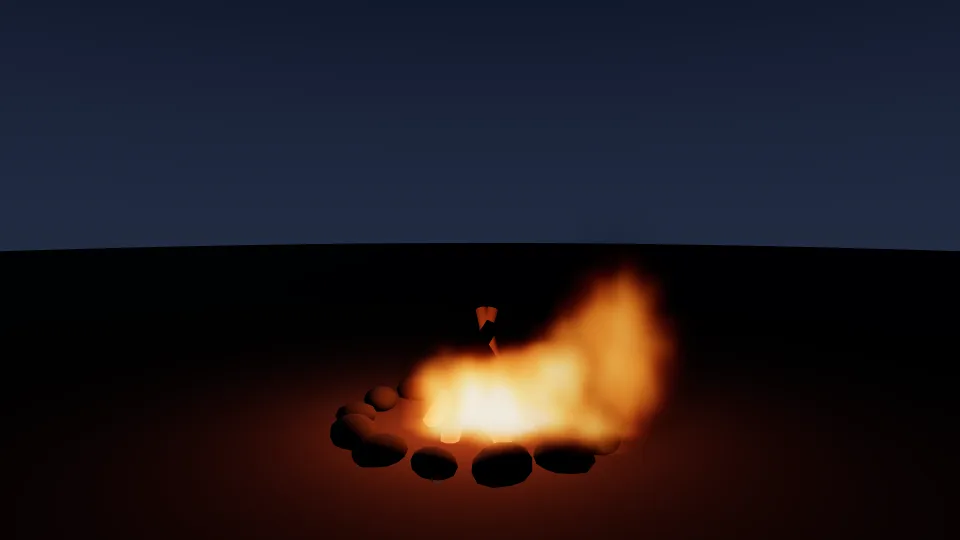
A box of air over burning ground stepped on the GPU every frame (advection, buoyancy, curl, a pressure solve) and drawn by marching each pixel’s ray through it.
 Simulation
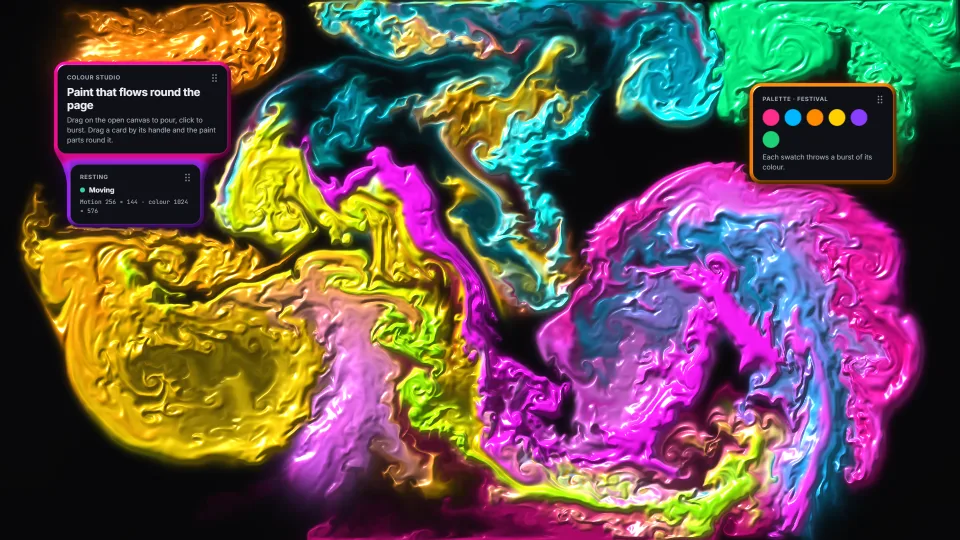
A stable-fluids simulation in WebGPU compute, nothing read back, with the page’s own panels as obstacles the paint flows round and a moving panel pushing it aside.
 Simulation
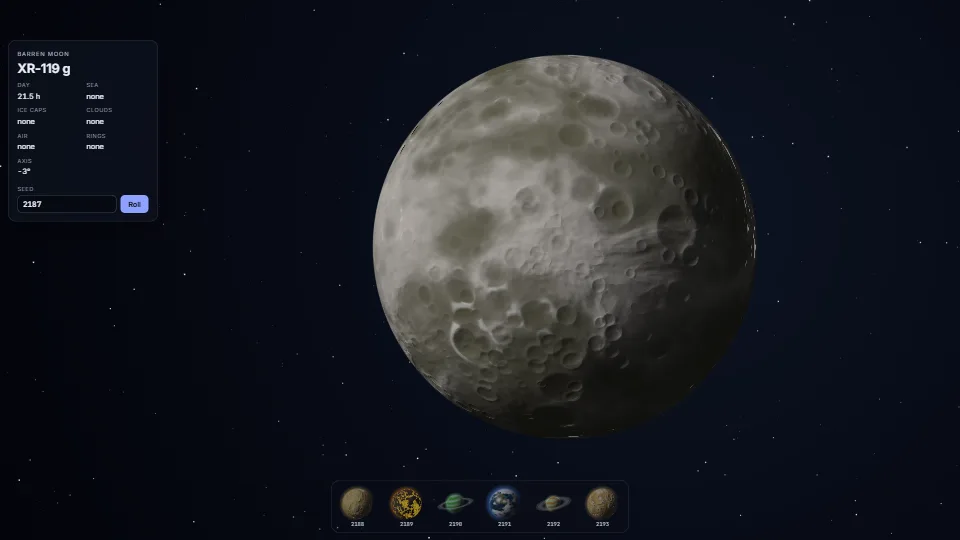
A whole planet from one number: a seed picks the kind (temperate, ocean, desert, ice, lava, gas giant or barren moon), its palette, its axis, and how much sea…