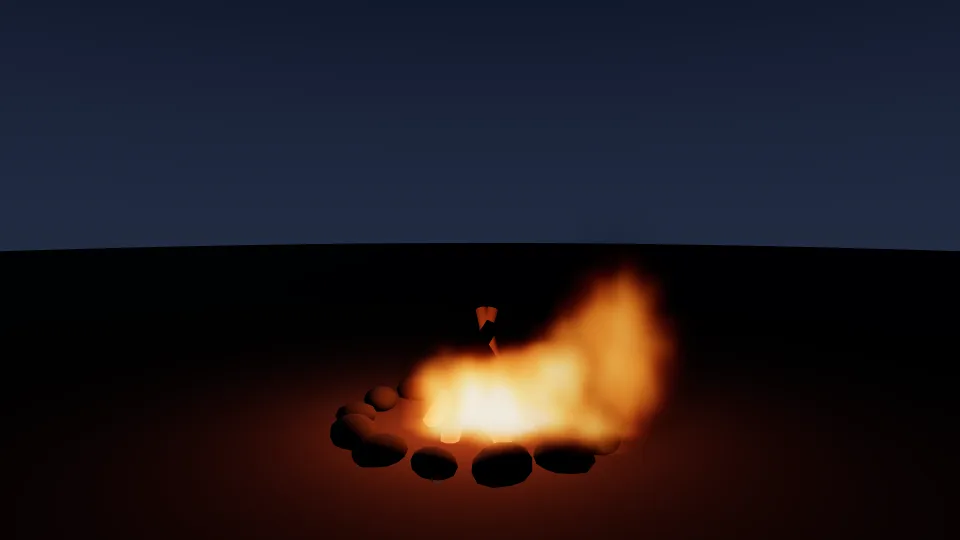
 Simulation
Fire as a fluid
A box of air over burning ground stepped on the GPU every frame (advection, buoyancy, curl, a pressure solve) and drawn by marching each pixel’s ray through it.
5.05 GPU · 0.23 CPU ms
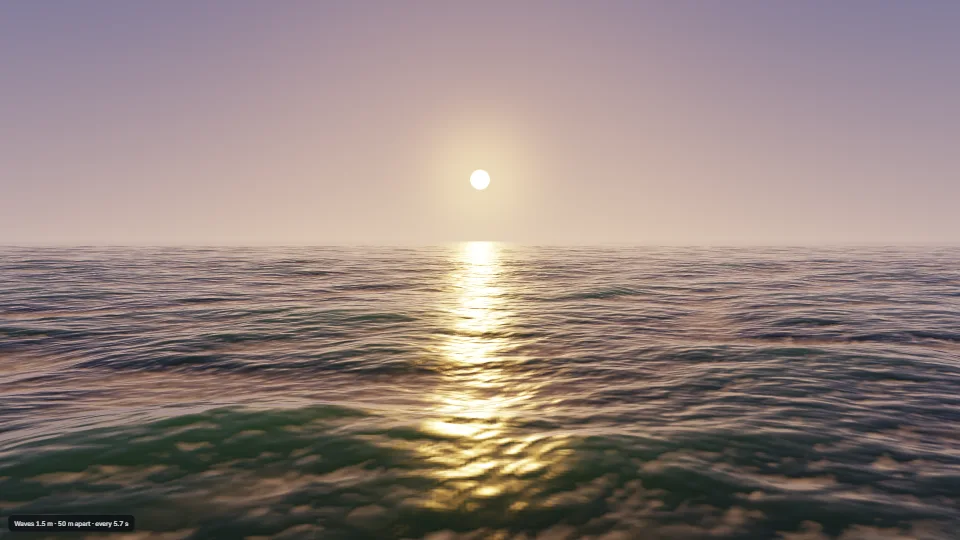
An open sea from a wind-wave spectrum (Tessendorf), summed back to heights, choppy sideways push and folds by a Stockham FFT on the GPU every frame, into…
Measured 11 November 2026 on 13th Gen Intel(R) Core(TM) i9-13900H, Chrome 157, 1920×1080 at 1×. 600 frames × 3 rounds, median kept. What ran: The default sea at golden hour: two 256² cascades transformed every frame (spectrum, row and column FFTs, assemble, mips), the sky and far-sea pass and the ~370k-triangle ring mesh at 4× MSAA, timed with its own timestamp queries. The waves move by themselves. Phones: tiers are being measured next.
| Machine | GPU ms | CPU ms | CPU p95 |
|---|---|---|---|
| unknown GPU · 13th Gen Intel(R) Core(TM) i9-13900Hreference · measuring tool | 4.77 | 0.11 | 0.18 |
| apple · Apple A19 Proin a browser tab · 16 November 2026 | 6.52 | 0.24 | 0.34 |
| Intel Arc 140V (Xe2-LPG) · Intel Core Ultra 7 258Vin a browser tab · 15 November 2026 | 4.26 | 0.27 | 0.41 |
Bars against one 16.7 ms frame. A browser-tab run is timed in a visible tab without the tool’s scripted input, so read it as close, not exact.
fetch for a lake, a bay or the lee of a coast, or a 10 m/s wind raises 2 m ocean waves on a 5 km lake (it should be about a third of a metre).From SpaciousPro. Fully custom code.
Jerry Tessendorf, Simulating Ocean Water (2001): The method: a Phillips spectrum of random waves, each turned to its phase by the deep-water dispersion sqrt(g k), summed by an inverse FFT, with the choppy sideways displacement and its Jacobian for foam.
Thomas Stockham, the autosort FFT: The radix-2 Stockham formulation that ping-pongs between two halves of shared memory, so no bit reversal is needed.
K. Hasselmann et al., the Joint North Sea Wave Project (JONSWAP, 1973): The growth of a wind sea with fetch: significant height 0.0016 √(gF/V²) V² / g and peak period 0.286 (gF/V²)^(1/3) V / g, until fully developed.
Pierson & Moskowitz (1964): A fully developed sea’s significant wave height for a wind speed, 0.21 V² / g: the default height.
Olano & Baker, LEAN Mapping (2010): The idea behind storing the squared slope beside the slope, so a mip’s lost slope variance widens the glint.
Walter et al. (2007), GGX; Schlick (1994): The sun glint’s microfacet lobe and the Fresnel approximation, written in the shader by their published formulas.
Krzysztof Narkowicz, ACES filmic tone curve fit (2015): The display curve.
Mark Jarzynski & Marc Olano, Hash Functions for GPU Rendering (2020): Their pcg2d drives the foam’s value noise and the dither.
Tommy Ettinger, mulberry32: The seeded random behind the waves’ phases (public domain).
Kasten & Young (1989), relative air mass: How much air the sun’s light crosses at an elevation: its colour by Beer–Lambert.
SimulationA box of air over burning ground stepped on the GPU every frame (advection, buoyancy, curl, a pressure solve) and drawn by marching each pixel’s ray through it.
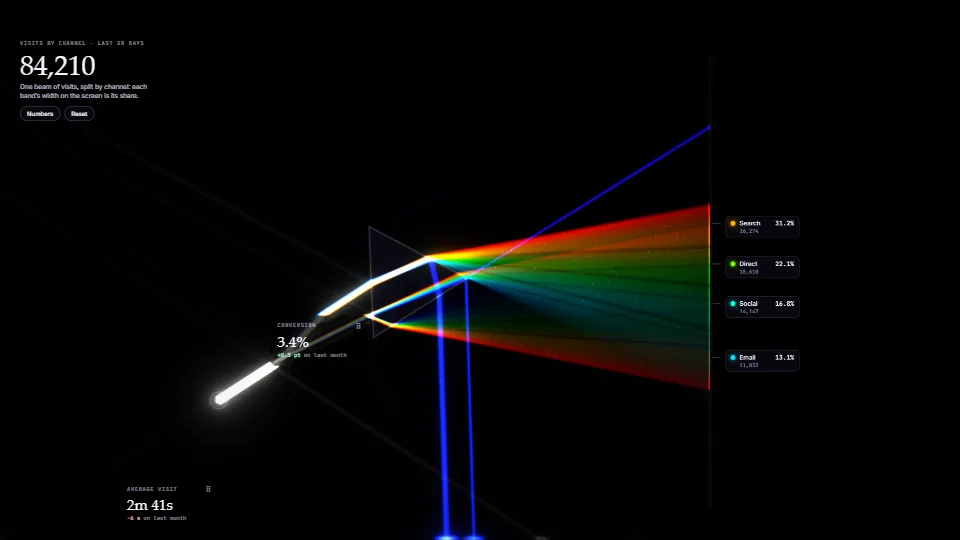 Simulation
Spectral 2D light transport in WebGPU compute.
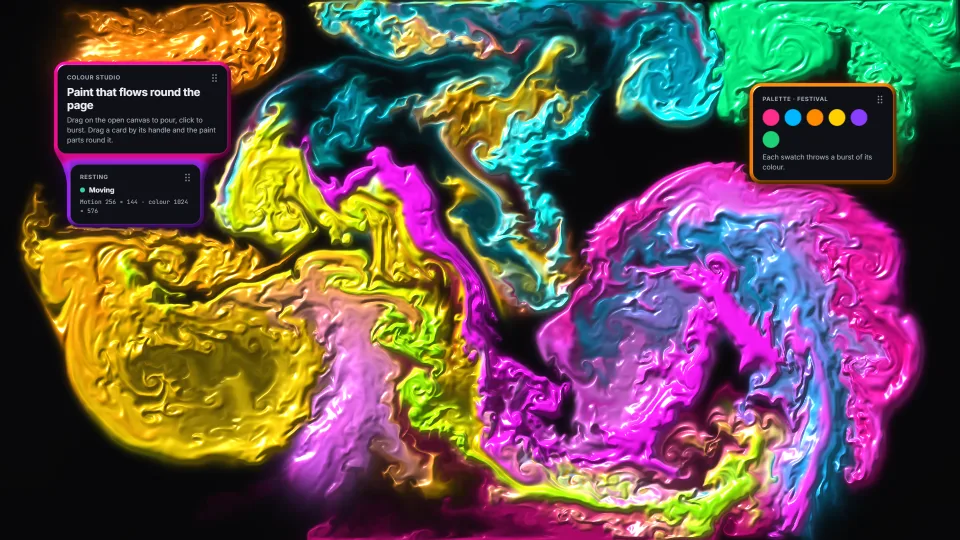 Simulation
A stable-fluids simulation in WebGPU compute, nothing read back, with the page’s own panels as obstacles the paint flows round and a moving panel pushing it aside.
 Simulation
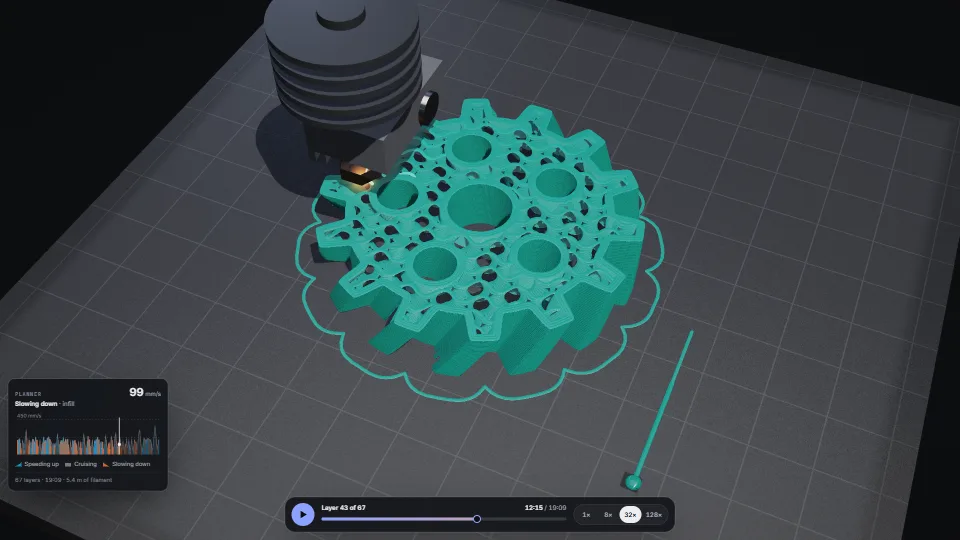
A 3D printer’s slicer and motion planner, with the print drawn as it is laid.