 Simulation
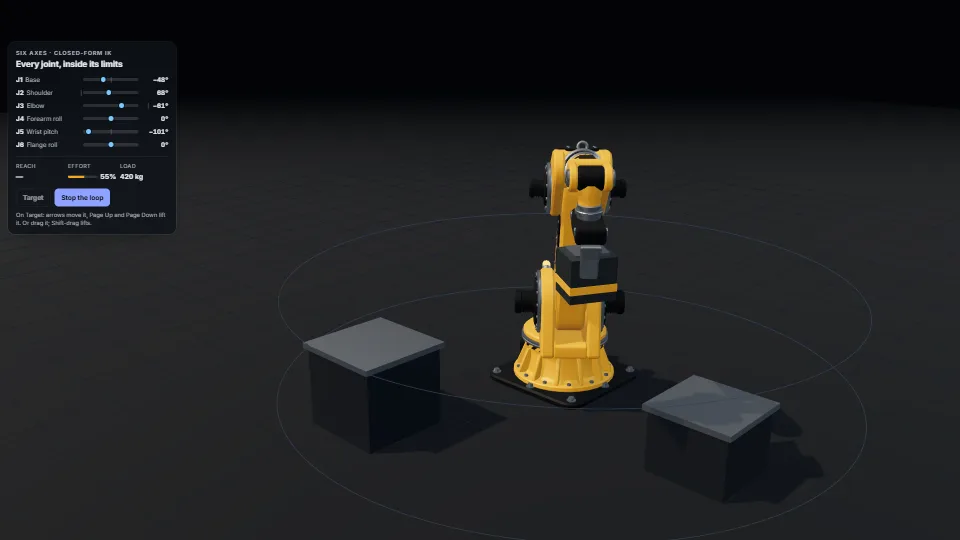
A six-axis arm with analytic IK
An industrial robot arm that moves like tonnes of servo-driven steel.
0.56 GPU · 0.77 CPU ms
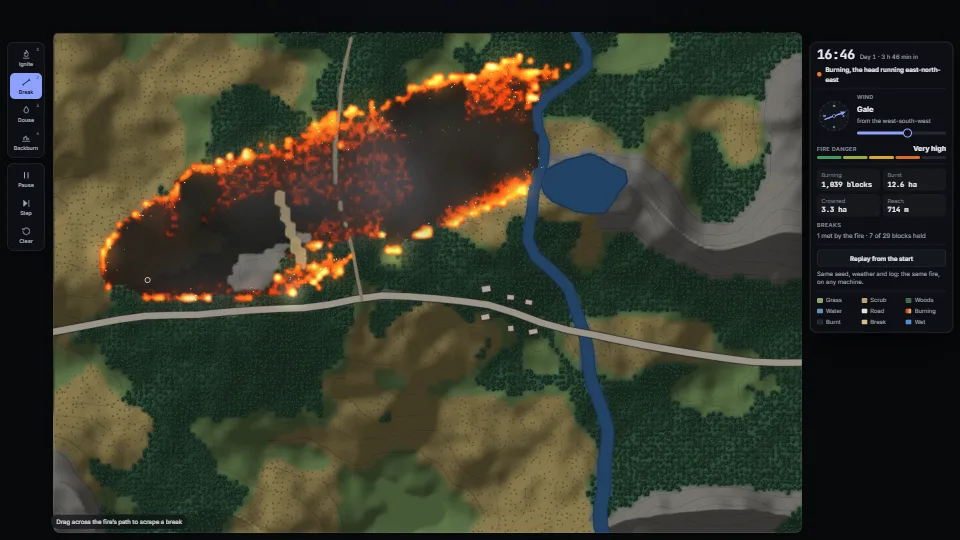
A wildfire run as pure, seeded rules a server can run as they are: 8 m blocks of grass, scrub and woods over a 1 m raster of roads and water, stepped a minute at a time.
Measured 13 November 2026 on RTX 4060 Laptop, 13th Gen Intel(R) Core(TM) i9-13900H, Chrome 157, 1920×1080 at 1×. 600 frames × 3 rounds, median kept (rounds ranged CPU 0.52–1.27 ms). What ran: Measured with a fire lit upwind in a strong breeze at 30 minutes a second, a break laid across its path, embers and smoke on; it is cleared and lit again when it goes out. The time includes stepping the fire map (about 13,500 blocks), redrawing its layer where it burns, and the Canvas 2D drawing. Paused or out, nothing is drawn. Phones: tiers are being measured next.
| Machine | GPU ms | CPU ms | CPU p95 |
|---|---|---|---|
| RTX 4060 Laptop · 13th Gen Intel(R) Core(TM) i9-13900Hreference · measuring tool | not timed | 0.80 | 5.34 |
| apple · Apple A19 Proin a browser tab · 16 November 2026 | not timed | 1.44 | 11.1 |
| Intel Arc 140V (Xe2-LPG) · Intel Core Ultra 7 258Vin a browser tab · 15 November 2026 | not timed | 1.41 | 6.01 |
Bars against one 16.7 ms frame. A browser-tab run is timed in a visible tab without the tool’s scripted input, so read it as close, not exact.
state.minute (or later).minuteSeconds (2 s, the source game’s compressed clock).seedFrom).restoreWildfire needs the same grid: it returns null for a bigger grid’s or for text that is not a snapshot, but a smaller grid’s restores misplaced, so keep the grid’s revision beside it too.fireCounts, reachOf) walk the touched box; heldLines walks the whole grid.From HaTac. Fully custom code.
Austin Appleby, MurmurHash3 (public domain): The rolls mix with MurmurHash3’s 32-bit finaliser (its two multiply–xorshift rounds).
Fowler–Noll–Vo hash, FNV-1a (public domain): `seedFrom` turns text into a seed with FNV-1a before the mix.
The elliptical fire shape (after Anderson, 1983, and Alexander, 1985): The idea that a wind-driven fire grows as an ellipse whose length-to-breadth ratio rises with the wind; the speeds and the ratio here are the game’s own tuning, not those papers’ equations.
SimulationAn industrial robot arm that moves like tonnes of servo-driven steel.
 Simulation
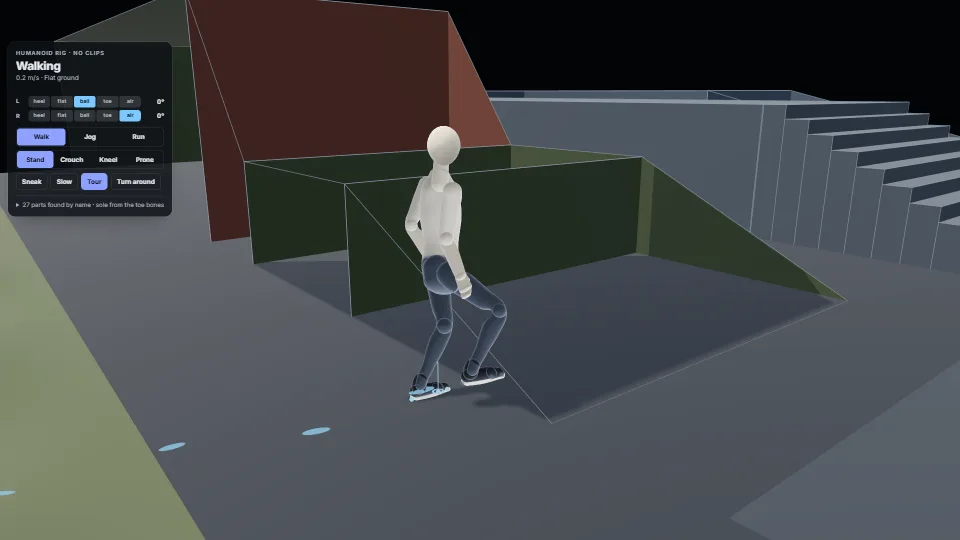
One adapter that poses any humanoid skeleton, and a walk with no clips to drive it.
 Simulation
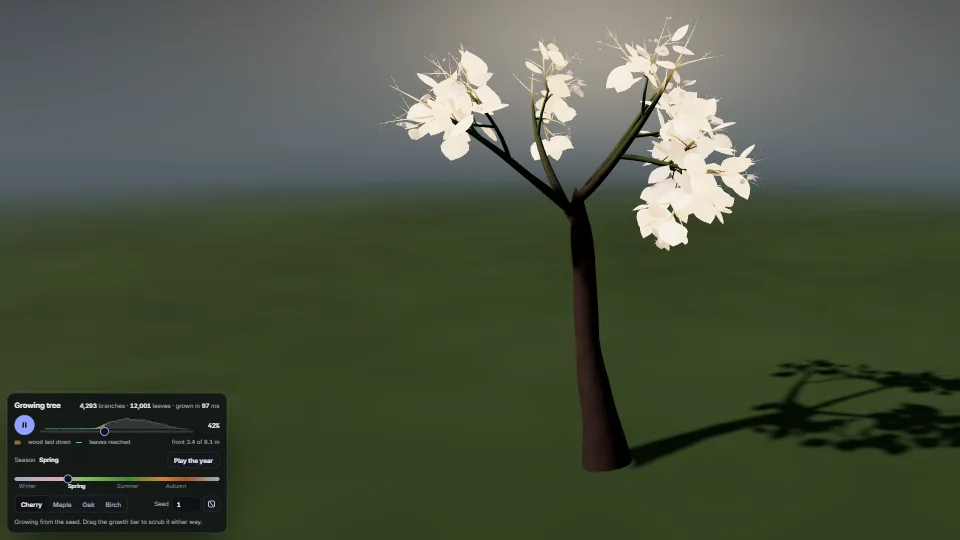
A tree grown by rule from a seed (Weber and Penn.
 Simulation
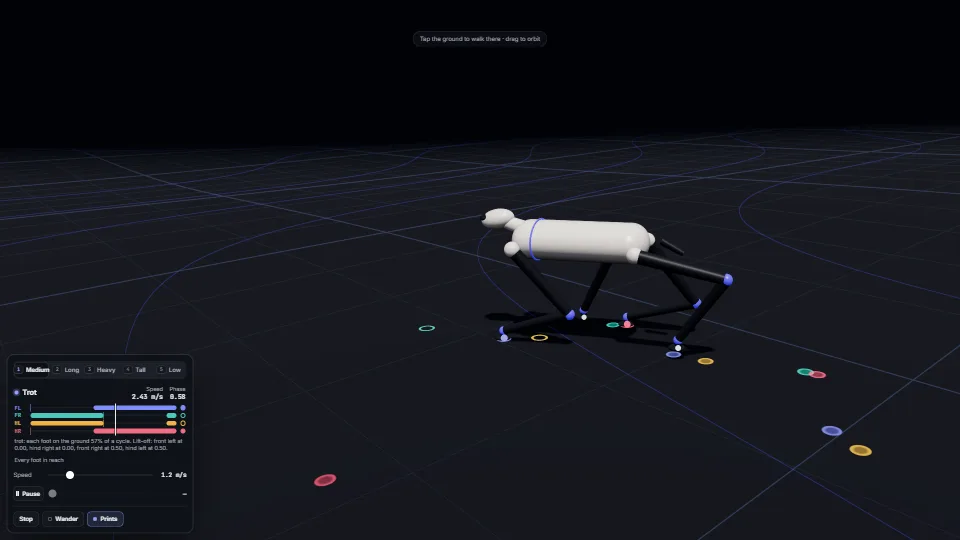
Four legs that walk, trot and run without a single animation clip.