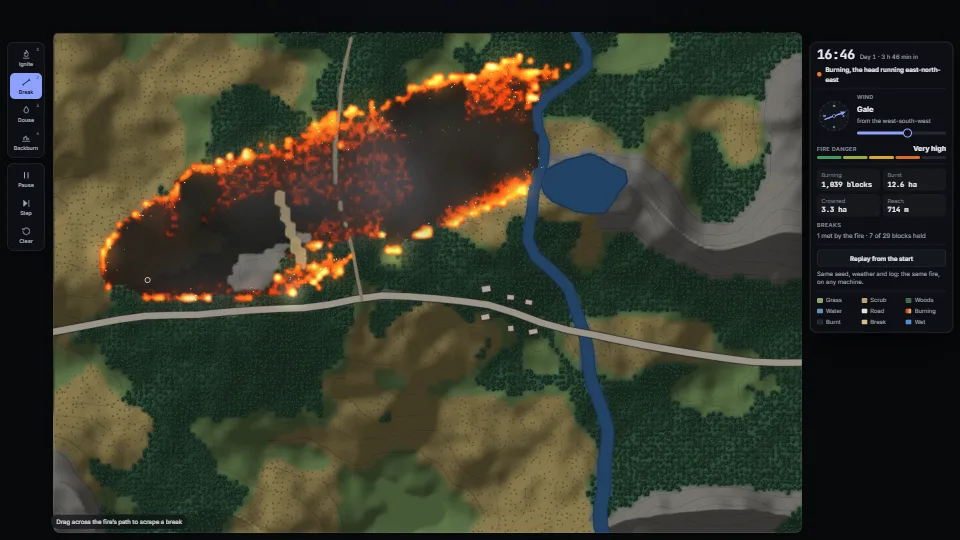
 Simulation
Wildfire on a seeded fire map
A wildfire run as pure, seeded rules a server can run as they are: 8 m blocks of grass, scrub and woods over a 1 m raster of roads and water, stepped a minute at a time.
0.80 CPU ms
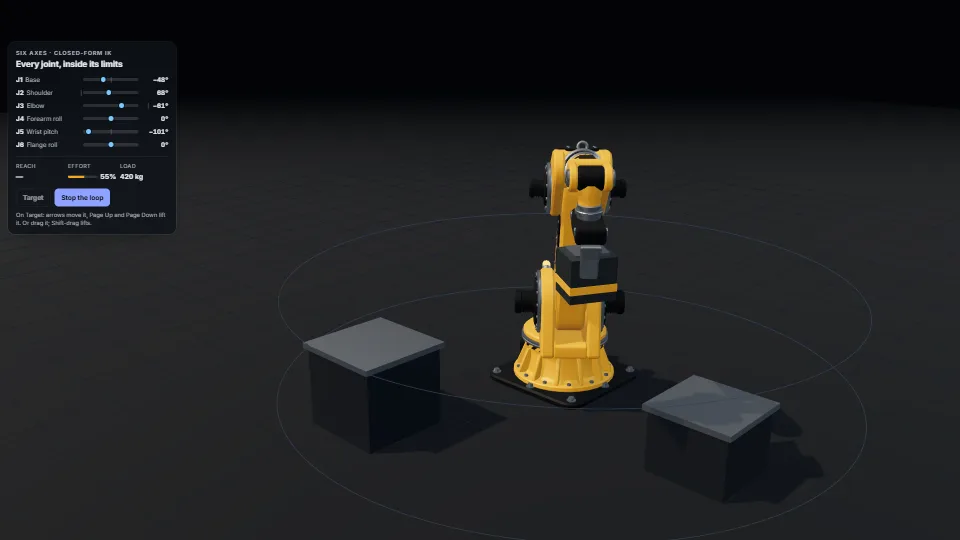
An industrial robot arm that moves like tonnes of servo-driven steel.
Measured 13 November 2026 on RTX 4060 Laptop, 13th Gen Intel(R) Core(TM) i9-13900H, Chrome 157, 1920×1080 at 1×. 600 frames × 3 rounds, median kept (rounds ranged GPU 0.35–0.96, CPU 0.56–0.77 ms). What ran: The pick-and-place loop with a 420 kg block: planned quintic moves, straight lines solved to joints every 1/180 s step, compliance, sag and settle, shadows from one key light and a room environment; the joint panel written a few times a second. Phones: tiers are being measured next.
| Machine | GPU ms | CPU ms | CPU p95 |
|---|---|---|---|
| RTX 4060 Laptop · 13th Gen Intel(R) Core(TM) i9-13900Hreference · measuring tool | 0.56 | 0.77 | 1.20 |
| apple · Apple A19 Proin a browser tab · 16 November 2026 | 2.11 | 0.54 | 1.82 |
| Intel Arc 140V (Xe2-LPG) · Intel Core Ultra 7 258Vin a browser tab · 15 November 2026 | 2.62 | 1.63 | 2.28 |
Bars against one 16.7 ms frame. A browser-tab run is timed in a visible tab without the tool’s scripted input, so read it as close, not exact.
From HaTac. Fully custom code.
Donald L. Pieper, The kinematics of manipulators under computer control (Stanford, 1968): Why a six-axis arm with a spherical wrist has a closed-form solution: position from the first three joints, orientation from the last three.
Tamar Flash & Neville Hogan, The coordination of arm movements (Journal of Neuroscience, 1985): The minimum-jerk quintic (10s³ − 15s⁴ + 6s⁵) every planned move follows.
A. M. Andrew, Another efficient algorithm for convex hulls in two dimensions (1979): The monotone-chain hull that outlines each cast link.
Numerical Recipes (Press et al.): The LCG constants (1664525, 1013904223) behind the servos’ hunting and the arc’s flicker.
SimulationA wildfire run as pure, seeded rules a server can run as they are: 8 m blocks of grass, scrub and woods over a 1 m raster of roads and water, stepped a minute at a time.
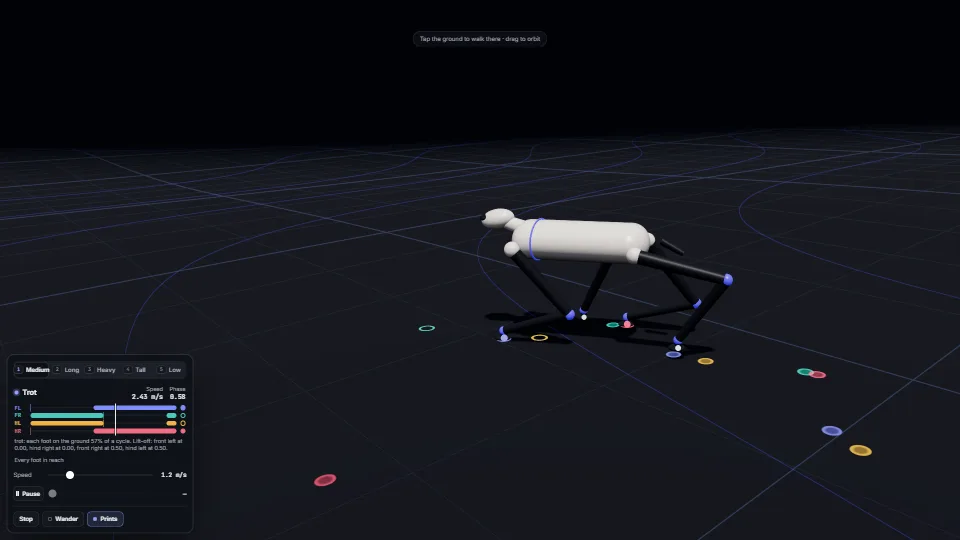 Simulation
Four legs that walk, trot and run without a single animation clip.
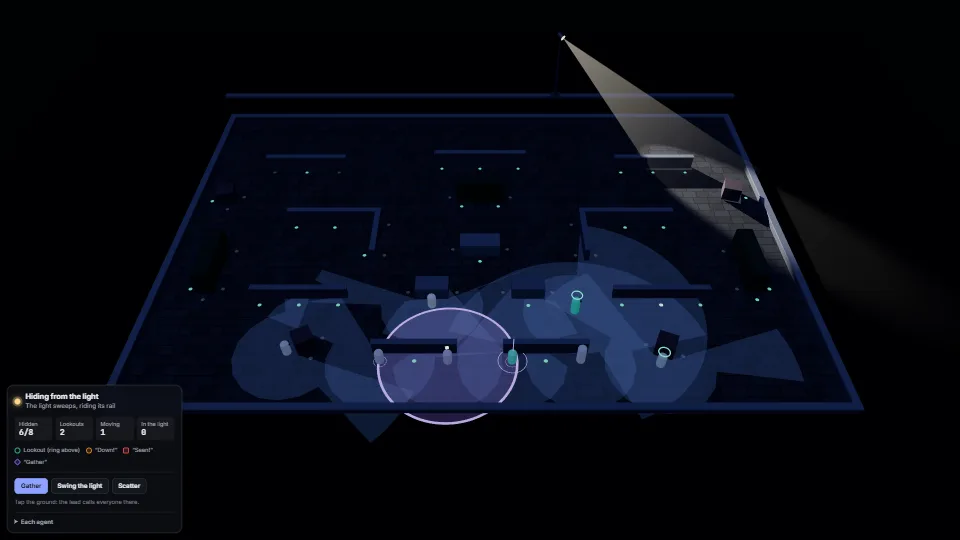 Simulation
 Simulation
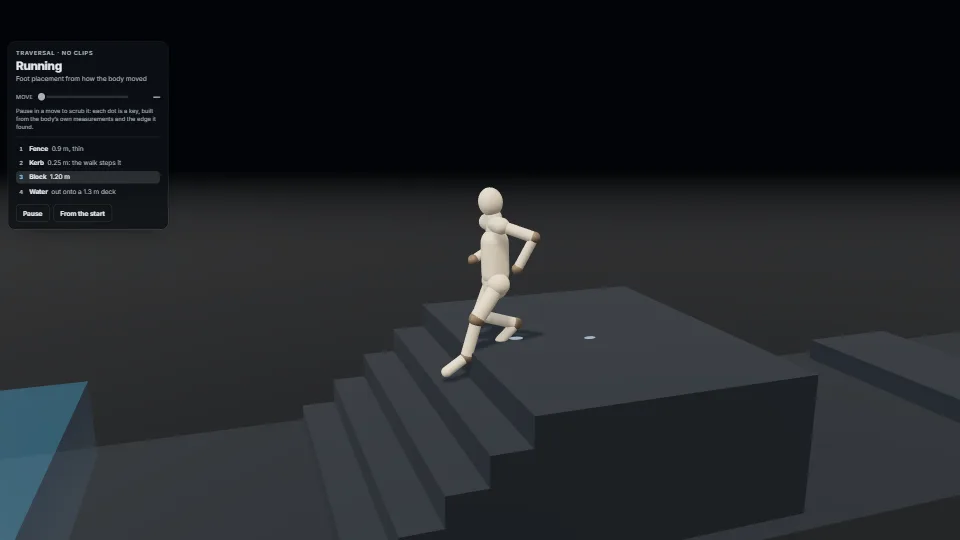
Getting over and up things with no animation clips and no jump.