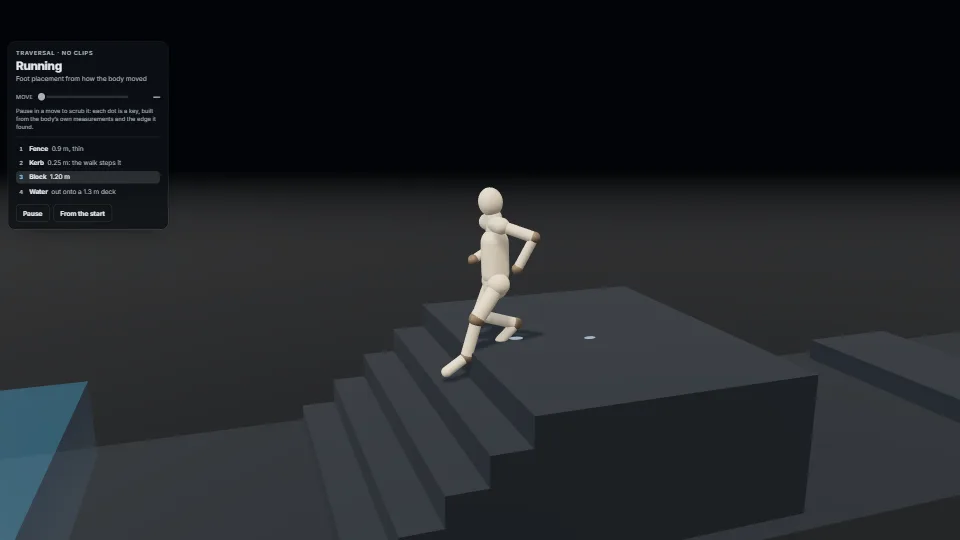
 Simulation
Vault, climb and mantle without clips
Getting over and up things with no animation clips and no jump.
0.72 GPU · 0.30 CPU ms
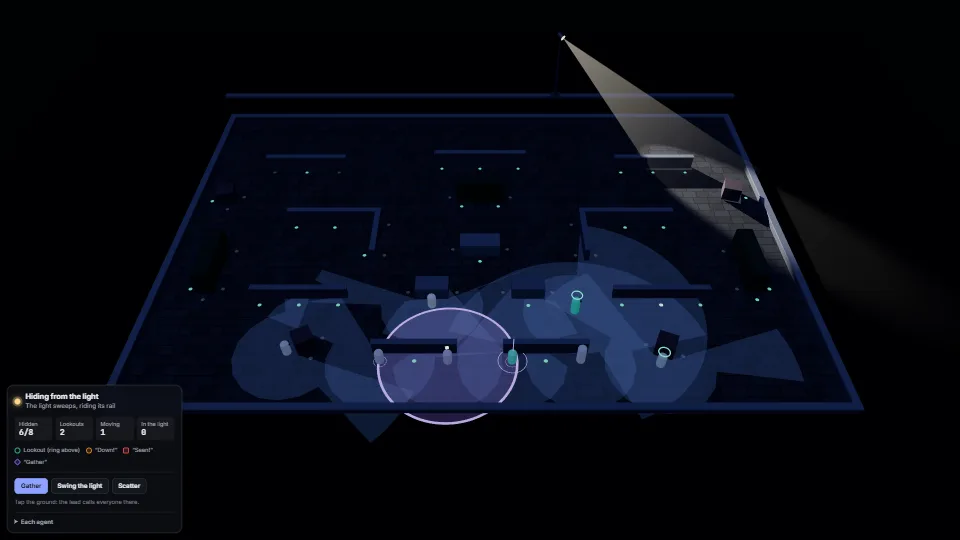
Agents that see, hear and hide as a group.
Measured 13 November 2026 on RTX 4060 Laptop, 13th Gen Intel(R) Core(TM) i9-13900H, Chrome 157, 1920×1080 at 1×. 600 frames × 3 rounds, median kept (rounds ranged GPU 0.47–0.73, CPU 0.60–0.81 ms). What ran: Measured as it runs by itself: eight agents hiding from the sweeping light on its moving mast, two lookouts taking turns, call-outs and regroups as they happen; sight cones (34 rays each against 30 solids at 30 Hz), cover spots, call rings and a 1024² spot-light shadow on. Phones: tiers are being measured next.
| Machine | GPU ms | CPU ms | CPU p95 |
|---|---|---|---|
| RTX 4060 Laptop · 13th Gen Intel(R) Core(TM) i9-13900Hreference · measuring tool | 0.73 | 0.60 | 0.84 |
| apple · Apple A19 Proin a browser tab · 16 November 2026 | 3.98 | 0.74 | 3.74 |
| Intel Arc 140V (Xe2-LPG) · Intel Core Ultra 7 258Vin a browser tab · 15 November 2026 | 2.49 | 1.49 | 2.25 |
Bars against one 16.7 ms frame. A browser-tab run is timed in a visible tab without the tool’s scripted input, so read it as close, not exact.
y as the height it sees from (a lamp’s head, a sentry’s eyes) and test the watched body’s chest, not its feet: feet are behind every kerb.wants, and only the director hands it a spot.speed: a listener is told when it passes, not when it is called.relayOf set to the first one: nobody hears the same news twice, so relays spread outward without echoing back.From HaTac. Fully custom code.
Chris Wellons, “lowbias32” integer hash (hash-prospector): The finalising constants of sweepPhase’s hash (public domain).
Hart, Nilsson and Raphael, A* search (1968): The walk grid’s search. The algorithm, not code.
Slab test for a ray against a box (Kay and Kajiya, 1986): segmentHit clips the line against each box’s three slabs. The method, not code.
SimulationGetting over and up things with no animation clips and no jump.
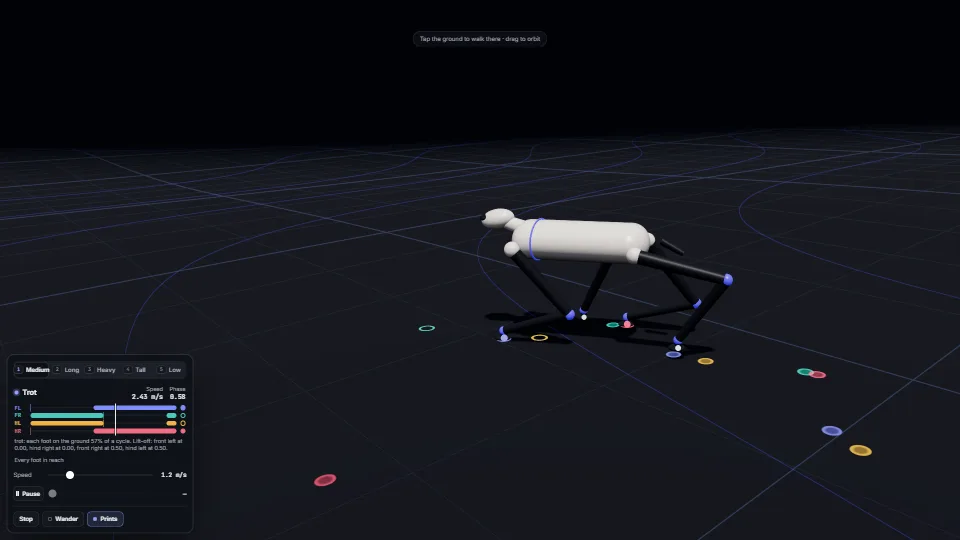 Simulation
Four legs that walk, trot and run without a single animation clip.
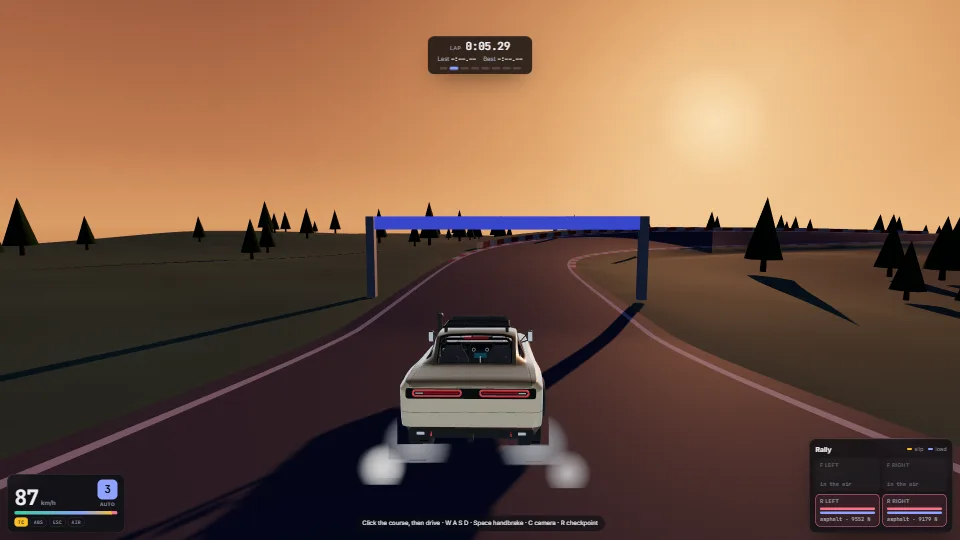 Simulation
A car as a rigid body in 3D on four raycast springs, stepped at a fixed 120 Hz with no physics engine.
 Simulation
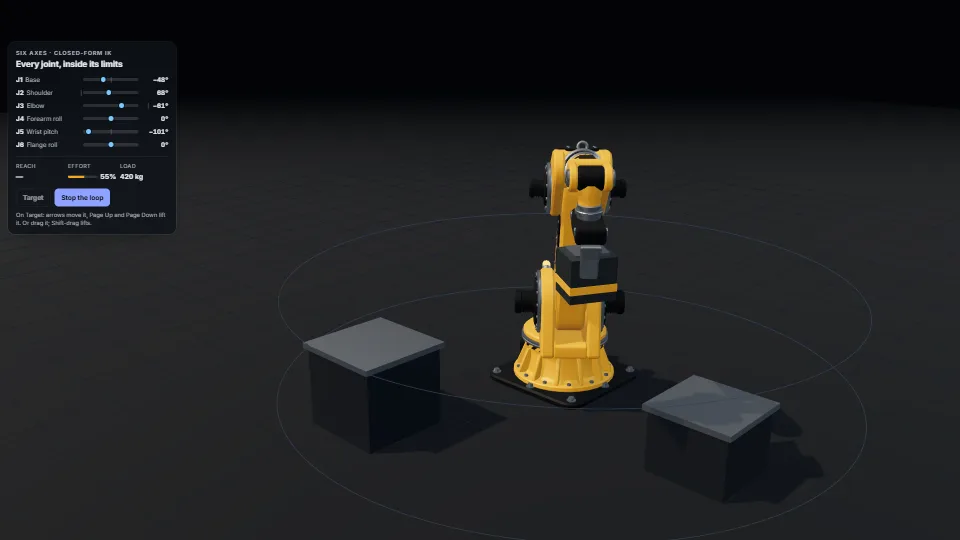
An industrial robot arm that moves like tonnes of servo-driven steel.