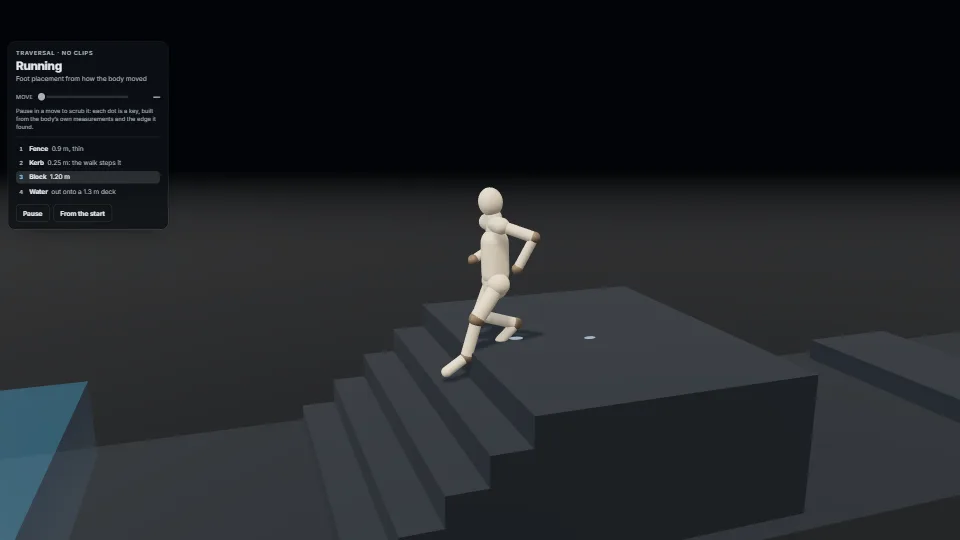
The live demo starts when it’s in view.Watch it cross the course · change the block’s height · Pause in a move and scrub it · orbit to look round
Getting over and up things with no animation clips and no jump.
What it costs a frame
GPU
0.72 ms
CPU
0.30 ms
02468101216.7 ms
GPU
0.72 ms
CPU, median
0.30 ms
CPU, 95th pct
0.47 ms
Draw calls
19
Weight
Moderate
Measured 13 November 2026 on RTX 4060 Laptop, 13th Gen Intel(R) Core(TM) i9-13900H, Chrome 157, 1920×1080 at 1×. 600 frames × 3 rounds, median kept (rounds ranged GPU 0.50–0.85, CPU 0.30–0.42 ms). What ran: Crosses the whole course at a jog, again and again: the walk’s foot placement on the fixed 60 Hz tick, the edge finder on the way, each move sampled every tick (monotone cubic over its keys), the mannequin solved by two-bone IK and drawn as three instanced meshes, one shadowed key light and a room environment. Phones: tiers are being measured next.
apple · Apple A19 Proin a browser tab · 16 November 2026
1.52
0.12
0.26
Intel Arc 140V (Xe2-LPG) · Intel Core Ultra 7 258Vin a browser tab · 15 November 2026
2.03
0.78
1.13
Bars against one 16.7 ms frame. A browser-tab run is timed in a visible tab without the tool’s scripted input, so read it as close, not exact.
What it needs
Renders with
WebGPU or WebGLWebGPU where there is one, WebGL2 where there is not.
Your browser
Runs hereNo WebGPU needed
Depends on
three.js 0.187.0No other packages
What it’s for
A third-person character that climbs onto anything of the right height, with no authored clips
NPCs whose path crosses fences, low walls and decks
Getting out of a pool, a river or a harbour onto a bank or a deck
Level design: a planner that says which edges a body can take, and how
Stairs and kerbs walked with feet that land on each step
Scrubbing a move key by key to tune it
Pitfalls, in brief
Ask the edge finder on intent, not every frame: when the body pushes into something that stopped it, when a key is pressed, or every few ticks while moving toward a face.
A box is not a floor.
The moves are authored for the reference body’s proportions (drawn at 0.89 m a unit).
TRAVERSE_TIMING is one shared object: a change to tempo, blendIn or blendOut holds for every move built after it, on every body.
The root is held along the move (rootAt) and the walk is not stepped meanwhile.
9 more in brief
Lay the move over the walk with its weight: a free hand (weight 0) keeps the walk’s swing, a held one goes exactly where the key puts it.
From afloat (surface set on the plan), the reach is measured from the water’s surface, not the feet.
The walk moves each foot along its line onto one tread (behind the ankle to in front of the ball, with a little room), plants it on the higher of the ankle’s and the ball’s ground where a tread is too shallow, and checks every point of the swinging sole against the ground just ahead (it waits rather than catch a nose).
On stairs the walk takes one tread a step and the Traverser holds the pace to Walker.stairPace (three steps a second × the tread’s depth: 0.96 m/s on 0.32 m treads).
The hips stand over the planted feet, not the root’s y: they come down through the swing onto a lower step and rise as the leg on a higher one straightens.
Everything runs on a fixed 1/60 s tick: run as many ticks as the frame needs (capped) and draw with sample(alpha).
Nothing here moves a skinned mesh: the module gives world joint positions (skeleton.ts JOINTS).
The mannequin is drawn from joints, not skinned: humanoid-rig’s sculpted walker is not used here.
After a move the walk takes the feet where the move left them, and from then on the legs are the walk’s (the faded move only bends the trunk and arms): a move whose last key does not stand the feet on the ground will see them step there.
14 pitfalls in full, the hook-up guide, the module source and its tests come with the part.
Where it comes from
From HaTac. Fully custom code.
F. N. Fritsch & R. E. Carlson, Monotone Piecewise Cubic Interpolation (SIAM Journal on Numerical Analysis, 1980): The slopes that ease each move through its keys without overshoot, so a hand or foot held still between two keys stays exactly still.
 Simulation
 Simulation
 Simulation
 Simulation