 Simulation
Trees grown in compute
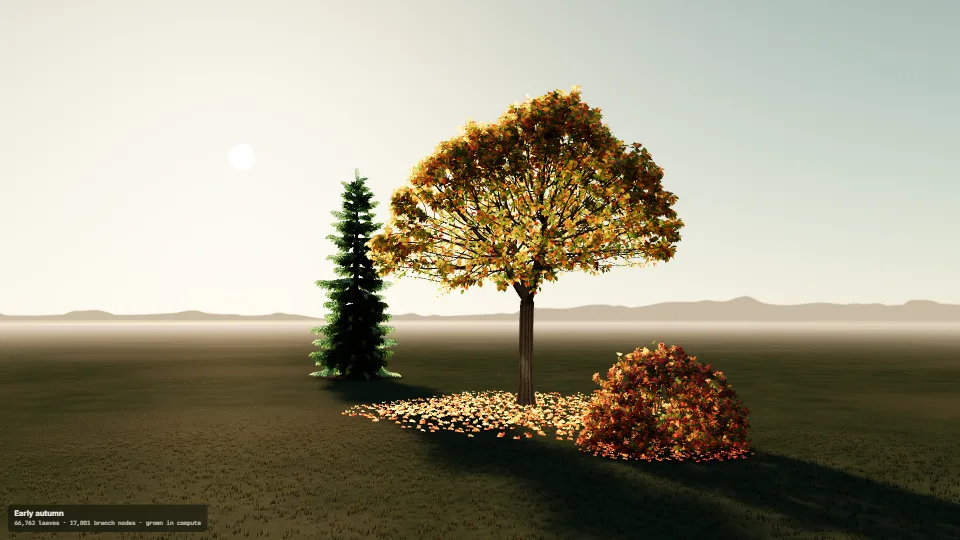
Grown in compute on the GPU: broadleaf, spruce and bush, with self-shadowed crowns and forests
A broadleaf tree, a spruce and a flowering bush grown on the GPU.
1.65 GPU · 0.35 CPU ms
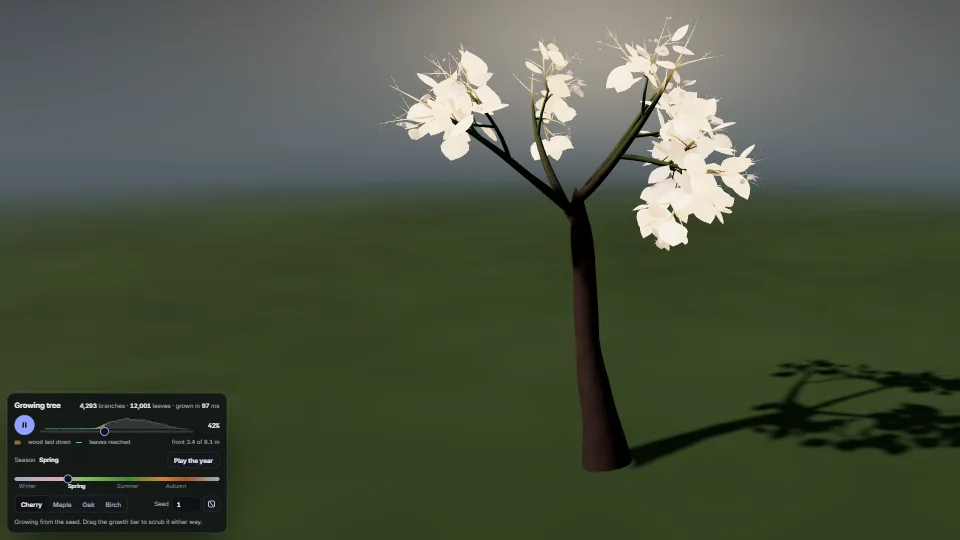
A tree grown by rule from a seed (Weber and Penn.
Measured 13 November 2026 on RTX 4060 Laptop, 13th Gen Intel(R) Core(TM) i9-13900H, Chrome 157, 1920×1080 at 1×. 600 frames × 3 rounds, median kept (rounds ranged GPU 0.82–1.03, CPU 0.28–0.52 ms). What ran: Measured growing the cherry (12,000 leaves) from seed to grown every 6 s with the front glowing, a breeze of 0.5 and a 2048 shadow map: every frame redraws the wood (about 238,000 triangles), the leaves and the shadow pass. Grown and still, it draws nothing. Phones: tiers are being measured next.
| Machine | GPU ms | CPU ms | CPU p95 |
|---|---|---|---|
| RTX 4060 Laptop · 13th Gen Intel(R) Core(TM) i9-13900Hreference · measuring tool | 0.83 | 0.49 | 0.71 |
| apple · Apple A19 Proin a browser tab · 16 November 2026 | 4.69 | 0.63 | 0.88 |
| Intel Arc 140V (Xe2-LPG) · Intel Core Ultra 7 258Vin a browser tab · 15 November 2026 | 4.06 | 1.13 | 1.54 |
Bars against one 16.7 ms frame. A browser-tab run is timed in a visible tab without the tool’s scripted input, so read it as close, not exact.
setTree): the colours and leaf size are uniforms, so a new species or seed compiles nothing.shadow.radius, or every material is built twice.SimulationGrown in compute on the GPU: broadleaf, spruce and bush, with self-shadowed crowns and forests
A broadleaf tree, a spruce and a flowering bush grown on the GPU.
From SpaciousPro. Fully custom code.
Jason Weber and Joseph Penn, “Creation and Rendering of Realistic Trees” (SIGGRAPH 1995): The tree by rule: a trunk, levels of branches by spacing, angle, length and curvature, inside a crown shape.
Kichiro Shinozaki et al., the pipe model theory (1964); Leonardo da Vinci’s rule of branching: A point’s radius from all it carries (radius^n summed over the branches beyond it); while growing, from the share of that which has grown.
Helmut Vogel, “A better way to construct the sunflower head” (1979): The golden angle (137.5°) between successive branches round a parent.
Richard L. Bishop, “There is more than one way to frame a curve” (1975): Each tube ring’s frame carried from the last without twist (a rotation-minimising frame).
Olinde Rodrigues, the rotation formula (1840): Turning a direction about an axis while a branch bends.
Tommy Ettinger, mulberry32 (public domain): The seeded random: the same seed grows the same tree everywhere.
Ken Perlin, improved noise (2002): The bark’s grain and a birch’s bands read three’s MaterialX noise node (mx_noise_float): imported, not copied.
 Simulation
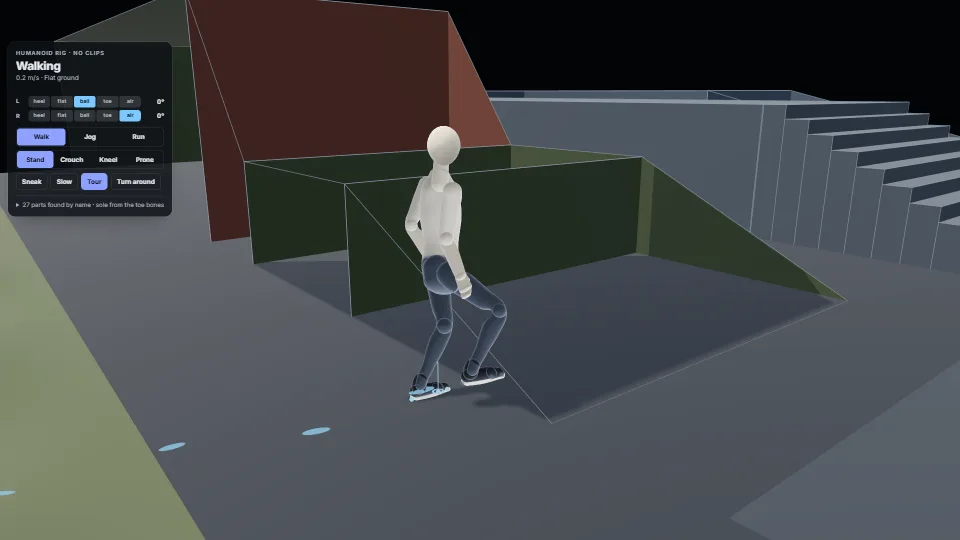
One adapter that poses any humanoid skeleton, and a walk with no clips to drive it.
 Simulation
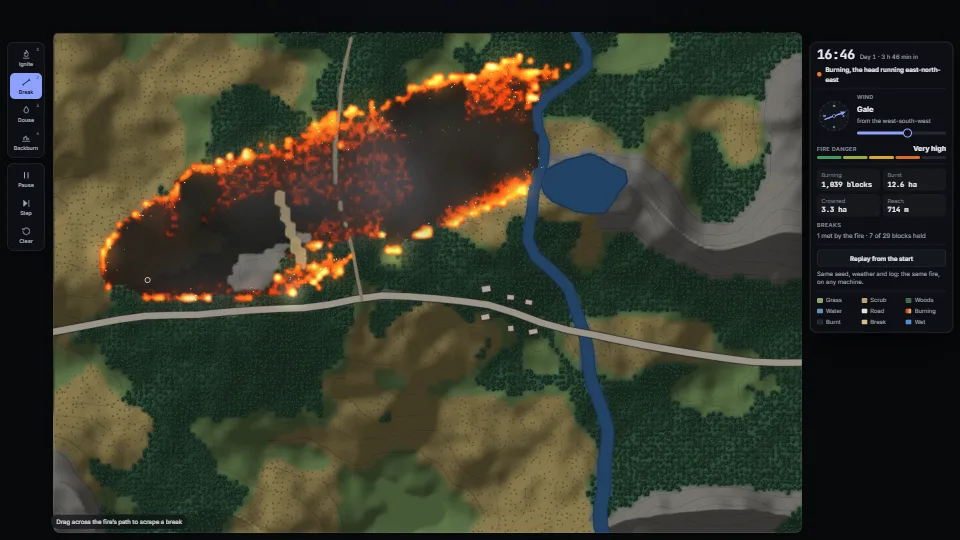
A wildfire run as pure, seeded rules a server can run as they are: 8 m blocks of grass, scrub and woods over a 1 m raster of roads and water, stepped a minute at a time.
 Simulation
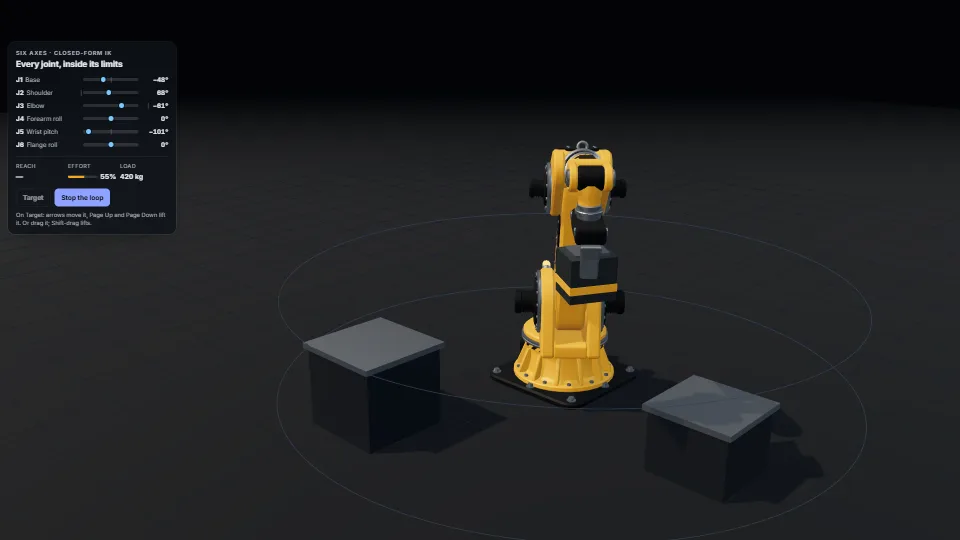
An industrial robot arm that moves like tonnes of servo-driven steel.
 Simulation
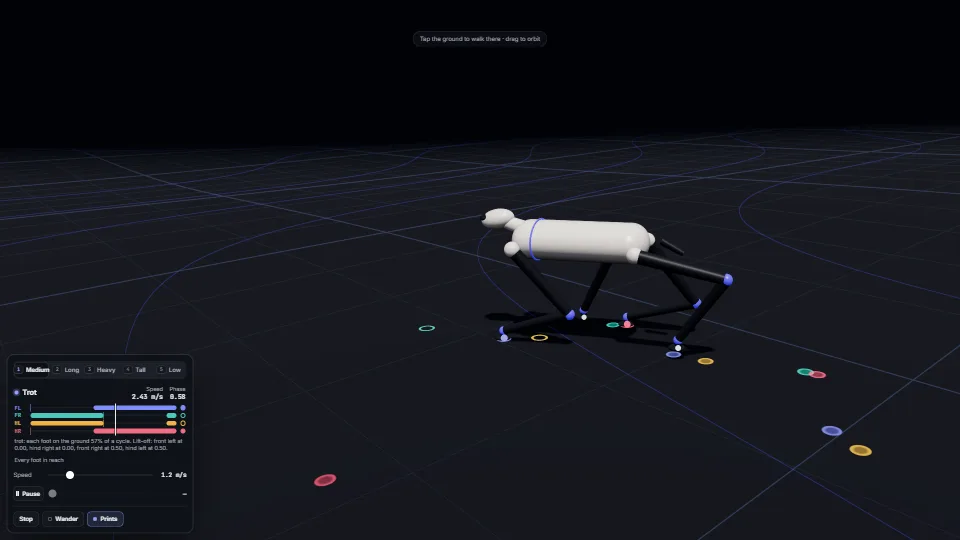
Four legs that walk, trot and run without a single animation clip.