The live demo starts when it’s in view.Watch the tour, or drive: W A S D walk · Shift runs · C crouch · V kneel · Z prone · X sneak · Q E turn on the spot · tap the ground to walk there
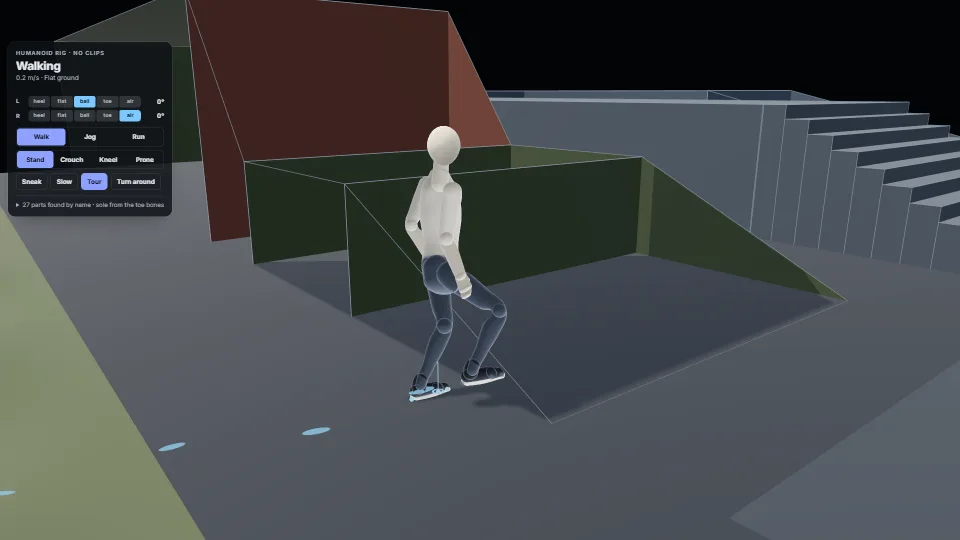
One adapter that poses any humanoid skeleton, and a walk with no clips to drive it.
What it costs a frame
GPU
0.28 ms
CPU
0.82 ms
02468101216.7 ms
GPU
0.28 ms
CPU, median
0.82 ms
CPU, 95th pct
1.21 ms
Draw calls
70
Weight
Moderate
Measured 13 November 2026 on RTX 4060 Laptop, 13th Gen Intel(R) Core(TM) i9-13900H, Chrome 157, 1920×1080 at 1×. 600 frames × 3 rounds, median kept (rounds ranged GPU 0.28–0.31, CPU 0.62–0.88 ms). What ran: The automatic tour at its own paces: the walk motor and the gait on the fixed 60 Hz tick, the skinned humanoid posed every frame by the rig (two-bone IK for each limb, feet on the ground’s normal), one SkinnedMesh of about 9,000 vertices, the course, foot contacts and prints, one shadowed key light and a room environment. Phones: tiers are being measured next.
apple · Apple A19 Proin a browser tab · 16 November 2026
1.84
0.34
1.08
Intel Arc 140V (Xe2-LPG) · Intel Core Ultra 7 258Vin a browser tab · 15 November 2026
2.10
1.39
1.92
Bars against one 16.7 ms frame. A browser-tab run is timed in a visible tab without the tool’s scripted input, so read it as close, not exact.
What it needs
Renders with
WebGPU or WebGLWebGPU where there is one, WebGL2 where there is not.
Your browser
Runs hereNo WebGPU needed
Depends on
three.js 0.187.0No other packages
What it’s for
A third-person character from any GLB (Mixamo, VRM, a game rig) walking with feet that land on the ground, no clips
NPCs and crowds on stairs, kerbs, ramps and uneven ground without foot sliding
Putting hands and feet exactly where gameplay says: a hand on a rail, a foot on a pedal
Mapping a ragdoll or a physics body back onto a skinned mesh
Checking a new rig: which bones were found, its measurements, a sole estimated or measured
A test course for tuning a walk: steps taken, a step refused, a hill, a bank too steep
Pitfalls, in brief
The model must stand on its own origin at rest, facing +Z, its left +X, the soles on y = 0: the sole is measured from that plane when the skeleton has no heel and ball markers.
Never let an AnimationMixer write the same bones in the same frame: apply() puts every driven bone back to rest first, so a clip under it is wiped.
Bones are compared by normalised name (case, separators and namespaces such as mixamorig:, Armature| and DEF- dropped).
Lengths are measured once, at construction, from the rest pose the model is in then.
Clone a skinned model per body with SkeletonUtils.clone, never Object3D.clone: a plain clone shares one skeleton, and every body would pose the same bones.
9 more in brief
A foot tilts to the ground only where heel and ball agree with the normal (within 3 cm).
The gait reads edges by asking height() along lines a few centimetres apart, each point asked near the last one’s height (so stairs are climbed in the query as they are on foot): about 80 to 150 height() calls a swinging foot a tick near steps, a handful on open ground.
The hips stand over the planted feet, not over the motor’s y: going down a step they come down through the swing, going up they rise as the leg on the step above straightens.
On stairs the stride is a whole number of treads and the pace has to allow one tread a step (3.3 steps a second at most): walkStep holds a body to stairPace() on stairs (0.96 m/s on the course’s 0.32 m treads).
The gait runs on fixed ticks of at most 1/30 s (step throws on a longer, zero or NaN one; the walk motor caps its tick at 0.05 s and treats a NaN one as 0; tick both at 1/60 s from an accumulator, as the demo does) and reads the motor’s collision-resolved velocity, not the input: feed it moveX/moveZ from walkStep (or your own controller’s actual motion), or the feet slide when a wall stops the body.
A course or world that answers "the one below" for a point inside a slope makes the walk read a cliff where there is a climb: answer a slope’s surface however high, and keep the reach rule for steps (kerbs, stairs), as course.ts does.
Stances assume level ground under the body: a kneel or prone pose is solved in the body’s own space and laid on the ground with the body’s height there.
The demo’s default figure is a 250 KB GLB loaded at start (walker.glb, imported with ?url); the mannequin made in code costs nothing to load and stays the choice for a project with no model.
The rig allocates nothing per frame, but apply() costs a bone-matrix walk per limb: for a crowd, pose distant bodies at a lower rate and draw them from a bake (see crowd-bake).
14 pitfalls in full, the hook-up guide, the module source and its tests come with the part.
Where it comes from
From HaTac, and in the garden walk showcase. Fully custom code.
humanoidskinned meshskeletonretargetbone namesmixamoinverse kinematicstwo-bone ikfoot placementfoot rollground normallocomotionprocedural animationgaitsneakcrouchkneelpronecrawlturn on the spotslopesstairsstep clearancetoe clearance
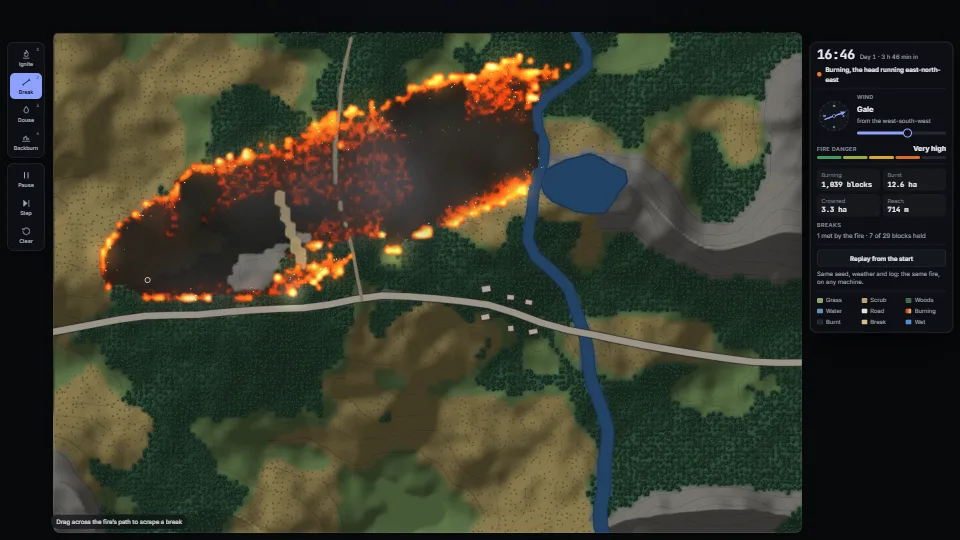
A wildfire run as pure, seeded rules a server can run as they are: 8 m blocks of grass, scrub and woods over a 1 m raster of roads and water, stepped a minute at a time.
 Simulation
 Simulation
 Simulation
 Simulation