Small vehicle models: helicopter, airboat, springs and a grapple line
0.49 GPU · 0.56 CPU ms
Still
The live demo starts when it’s in view.1 to 4 pick a model · W A S D drive · Space and Shift lift or brake · Q E turn or reel · drag to look round · R puts it back
Four small, pure models of how things move, each stepped with plain ground functions and no physics engine.
What it costs a frame
GPU
0.49 ms
CPU
0.56 ms
02468101216.7 ms
GPU
0.49 ms
CPU, median
0.56 ms
CPU, 95th pct
0.79 ms
Draw calls
58
Weight
Moderate
Measured 13 November 2026 on RTX 4060 Laptop, 13th Gen Intel(R) Core(TM) i9-13900H, Chrome 157, 1920×1080 at 1×. 600 frames × 3 rounds, median kept (rounds ranged GPU 0.46–0.66, CPU 0.42–0.63 ms). What ran: Measured flying the helicopter by itself: it spools up, climbs to about 8 m and flies a wide left circle past the posts. The airboat, the car and the figure are stepped too, parked (they cost almost nothing at rest). Standing still with every rotor stopped, nothing is drawn. Phones: tiers are being measured next.
apple · Apple A19 Proin a browser tab · 16 November 2026
2.07
0.16
0.26
Intel Arc 140V (Xe2-LPG) · Intel Core Ultra 7 258Vin a browser tab · 15 November 2026
3.11
1.20
1.70
Bars against one 16.7 ms frame. A browser-tab run is timed in a visible tab without the tool’s scripted input, so read it as close, not exact.
What it needs
Renders with
WebGPU or WebGLWebGPU where there is one, WebGL2 where there is not.
Your browser
Runs hereNo WebGPU needed
Depends on
NothingNo other packages
What it’s for
A flyable helicopter in an open world
Boats on lakes, rivers and marsh
Cars whose bodies pitch and roll on their springs
A swinging grapple or rope
Vehicles stepped on a server or in tests
Tuning panels for vehicle feel
Pitfalls, in brief
Step at a fixed rate near 60 Hz, or split a long frame into steps of at most 1/60 s: the tuning (spool rates, flare, spring rates) was set at 60 Hz, and one 100 ms step lets a stiff spring or a fast helicopter tunnel and ring.
Heading 0 faces -z and positive heading turns left, in every model.
Pitch is nose up and roll is the right side up: draw with rotation order YXZ (yaw, then pitch, then roll), as set(pitch, heading, roll, "YXZ").
Give the helicopter the height it can stand on (the ground, roofs, a pad) and the airboat and the car only the terrain, with the pad as solid: a car whose wheels read a roof’s height through a wall climbs it.
A helicopter lifts only once the rotor is 70 % spun: holding the collective from a stop does nothing for most of spoolUp.
7 more in brief
Keep touchdownSpeed under hardLanding (heliIssues says so): otherwise every held descent ends in a hard landing.
The airboat’s rudders need air on them: stopped with the fan idle it does not turn at all.
The airboat’s top speed comes from thrust per kilo: change the mass and keep the thrust, and it runs faster or slower than topSpeedKmh (by design: a heavier boat is slower).
The suspension has no rollover solver: it bounds the cornering moment short of tipping, so a body goes up on two wheels for a moment but never over.
Swap the helicopter’s config for a new object to retune it (heli.config = { ...heli.config, topSpeed }): its airframe columns are worked out once per config object.
A grapple plan is null when the hold is not 1.5 m over the hands or the arc would not clear the ground: tell the player why (too close under it, or out of reach), not just that it failed.
Models you are not driving still need stepping with PARKED controls: an unflown helicopter in the air comes down and parks itself, a boat on water keeps riding the swell, and a figure on a grapple line swings on and lands (the demo steps it with no keys while another model is driven).
12 pitfalls in full, the hook-up guide, the module source and its tests come with the part.
A planet to put a story on: land and sea from Natural Earth, the sun rising over the edge through an atmosphere, its glint on the water, city lights on the…
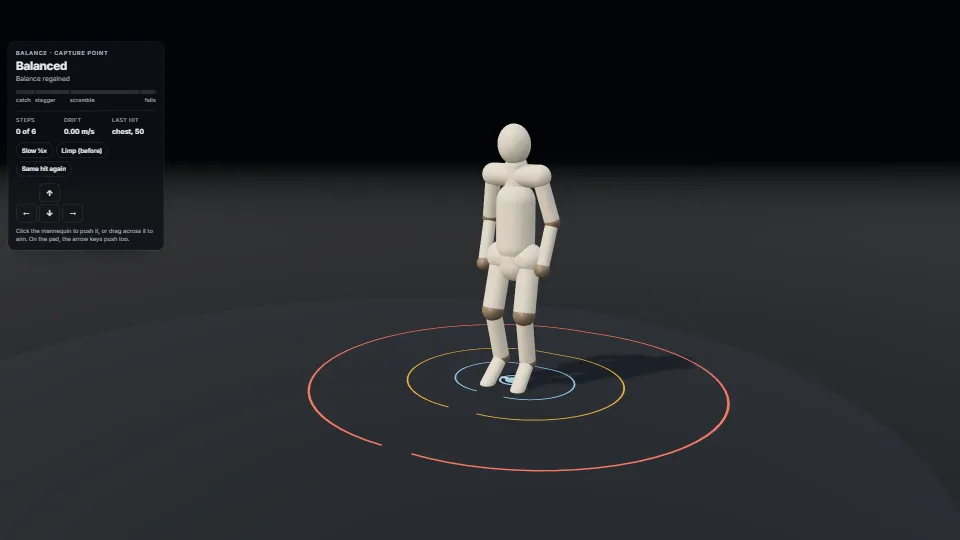 Simulation
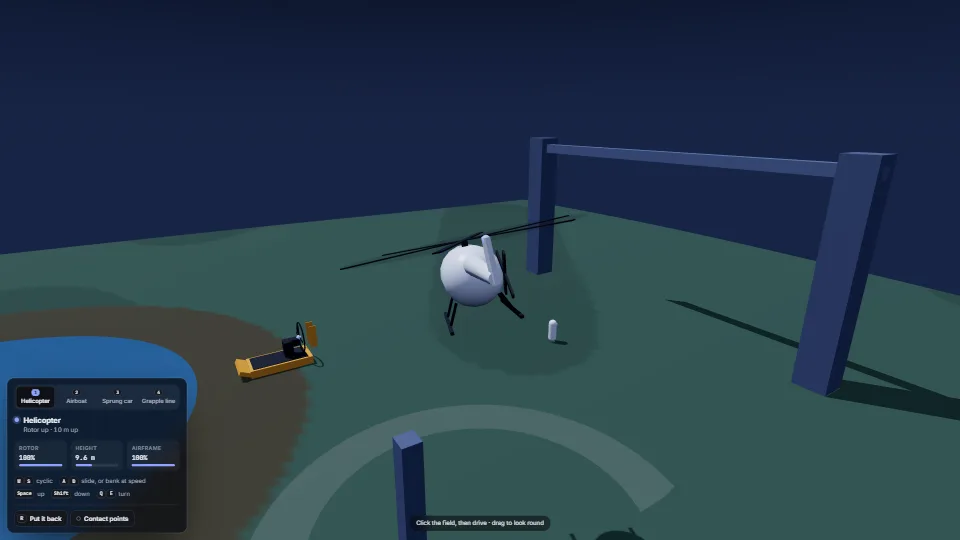
 Simulation
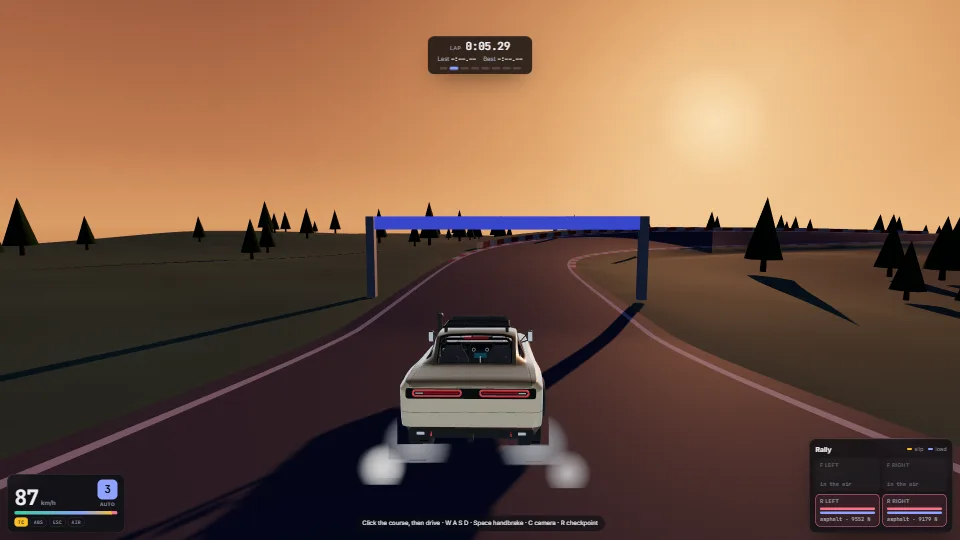 Simulation
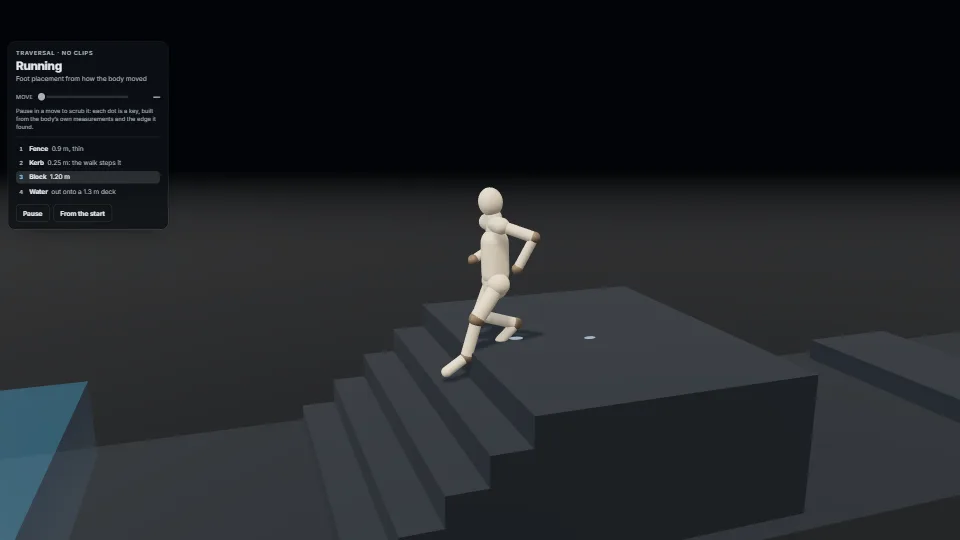 Simulation