 Simulation
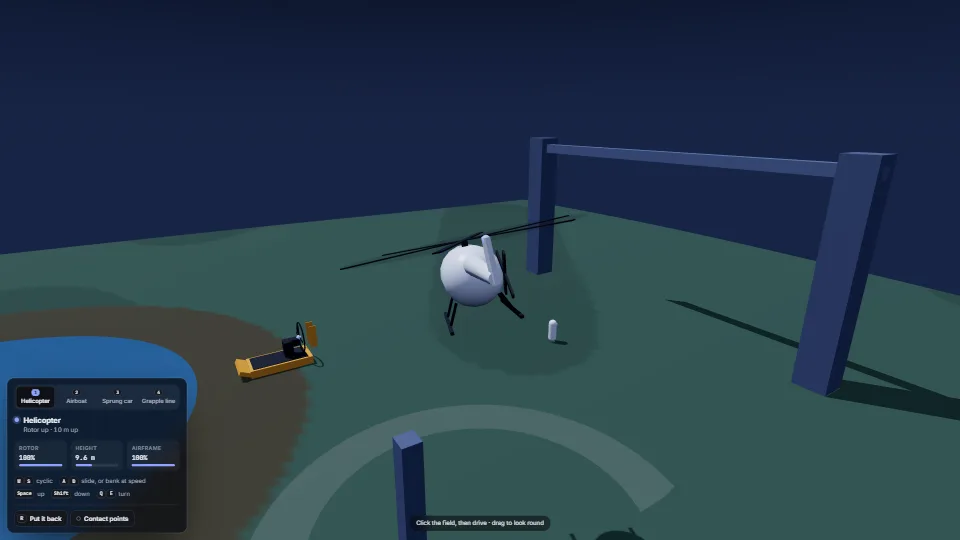
Small vehicle models: helicopter, airboat, springs and a grapple line
Four small, pure models of how things move, each stepped with plain ground functions and no physics engine.
0.49 GPU · 0.56 CPU ms
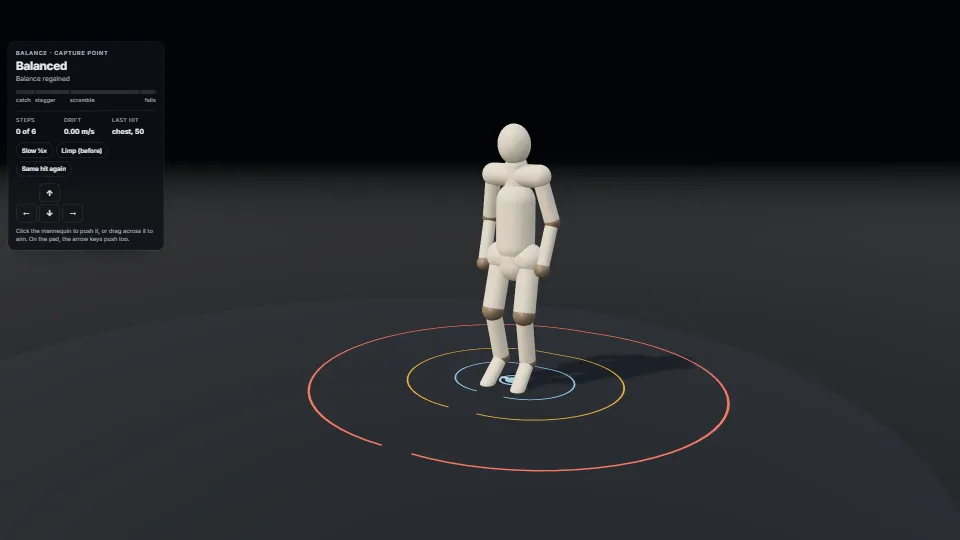
A pushed body that decides, the same way every time, whether it catches itself.
Measured 13 November 2026 on RTX 4060 Laptop, 13th Gen Intel(R) Core(TM) i9-13900H, Chrome 157, 1920×1080 at 1×. 600 frames × 3 rounds, median kept (rounds ranged GPU 0.32–0.52, CPU 0.41–0.44 ms). What ran: Knocked over by a 420 N·s chest hit on its first frame, so the measured frames are the controlled fall; after that it pushes itself every 2.4 s while standing, round the compass and at different parts, alternating a sway, a stagger and a fall: the balance and catch steps, or the controlled fall (shape matching, reach, limits) and the get-up through poses, on the fixed 60 Hz tick; the mannequin as three instanced meshes, one shadowed key light and a room environment. Phones: tiers are being measured next.
| Machine | GPU ms | CPU ms | CPU p95 |
|---|---|---|---|
| RTX 4060 Laptop · 13th Gen Intel(R) Core(TM) i9-13900Hreference · measuring tool | 0.49 | 0.41 | 0.65 |
| apple · Apple A19 Proin a browser tab · 16 November 2026 | 1.67 | 0.28 | 0.54 |
| Intel Arc 140V (Xe2-LPG) · Intel Core Ultra 7 258Vin a browser tab · 15 November 2026 | 2.03 | 0.65 | 1.06 |
Bars against one 16.7 ms frame. A browser-tab run is timed in a visible tab without the tool’s scripted input, so read it as close, not exact.
From HaTac. Fully custom code.
Jerry Pratt, John Carff, Sergey Drakunov & Ambarish Goswami, Capture Point: A Step toward Humanoid Push Recovery (Humanoids 2006): The point a pushed body must step to: its position plus its velocity over a time constant, checked against the support between the feet.
Thomas Jakobsen, Advanced Character Physics (GDC 2001): The ragdoll’s method: Verlet particles for joints, distance constraints relaxed in a few passes, collisions as projections.
Numerical Recipes (Press et al.): The LCG constants (1664525, 1013904223) behind the seeded bracing gesture.
Matthias Müller, Bruno Heidelberger, Matthias Teschner & Markus Gross, Meshless Deformations Based on Shape Matching (SIGGRAPH 2005): The fading muscle tone: joints pulled toward their standing shape, best-fit rotated, in two clusters.
Matthias Müller, Jan Bender, Nuttapong Chentanez & Miles Macklin, A Robust Method to Extract the Rotational Part of Deformations (MIG 2016): The quaternion iteration that finds each cluster’s rotation, warm-started each step.
Wilfrid Dempster (1955), via David Winter, Biomechanics and Motor Control of Human Movement: The segment masses lumped onto the joints (mass.ts MASS_SHARE).
Fay Horak & Lewis Nashner, Central programming of postural movements (Journal of Neurophysiology 1986): The ankle and the hip strategy, before a step.
A. M. Andrew, Another efficient algorithm for convex hulls in two dimensions (1979): The monotone chain that outlines the feet.
SimulationFour small, pure models of how things move, each stepped with plain ground functions and no physics engine.
 Simulation
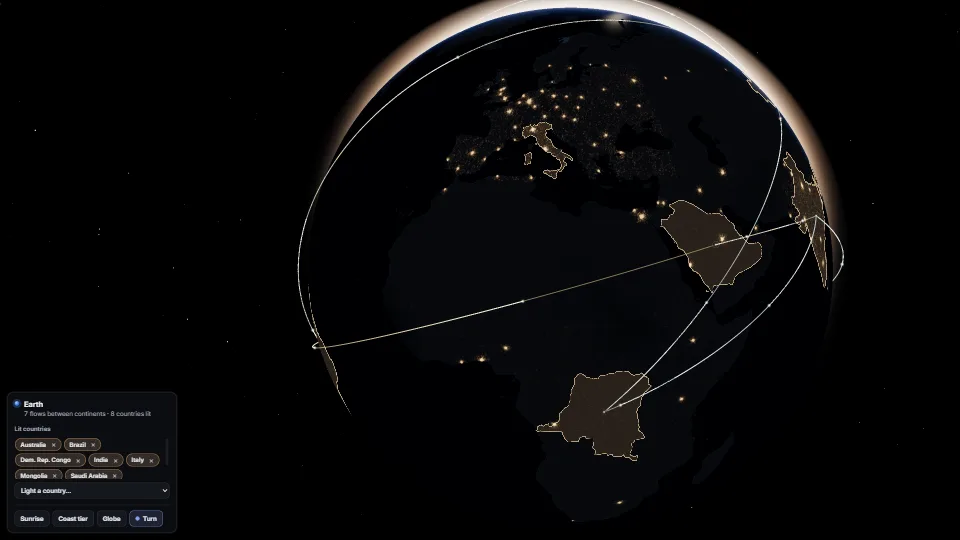
A planet to put a story on: land and sea from Natural Earth, the sun rising over the edge through an atmosphere, its glint on the water, city lights on the…
 Simulation
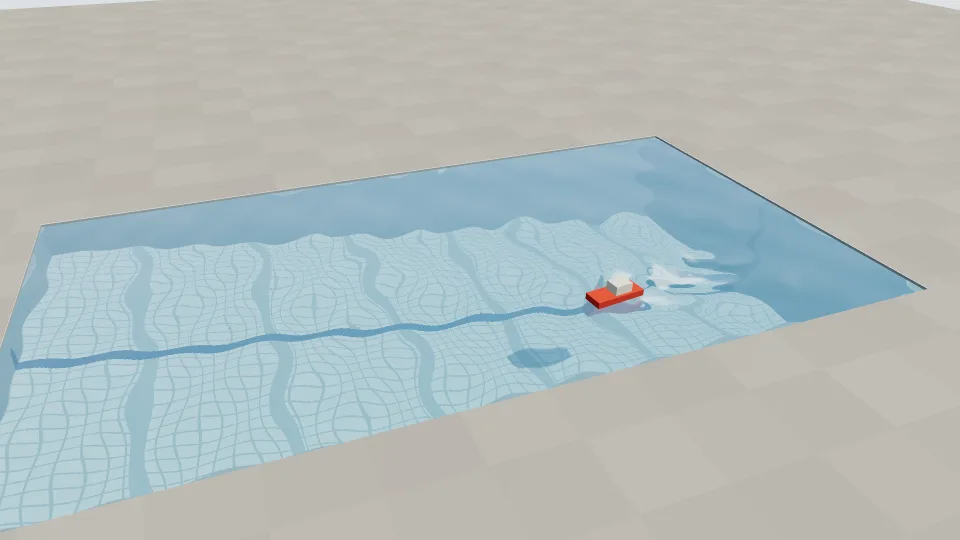
The wave equation as compute on a ring of cells that follows the camera, a smooth Catmull-Rom read, an absorbing edge and a coarse second field for long wakes…
 Simulation
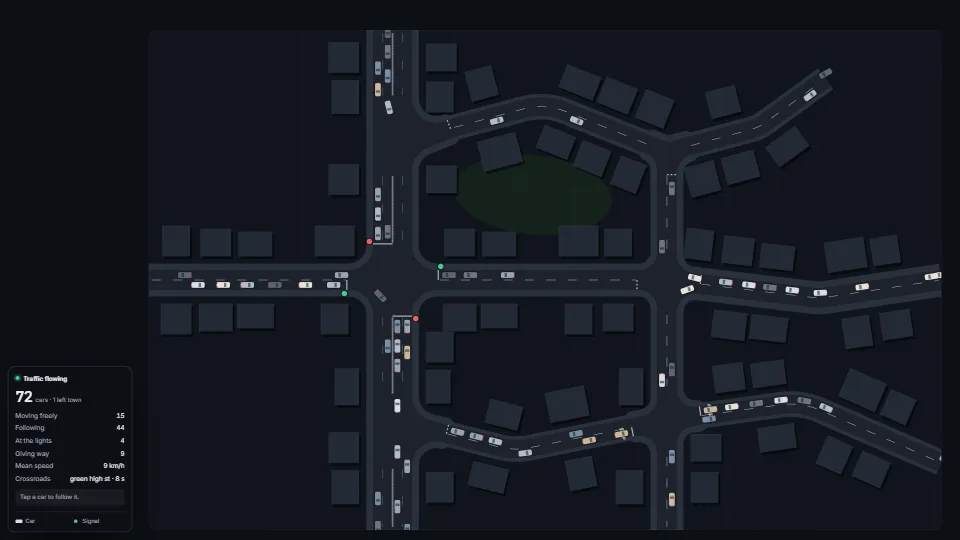
Roads as plain data (nodes, edges drawn through bends and rounded to arcs, a type on each) laid out into junctions with kerb returns and setbacks, then…