 Simulation
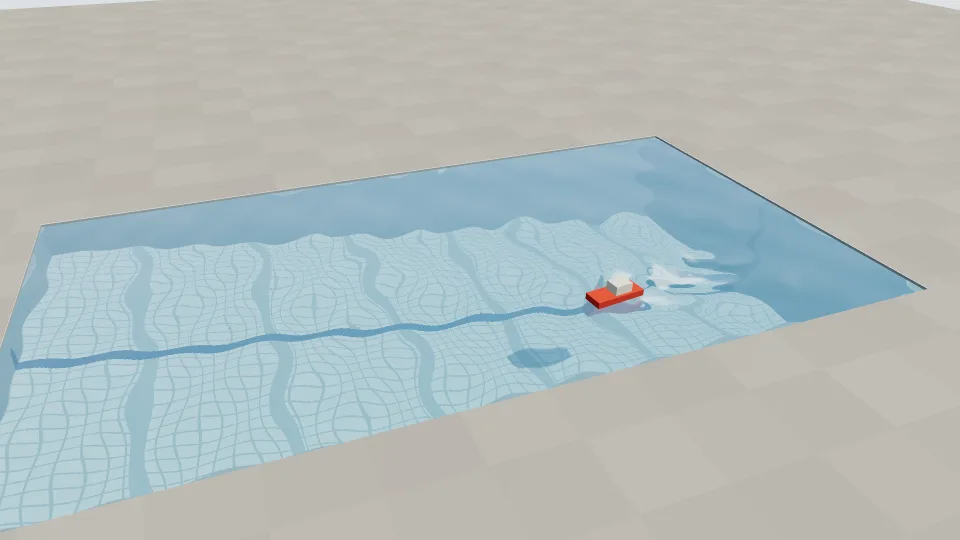
Water ripples, wakes & caustics
The wave equation as compute on a ring of cells that follows the camera, a smooth Catmull-Rom read, an absorbing edge and a coarse second field for long wakes…
0.32 GPU · 0.23 CPU ms
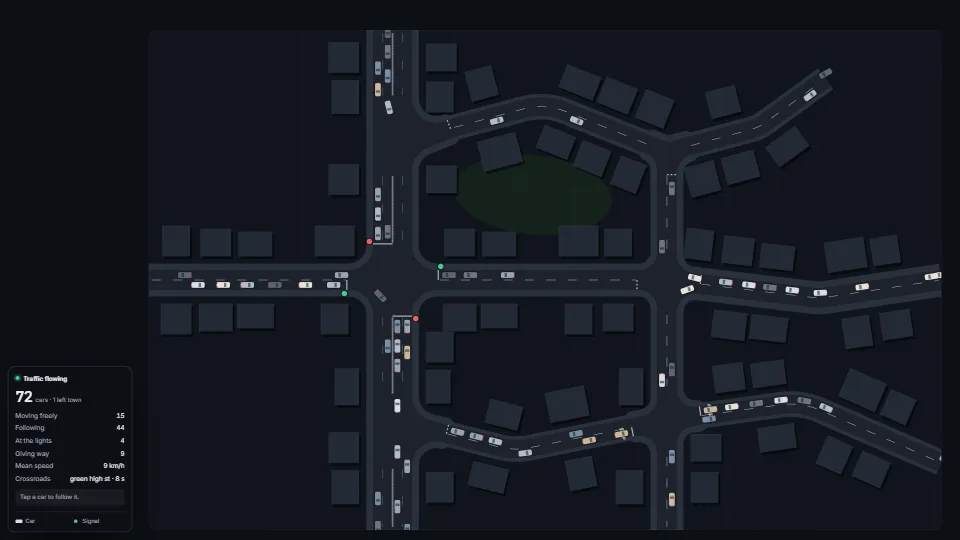
Roads as plain data (nodes, edges drawn through bends and rounded to arcs, a type on each) laid out into junctions with kerb returns and setbacks, then…
Measured 13 November 2026 on RTX 4060 Laptop, 13th Gen Intel(R) Core(TM) i9-13900H, Chrome 157, 1920×1080 at 1×. 600 frames × 3 rounds, median kept (rounds ranged CPU 0.29–0.34 ms). What ran: Measured running at 20 new cars a minute on each road in (about 100 cars at once): every car decides and moves every 1/20 s of simulated time, and the frame includes the Canvas 2D drawing of the cars, lights and overlays over a cached road layer. Phones: tiers are being measured next.
| Machine | GPU ms | CPU ms | CPU p95 |
|---|---|---|---|
| RTX 4060 Laptop · 13th Gen Intel(R) Core(TM) i9-13900Hreference · measuring tool | not timed | 0.31 | 0.48 |
| apple · Apple A19 Proin a browser tab · 16 November 2026 | not timed | 0.68 | 1.36 |
| Intel Arc 140V (Xe2-LPG) · Intel Core Ultra 7 258Vin a browser tab · 15 November 2026 | not timed | 0.50 | 0.89 |
Bars against one 16.7 ms frame. A browser-tab run is timed in a visible tab without the tool’s scripted input, so read it as close, not exact.
TRAFFIC_STEP) and keeps the rest of dt for the next call, so the same seed gives the same traffic at any frame rate; pose(car) looks ahead by that rest, so cars glide.From HaTac. Fully custom code.
Treiber, Hennecke and Helbing, the Intelligent Driver Model (2000): Car following: the desired gap s0 + vT + v·Δv / 2√(ab) and the acceleration a[1 − (v/v0)⁴ − (s*/s)²]. The published model, not code.
Dijkstra’s shortest paths (1959): Routing over lane paths, with arriving at the goal as a node of its own.
George Marsaglia, xorshift generators (2003): The seeded generator behind spawning and choices.
Fowler–Noll–Vo hash (FNV-1a): Each junction’s signal offset from its id.
SimulationThe wave equation as compute on a ring of cells that follows the camera, a smooth Catmull-Rom read, an absorbing edge and a coarse second field for long wakes…
 Simulation
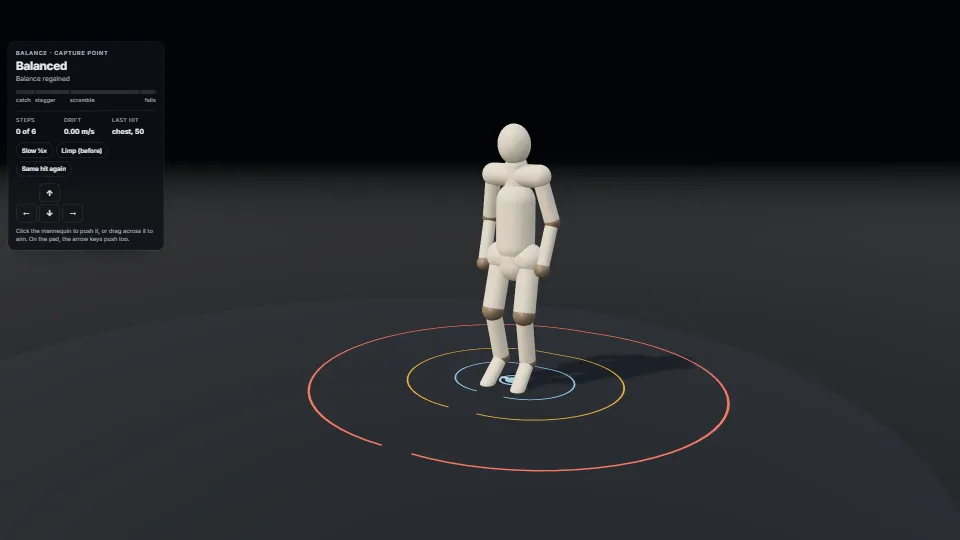
A pushed body that decides, the same way every time, whether it catches itself.
 Simulation
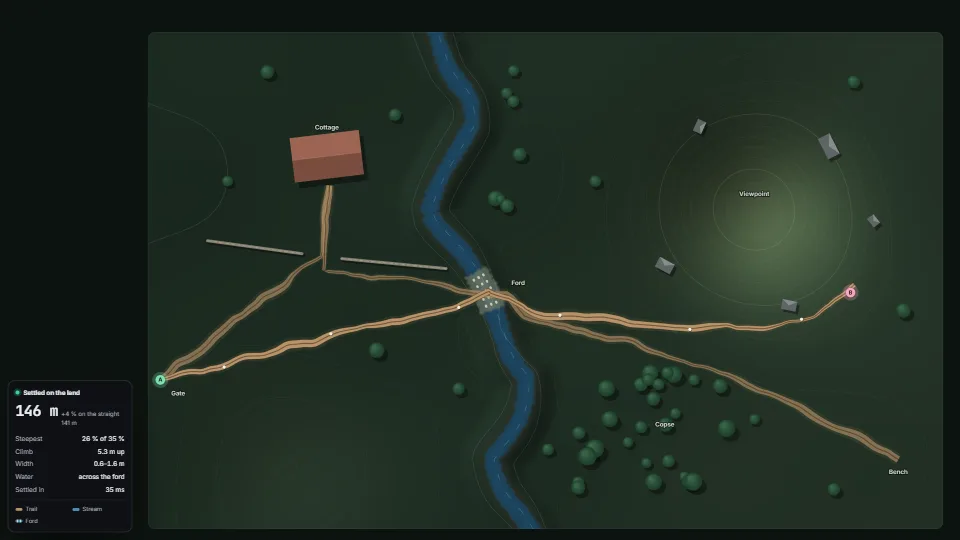
The trail people would wear between two places, worked out from the land.
 Simulation
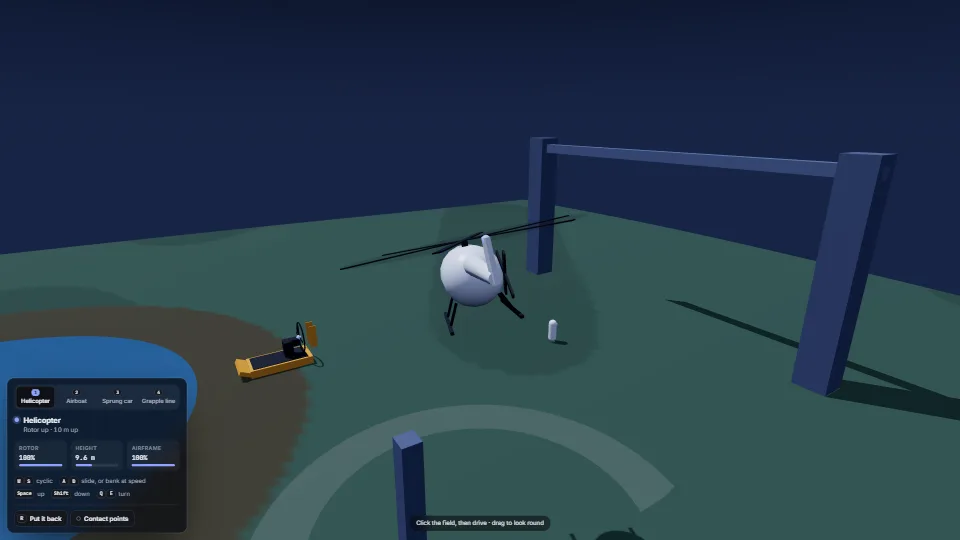
Four small, pure models of how things move, each stepped with plain ground functions and no physics engine.