 Simulation
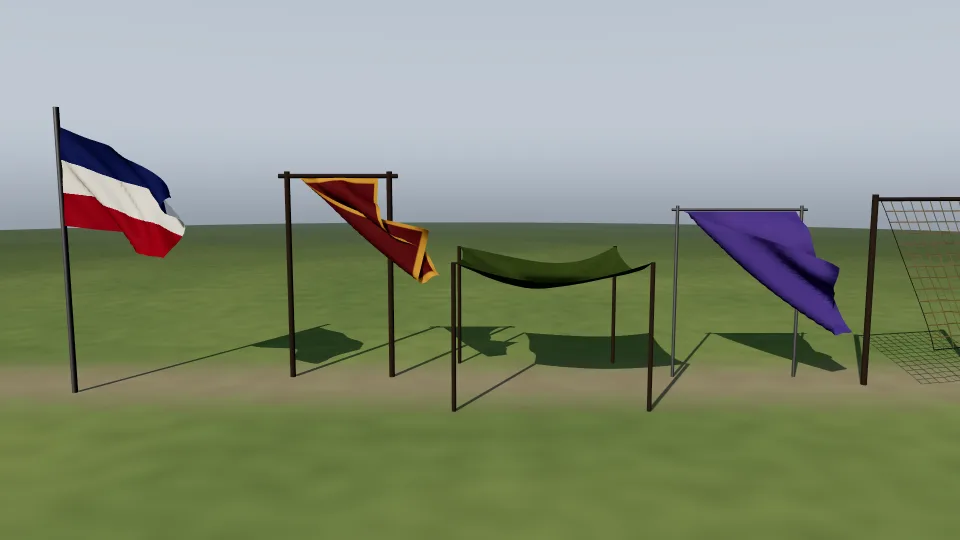
GPU cloth
In three.js TSL: flags, banners, tarps and nets in wind, torn by shots along a ray; no DOM, no loads, no link health.
Flags, banners, tarps, curtains and nets in one compute pass and one draw.
0.93 GPU · 0.29 CPU ms
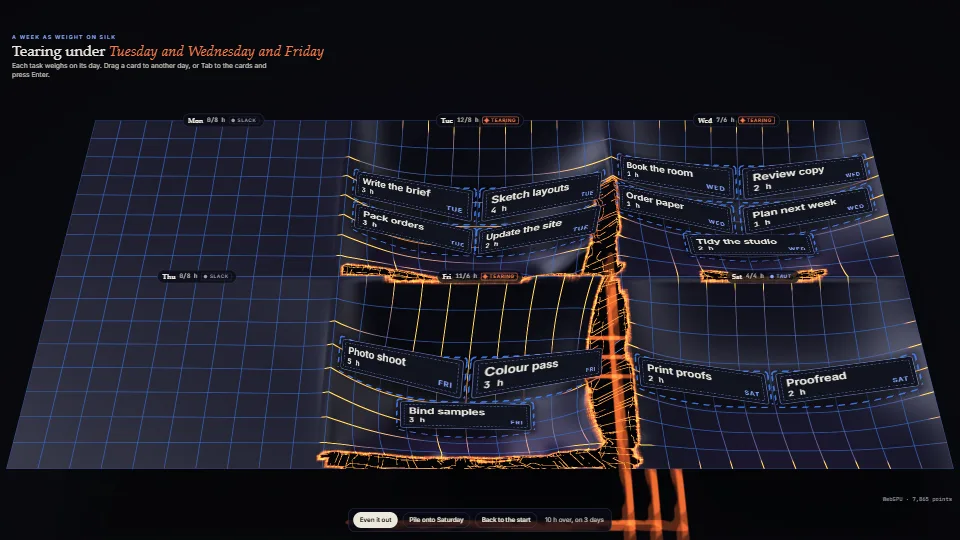
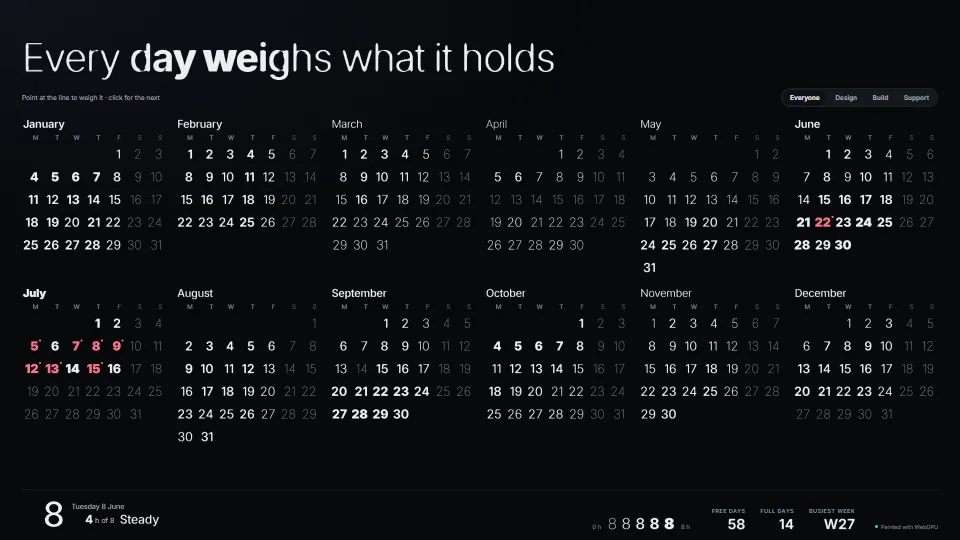
Real, selectable DOM text riding a cloth simulated on the GPU.
Measured 14 November 2026 on RTX 4060 Laptop, 13th Gen Intel(R) Core(TM) i9-13900H, Chrome 157, 1920×1080 at 1×. 600 frames × 3 rounds, median kept (rounds ranged GPU 1.45–2.36, CPU 0.21–0.23 ms). What ran: Measured on the sheet: 6 panels, 7,865 points, 3 substeps of 15 Jacobi passes a frame, 14 cards read back as 56 probes. A card is moved to another day every 1.2 s, so the cloth never rests and the readback and matrix3d placement run every frame. Phones: tiers are being measured next.
| Machine | GPU ms | CPU ms | CPU p95 |
|---|---|---|---|
| RTX 4060 Laptop · 13th Gen Intel(R) Core(TM) i9-13900Hreference · measuring tool | 1.75 | 0.21 | 0.34 |
| apple · Apple A19 Proin a browser tab · 16 November 2026 | 14.0 | 0.24 | 0.34 |
| Intel Arc 140V (Xe2-LPG) · Intel Core Ultra 7 258Vin a browser tab · 15 November 2026 | 6.95 | 0.34 | 0.67 |
Bars against one 16.7 ms frame. A browser-tab run is timed in a visible tab without the tool’s scripted input, so read it as close, not exact.
Frames run on a 60 Hz timer (a page demo), so most frames take about one tick, 16.7 ms: the spread around it is what matters.
transform-origin: 0 0 and must sit at its container’s (0, 0), the same origin the camera’s W × H uses.SimulationIn three.js TSL: flags, banners, tarps and nets in wind, torn by shots along a ray; no DOM, no loads, no link health.
Flags, banners, tarps, curtains and nets in one compute pass and one draw.
From HaTac. Fully custom code.
Thomas Jakobsen, Advanced Character Physics (GDC 2001): Verlet integration with constraints relaxed toward rest lengths, the method under the cloth.
Mark Jarzynski & Marc Olano, Hash Functions for GPU Rendering (JCGT, 2020): The PCG hash behind the crack lines and the fibres, the same on the GPU and the CPU.
Paul Heckbert, Fundamentals of Texture Mapping and Image Warping (1989): The closed-form square-to-quad homography that quadMatrix turns into a CSS matrix3d.
Inigo Quilez, 2D distance functions: The box distance that puckers the silk round each card, re-written in WGSL.
 UI & interaction
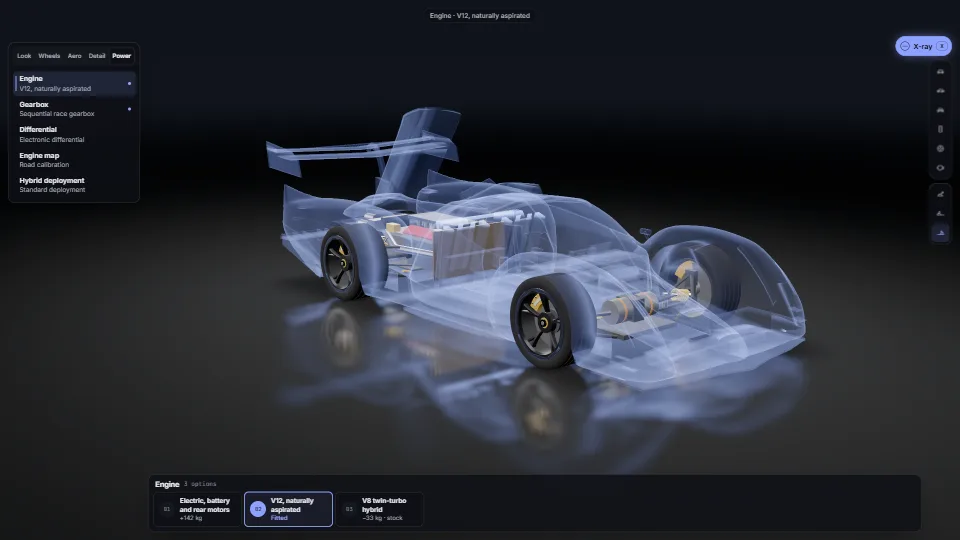
A staged bay for any glTF vehicle whose parts are named nodes.
 UI & interaction
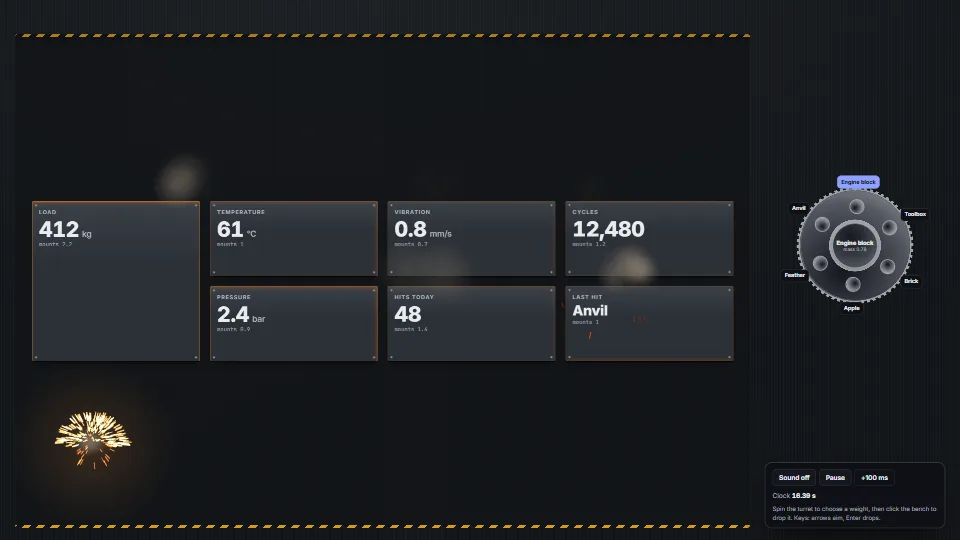
One event, felt everywhere: impact({ x, y, mass }) makes every [data-body] element dip, rock and ring down on its shock mounts by its distance and its own…
 UI & interaction
One distance-field atlas holds a thin and a black cut of a typeface in its red and green channels, every glyph in the same fixed cell, so mixing the channels…
 UI & interaction
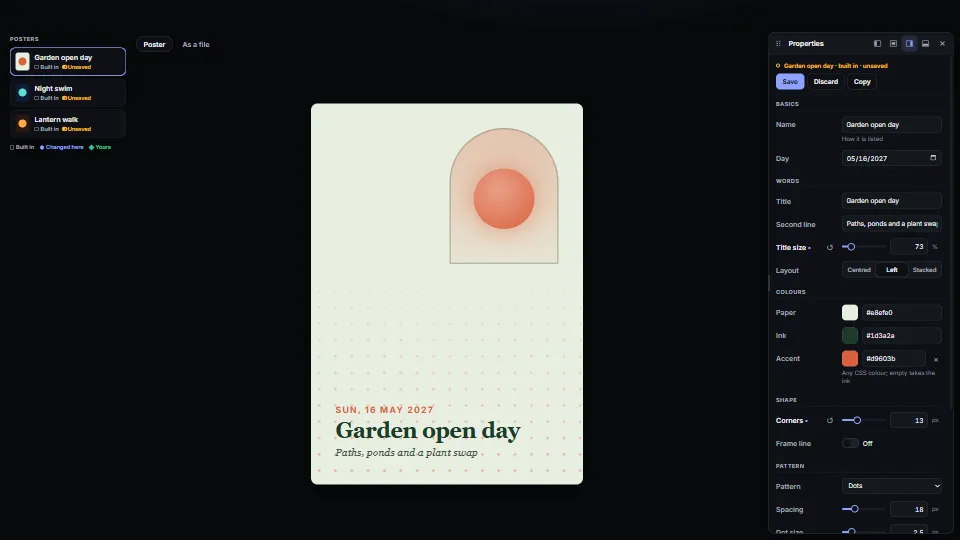
An inspector built from a description of the settings.