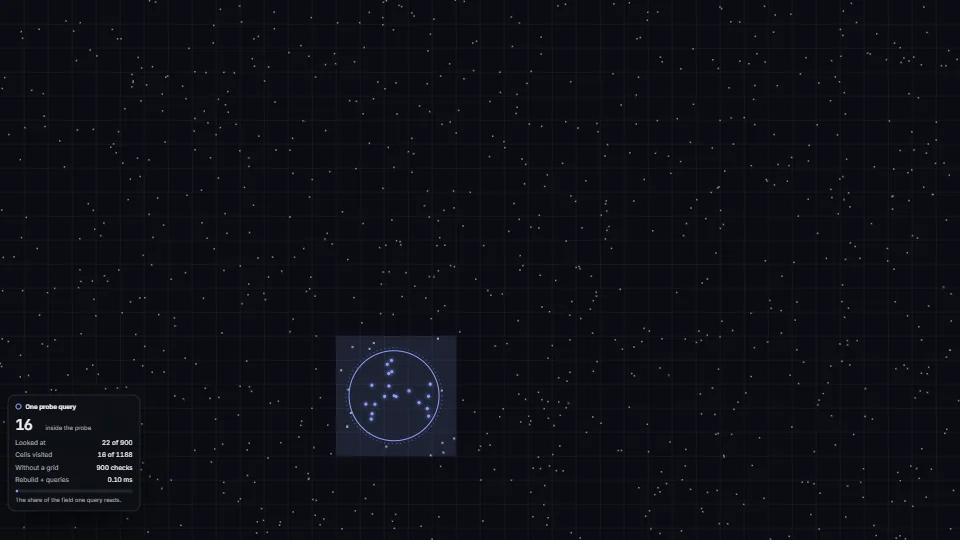
The live demo starts when it’s in view.Move the pointer over the field (or focus it and use the arrow keys) to move the probe · Cells shows what one query visits
The neighbour search under a 2D action game.
The neighbour search under a 2D action game: hundreds of bodies dropped into a uniform grid every tick in O(n) (a head per cell and a next per body, two typed arrays), then asked "who is near this circle?" by visiting only the cells it touches. The answer lands in a scratch array, so a tick of pushes, hit tests and nearest-enemy searches allocates nothing. A cell query (a superset) and an exact one; plain functions over typed-array columns, no dependencies, tested against brute force.
What it costs a frame
CPU
0.41 ms
02468101216.7 ms
GPU
not used
CPU, median
0.41 ms
CPU, 95th pct
0.69 ms
Draw calls
0
Weight
Light
Measured 21 November 2026 on RTX 4060 Laptop, 13th Gen Intel(R) Core(TM) i9-13900H, Chrome 157, 1920×1080 at 1×. 600 frames × 3 rounds, median kept (rounds ranged CPU 0.40–0.42 ms). What ran: Alone: 900 points drift, the grid is rebuilt every frame and the probe sweeps the field with one exact circle query; the frame includes the Canvas 2D drawing. Phones: tiers are being measured next.
How steadily it runs on RTX 4060 Laptop · 13th Gen Intel(R) Core(TM) i9-13900H · reference
Typical frame ?
16.77 ms
1% low ?
54 fps
Varies by ?
±0.45 ms
All metricsRTX 4060 Laptop · 13th Gen Intel(R) Core(TM) i9-13900H · referenceHow long each frame took. Most frames sit in the tall bars; a long tail to the right is hitching.
Frames run on a 60 Hz timer (a page demo), so most frames take about one tick, 16.7 ms: the spread around it is what matters.
Frames
Median (p50) ?
16.77 ms
p95 ?
17.66 ms
p99 ?
18.07 ms
Slowest ?
18.96 ms
Mean ?
16.82 ms
Standard deviation ?
0.45 ms
1% low ?
54 fps
0.1% low ?
53 fps
Hitches ?
0 of 600
Over budget ?
0 of 600
Main thread
Long tasks ?
0
Long frames ?
0
Event-loop delay ?
0.1 / 0.9 / 1.1 ms
Input
No input during this run.
Memory
JavaScript heap ?
34.3 → 34.6 MB
Growth ?
+0.36 MB
Browser
JavaScript a frame ?
0.56 ms
All tasks a frame ?
1.04 ms
Layout / style ?
0.05 / 0.01 ms
Main thread busy ?
6%
Garbage collection
Collections ?
0 (0 minor, 0 major)
Pauses ?
0.0 ms in all, longest 0.0
What it needs
Renders with
Canvas 2DA 2D canvas: every current browser.
Your browser
Runs hereNo WebGPU needed
Depends on
NothingNo other packages
With an agent
install("spatial-grid-2d")Your coding agent reads its pitfalls and installs it through the library’s MCP server. Set it up
What it’s for
A swarm that keeps apart, so hundreds read as many and not one blot
Hit tests for shots, beams and blasts against a crowd
The nearest enemy for auto-aim, or pickups within a magnet radius
Particles or boids that react to their neighbours
Hover and lasso picking over thousands of points on a 2D chart or map
Pitfalls, in brief
g.hits is shared scratch: the next query overwrites it.
queryCircle is a superset (everything in the touched cells): test the distance yourself, or call queryWithin.
Rebuild once a tick, after everything has moved and before anything queries.
Indices are positions in your columns.
Pick the cell near your common query radius.
1 more in brief
The capacity is fixed when you create it (nextIn and hits are that long); a query that finds more than that stops at capacity.
6 pitfalls in full, the hook-up guide, the module source and its tests come with the part.
Where it comes from
From another of the maker’s apps. Fully custom code.
 Systems & toolingNew
 Systems & toolingNew
 Systems & toolingNew
 Systems & toolingNew