 Screen effects
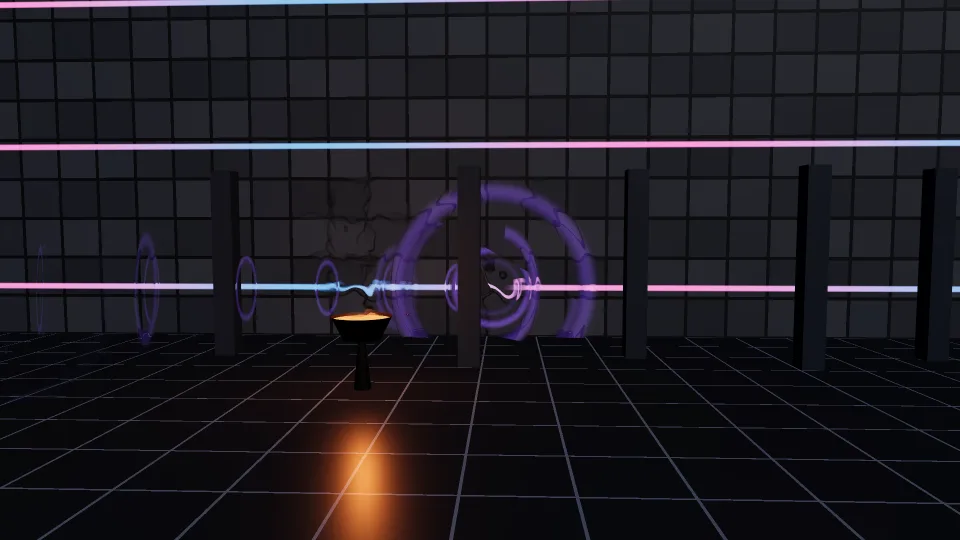
Heat haze & shockwave rings
Air that bends what is behind it: shimmering heat over fires and blasts, and sonic shockwaves (rings, shells and a flying core) animated on the GPU from their…
0.21 GPU · 0.23 CPU ms

Six ways from one picture to the next on WebGPU.
Measured 11 November 2026 on 13th Gen Intel(R) Core(TM) i9-13900H, Chrome 157, 1920×1080 at 1×. 600 frames × 3 rounds, median kept. What ran: Plays all six transitions back to back, one picture to the next, at the stage’s size: one full-screen pass each (the shatter adds 288 shard triangles over it), timed with its own timestamp queries. Phones: tiers are being measured next.
| Machine | GPU ms | CPU ms | CPU p95 |
|---|---|---|---|
| unknown GPU · 13th Gen Intel(R) Core(TM) i9-13900Hreference · measuring tool | 0.28 | <0.01 | <0.01 |
| apple · Apple A19 Proin a browser tab · 16 November 2026 | 6.15 | <0.01 | 0.02 |
| Intel Arc 140V (Xe2-LPG) · Intel Core Ultra 7 258Vin a browser tab · 15 November 2026 | 0.33 | <0.01 | <0.01 |
Bars against one 16.7 ms frame. A browser-tab run is timed in a visible tab without the tool’s scripted input, so read it as close, not exact.
From SpaciousPro. Fully custom code.
Mark Jarzynski & Marc Olano, Hash Functions for GPU Rendering (2020): Their pcg2d, on the float’s bits, replaces the original shader’s hash.
Inigo Quilez, 2D distance functions: The digits’ segments use his box distance (sdBox).
Robert Penner, easing equations: The cubic in, out and in-out eases are the well-known forms of his curves.
Screen effectsAir that bends what is behind it: shimmering heat over fires and blasts, and sonic shockwaves (rings, shells and a flying core) animated on the GPU from their…
 Screen effects
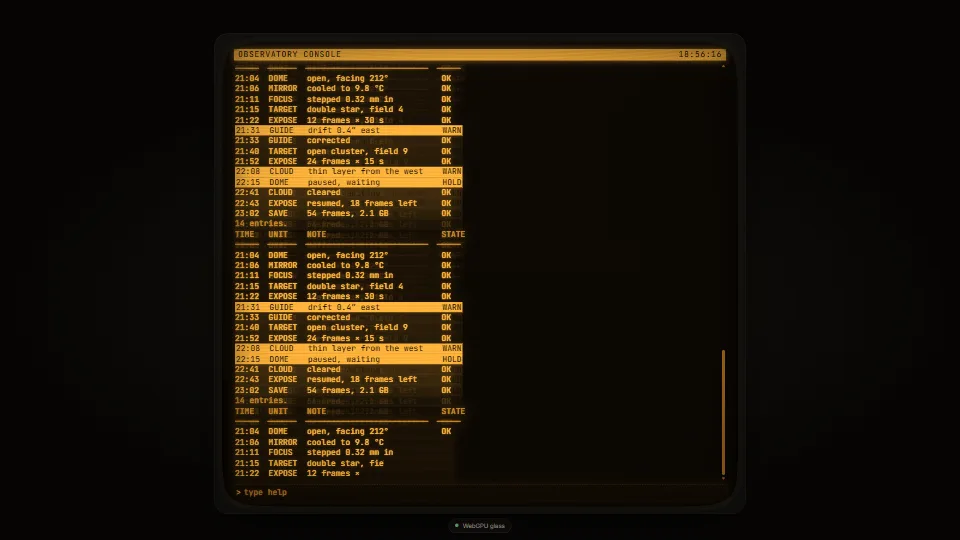
A CRT phosphor terminal drawn round live DOM text: the text stays real, selectable and read aloud, and the tube is laid over it.
 Screen effects
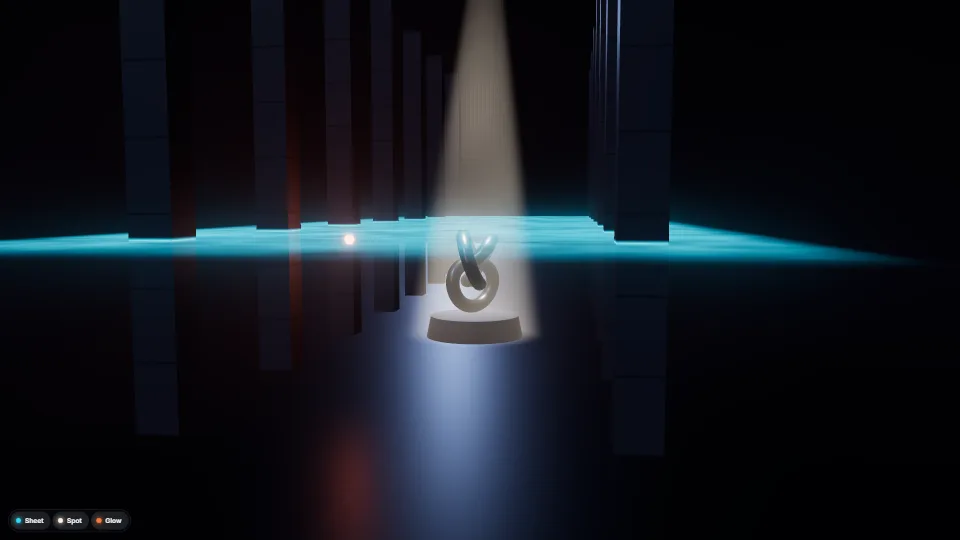
Volumetric air after the scene, for three.js WebGPU in TSL.
 Screen effects
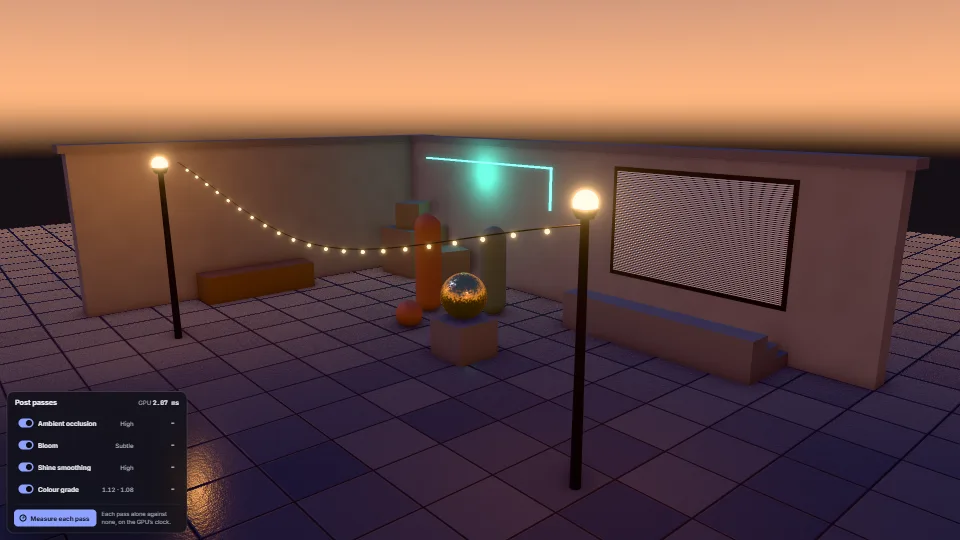
Ambient occlusion (GTAO from the frame’s own depth), bloom that only takes light brighter than lit white, specular anti-aliasing in every lit material and a…