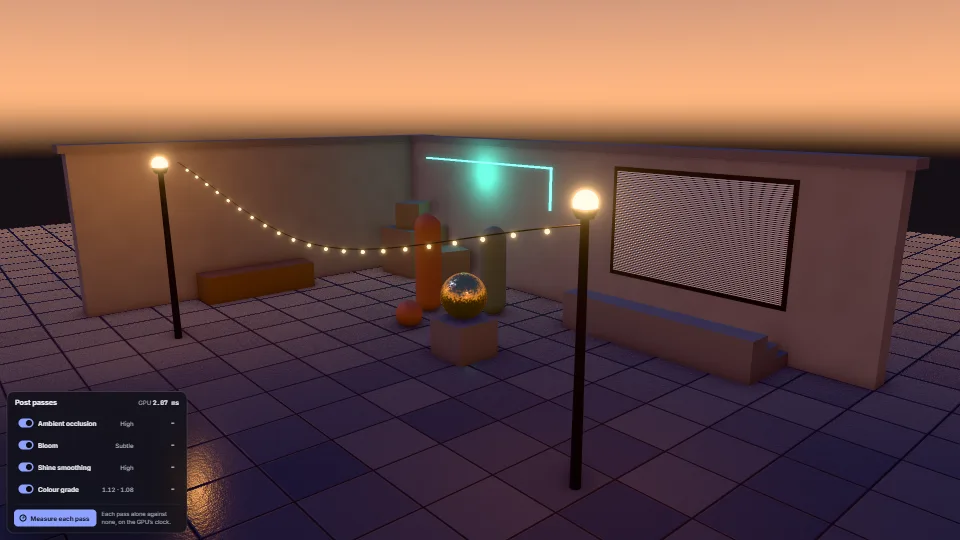
 Screen effects
Post stack: AO, bloom, shine smoothing
Ambient occlusion (GTAO from the frame’s own depth), bloom that only takes light brighter than lit white, specular anti-aliasing in every lit material and a…
2.08 GPU · 0.56 CPU ms
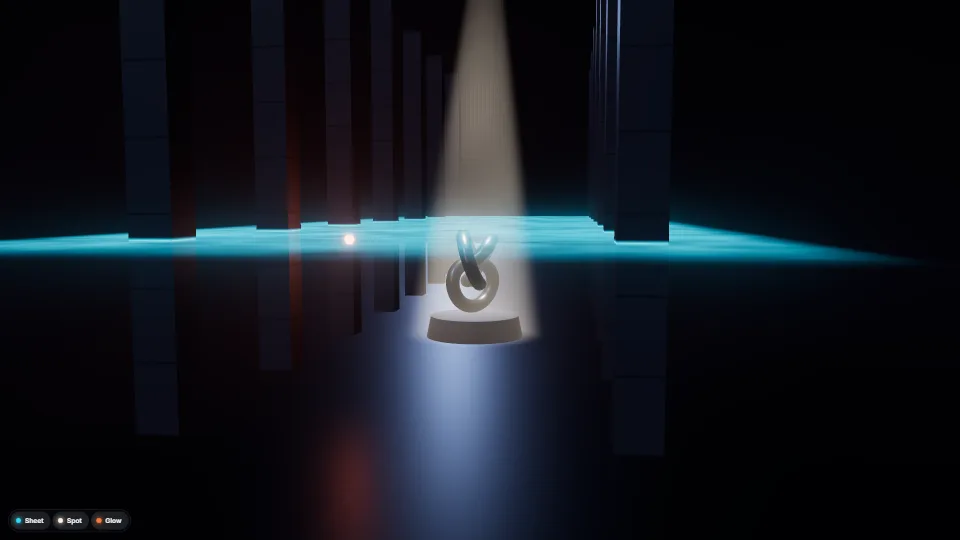
Volumetric air after the scene, for three.js WebGPU in TSL.
Measured 11 November 2026 on RTX 4060 Laptop, 13th Gen Intel(R) Core(TM) i9-13900H, Chrome 157, 1920×1080 at 1×. 600 frames × 3 rounds, median kept. What ran: The hall at 1920×1080: 40 steps a pixel with the level sheet scanning, the spot and the glow lit and the haze drifting, then bloom; drawn every frame. Phones: tiers are being measured next.
| Machine | GPU ms | CPU ms | CPU p95 |
|---|---|---|---|
| RTX 4060 Laptop · 13th Gen Intel(R) Core(TM) i9-13900Hreference · measuring tool | 1.24 | 0.46 | 0.81 |
| apple · Apple A19 Proin a browser tab · 16 November 2026 | 8.69 | 0.24 | 0.34 |
| Intel Arc 140V (Xe2-LPG) · Intel Core Ultra 7 258Vin a browser tab · 15 November 2026 | 10.6 | 1.55 | 2.63 |
Bars against one 16.7 ms frame. A browser-tab run is timed in a visible tab without the tool’s scripted input, so read it as close, not exact.
tier (LIGHT_SHEETS_TIER): low marches 24 steps at a third of the canvas, medium 32 at two fifths; the blades stay exact.resolution, never node() again (each call makes a new texture and a new shader).From My other apps. Fully custom code.
Henyey and Greenstein, phase function (1941): The spots’ forward scattering in the haze: the published formula.
Alexander Keller and Wolfgang Heidrich, Interleaved Sampling (Eurographics Workshop on Rendering, 2001): Neighbouring pixels march with different fixed offsets and a small filter combines them: here four offsets in each 2×2 block, averaged by the upsampling’s tent.
Johannes Kopf, Michael Cohen, Dani Lischinski and Matt Uyttendaele, Joint Bilateral Upsampling (SIGGRAPH 2007): The idea behind spreading the half-size march by the full-size depth: each low-resolution sample weighted by how alike its depth is.
Beer–Lambert law: The transmittance through the haze, step by step.
Numerical Recipes’ linear congruential generator (Press et al.): The constants 1664525 and 1013904223 that fill the noise lattices.
Screen effectsAmbient occlusion (GTAO from the frame’s own depth), bloom that only takes light brighter than lit white, specular anti-aliasing in every lit material and a…
 Screen effects
 Screen effects
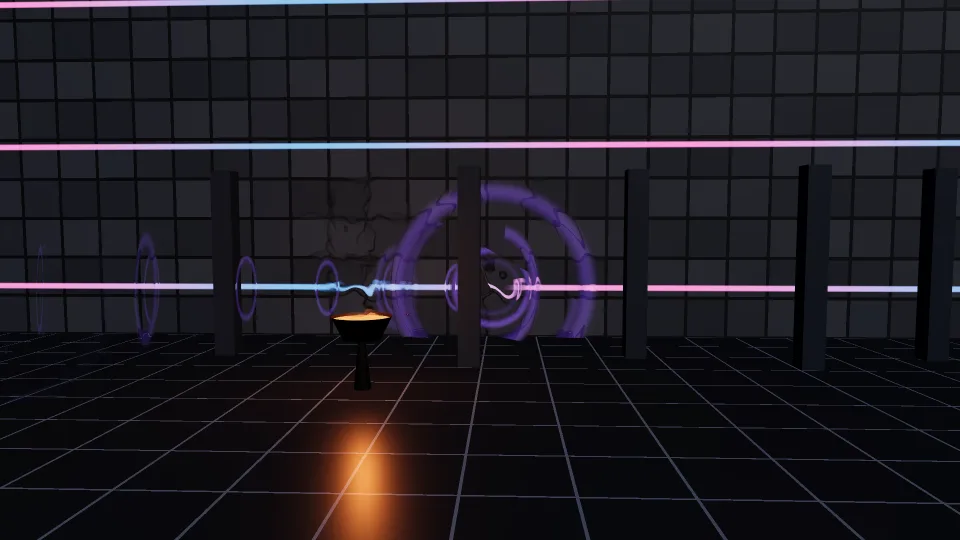
Air that bends what is behind it: shimmering heat over fires and blasts, and sonic shockwaves (rings, shells and a flying core) animated on the GPU from their…
 Screen effects
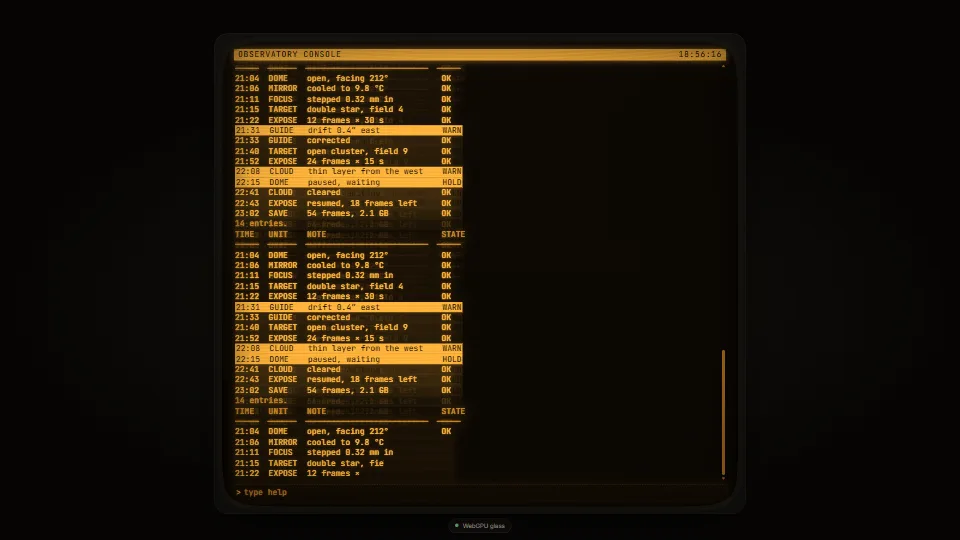
A CRT phosphor terminal drawn round live DOM text: the text stays real, selectable and read aloud, and the tube is laid over it.