 Screen effects
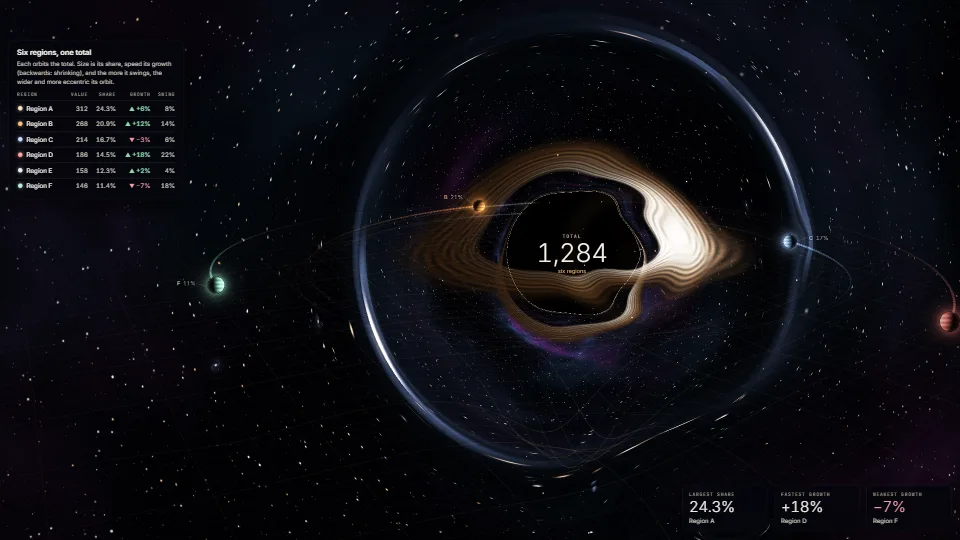
A gravitational lens behind the page
Elements on the page are masses that bend a procedural deep sky behind them.
2.78 GPU · 0.41 CPU ms
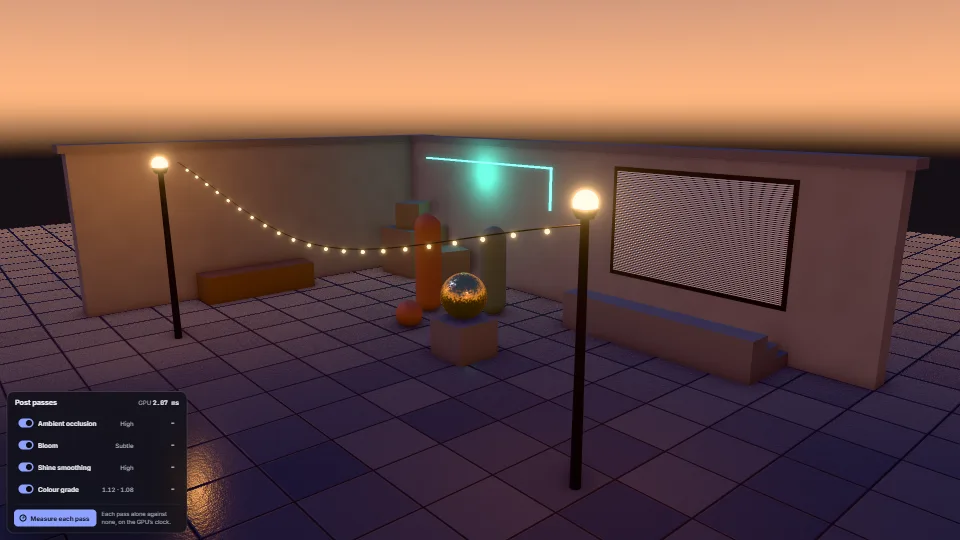
Ambient occlusion (GTAO from the frame’s own depth), bloom that only takes light brighter than lit white, specular anti-aliasing in every lit material and a…
Measured 13 November 2026 on RTX 4060 Laptop, 13th Gen Intel(R) Core(TM) i9-13900H, Chrome 157, 1920×1080 at 1×. 600 frames × 3 rounds, median kept (rounds ranged GPU 1.81–2.08, CPU 0.56–0.63 ms). What ran: The courtyard at 1× with all four passes on at their defaults (AO High at full resolution, bloom Subtle, shine smoothing High, the grade), the split off, the camera swaying so every frame is drawn. Standing still with nothing changing, nothing is drawn. Phones: tiers are being measured next.
| Machine | GPU ms | CPU ms | CPU p95 |
|---|---|---|---|
| RTX 4060 Laptop · 13th Gen Intel(R) Core(TM) i9-13900Hreference · measuring tool | 2.08 | 0.56 | 0.77 |
| apple · Apple A19 Proin a browser tab · 16 November 2026 | 17.1 | 0.50 | 1.38 |
| Intel Arc 140V (Xe2-LPG) · Intel Core Ultra 7 258Vin a browser tab · 15 November 2026 | 15.7 | 1.90 | 2.76 |
Bars against one 16.7 ms frame. A browser-tab run is timed in a visible tab without the tool’s scripted input, so read it as close, not exact.
tier to the PostStack: the AO is nearly all its cost, so medium draws High at 0.75 of the resolution and low at half with 2 slices of 4 steps (radius and strength unchanged).From HaTac. Adapted from published work, named below.
Jorge Jimenez, Xian-Chun Wu, Angelo Pesce, Adrian Jarabo, “Practical Real-Time Strategies for Accurate Indirect Occlusion” (GTAO, SIGGRAPH 2016): The method: horizons searched along screen slices, the cosine-weighted slice integral, the projected normal.
Intel XeGTAO (MIT): The AO follows its formulation closely: the slice integral as it writes it, the horizon falloff with its 0.615 share, the low horizon the falloff blends to, the quadratic step spacing and the minimum first step. Written in TSL, not copied text; its MIT notice is kept in NOTICE.md. Not taken: its denoiser, Hilbert noise and thickness heuristic.
Anton Kaplanyan and Stephen Hill (Hoffman), “Filtering Distributions of Normals for Shading Antialiasing” (HPG 2016), as Filament implements it: Shine smoothing widens GGX’s alpha² by the variance of the normal’s screen derivatives, capped.
three.js BloomNode and neutralToneMapping (MIT): The bloom extends three’s mip-chain BloomNode (its bright pass replaced); the grade calls three’s Khronos PBR Neutral curve. Both stay in three: nothing of theirs is copied.
Third-party terms ship with it in NOTICE.md.
Screen effectsElements on the page are masses that bend a procedural deep sky behind them.
 Screen effects
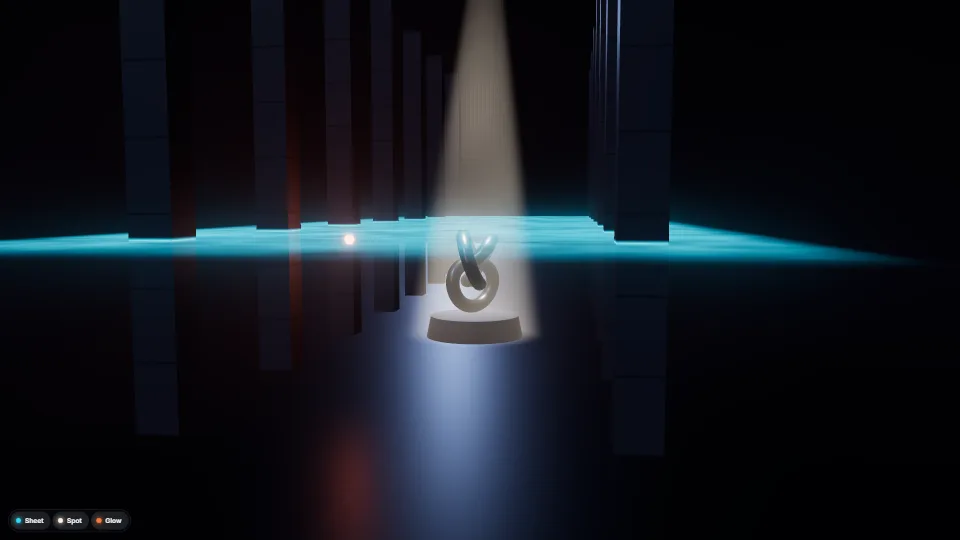
Volumetric air after the scene, for three.js WebGPU in TSL.
 Screen effects
 Screen effects
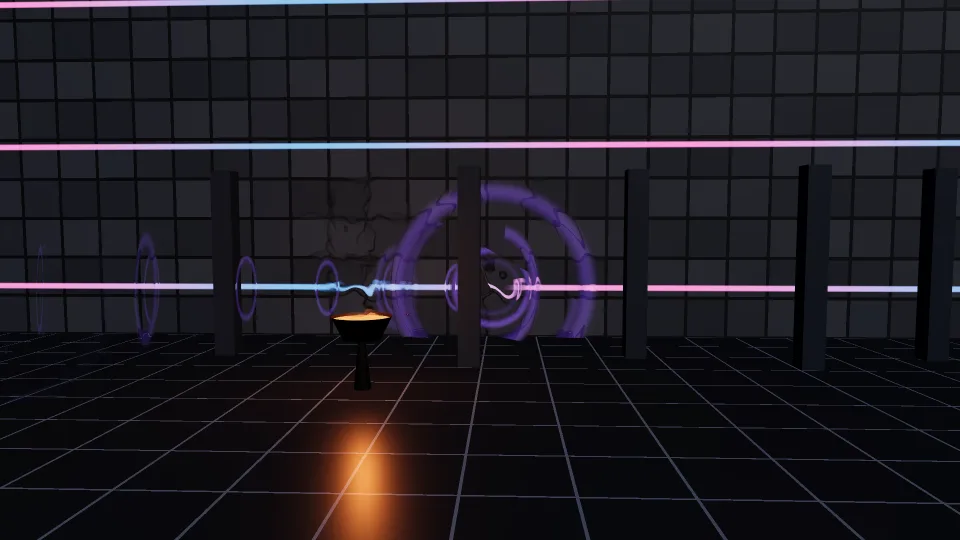
Air that bends what is behind it: shimmering heat over fires and blasts, and sonic shockwaves (rings, shells and a flying core) animated on the GPU from their…