 UI & interaction
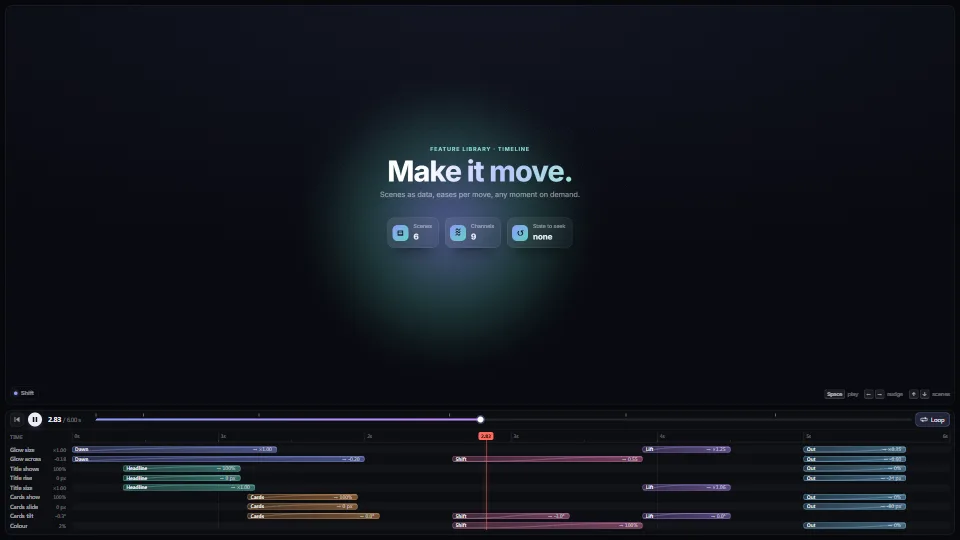
Scrubbable keyframe timeline
Scenes as plain data ("move these channels to these values over this long, with this ease"), any moment worked out on demand with no state, and the editor that…
0.08 CPU ms
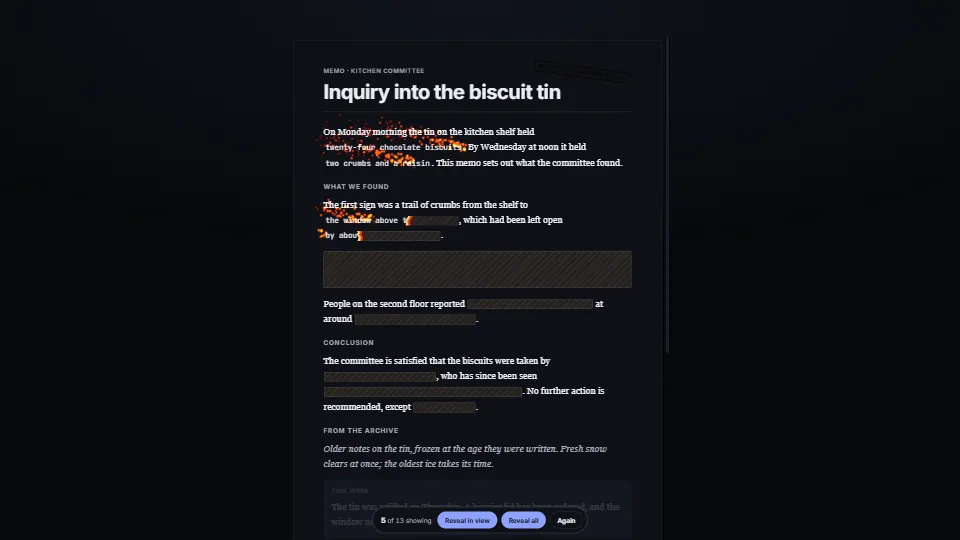
A passage hidden under a material until the reader reaches it.
Measured 14 November 2026 on RTX 4060 Laptop, 13th Gen Intel(R) Core(TM) i9-13900H, Chrome 157, 1920×1080 at 1×. 600 frames × 3 rounds, median kept (rounds ranged GPU <0.01–<0.01, CPU 0.09–0.10 ms). What ran: Measured with the demo running itself from its first frame: every 1.8 s the passages in view are hidden and revealed again, turn about at the top of the memo (bars burning in reading order, with their embers) and at the archive (three slabs thawing). The controller is driven from the demo’s update(), so CPU time is its frame (starting passages, reading rects, the thaw) and GPU time the overlay’s pass (slabs and embers), from its timestamp queries. The bars’ masks themselves are CSS animations, outside both. Phones: tiers are being measured next.
| Machine | GPU ms | CPU ms | CPU p95 |
|---|---|---|---|
| RTX 4060 Laptop · 13th Gen Intel(R) Core(TM) i9-13900Hreference · measuring tool | <0.01 | 0.10 | 0.41 |
| apple · Apple A19 Proin a browser tab · 16 November 2026 | 0.64 | 0.80 | 2.08 |
| Intel Arc 140V (Xe2-LPG) · Intel Core Ultra 7 258Vin a browser tab · 15 November 2026 | 0.07 | 0.15 | 0.55 |
Bars against one 16.7 ms frame. A browser-tab run is timed in a visible tab without the tool’s scripted input, so read it as close, not exact.
Frames run on a 60 Hz timer (a page demo), so most frames take about one tick, 16.7 ms: the spread around it is what matters.
From HaTac. Fully custom code.
Mark Jarzynski and Marc Olano, Hash Functions for GPU Rendering (JCGT 2020): The PCG hash every random number comes from, the same in JavaScript and WGSL.
CSS Properties and Values API (CSS Houdini, W3C): @property registers --rr-burn as a number, so a CSS animation can slide the mask.
UI & interactionScenes as plain data ("move these channels to these values over this long, with this ease"), any moment worked out on demand with no state, and the editor that…
 UI & interaction
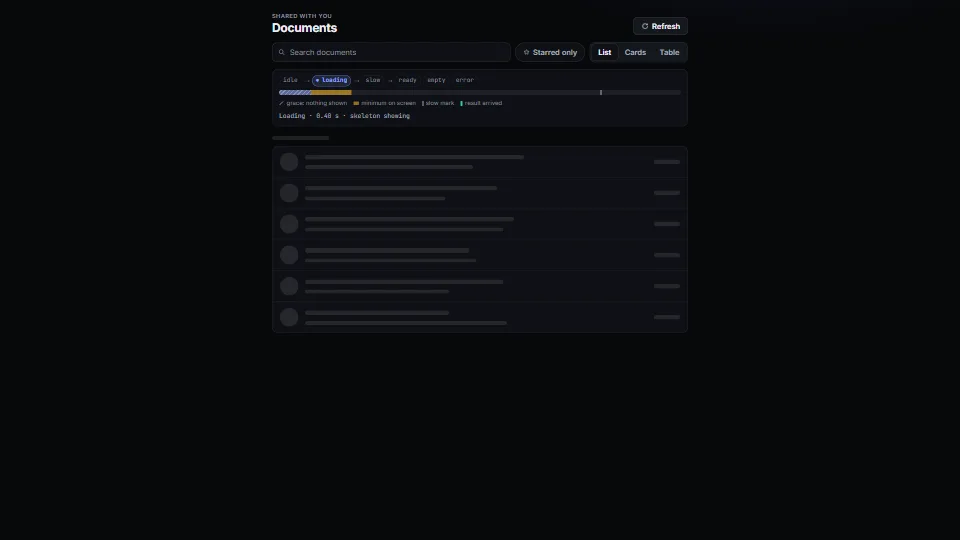
The states every view needs, done calmly: a tiny state machine (idle → loading → slow → ready | empty | error) with a grace delay so fast loads never flash a…
 UI & interaction
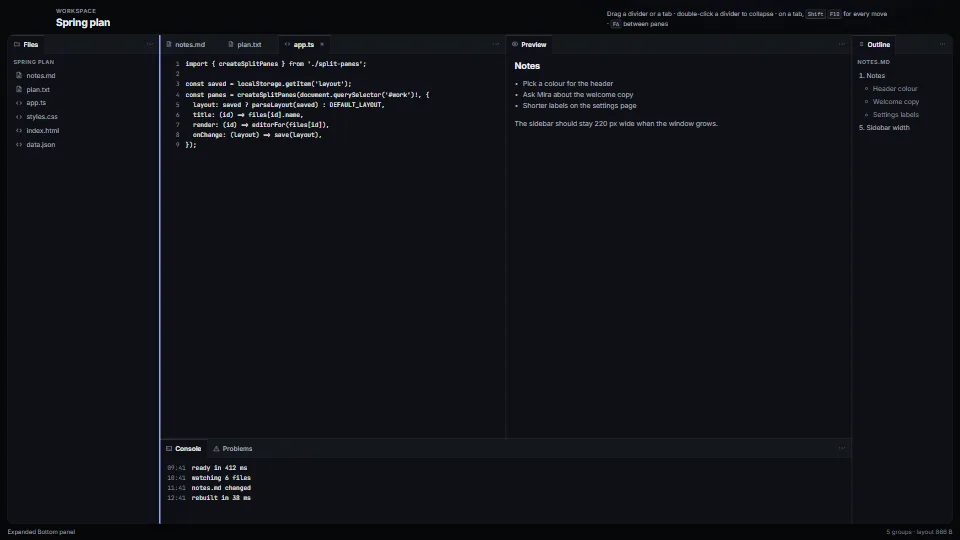
The layout of every editor, from a JSON tree you can save and restore.
 UI & interaction
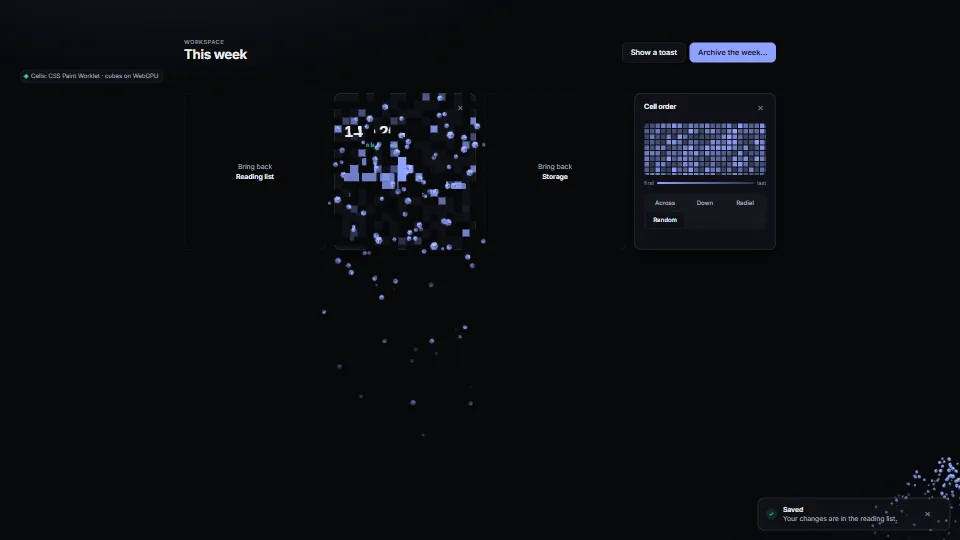
An element dissolves, or assembles, cell by cell: a CSS Paint Worklet masks it, WAAPI drives a registered property, and the calls return promises.