 Screen effects
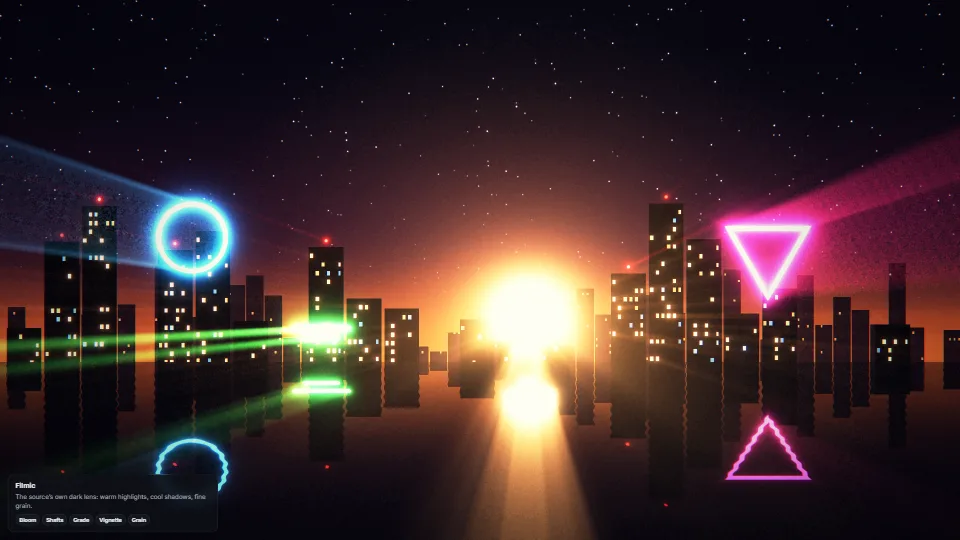
Cinematic lens
A post chain for any HDR picture on WebGPU (and a WebGL2 twin of it).
4.81 GPU · 0.14 CPU ms
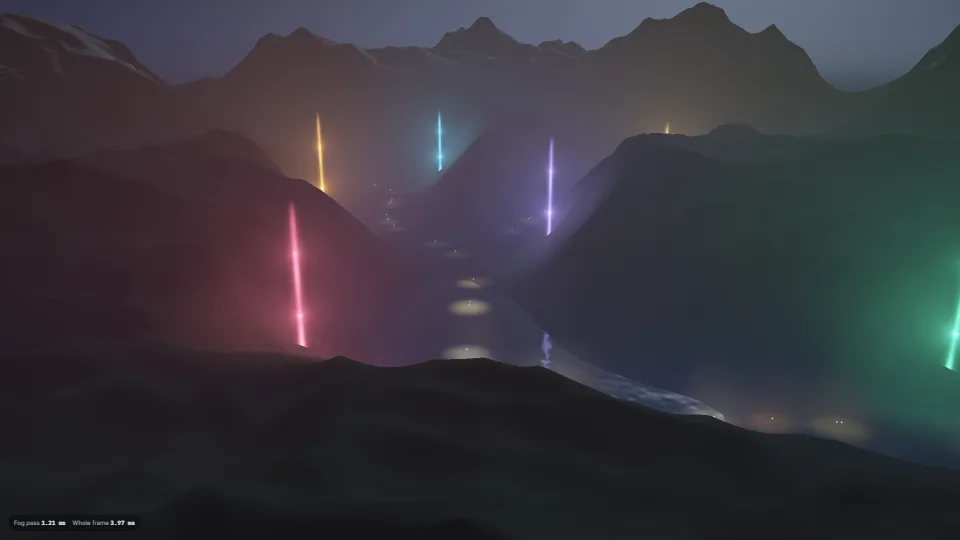
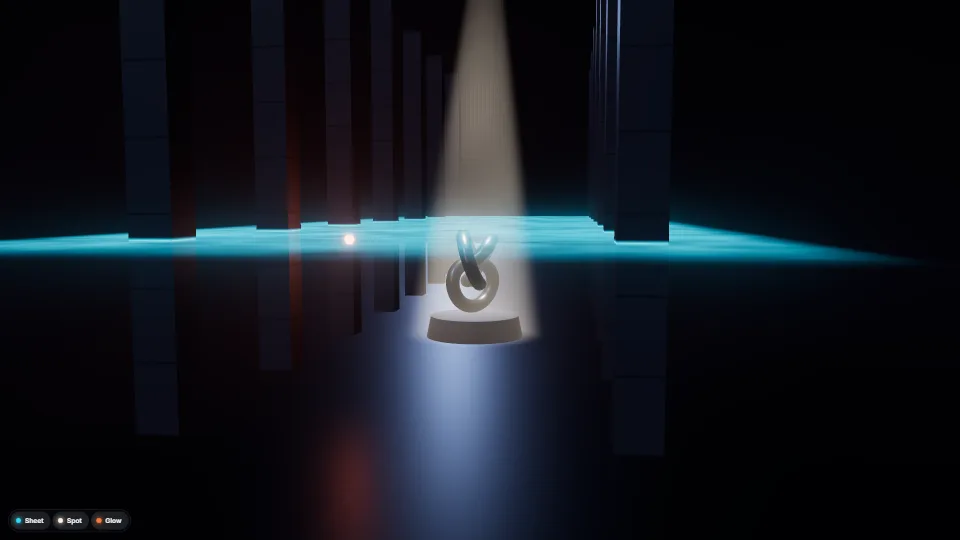
Fog that fills the low ground and glows round the lights in it, in one full-screen pass over any scene with a depth buffer (WebGPU, or WebGL2 where it is missing).
Measured 11 November 2026 on 13th Gen Intel(R) Core(TM) i9-13900H, Chrome 157, 1920×1080 at 1×. 600 frames × 3 rounds, median kept. What ran: Measured at night on the slow orbit: 40 lights moving along the valleys and six beacons splatted into a 256² light field, a 256 × 256 ground and the sky, the fog pass (six beacons glowing in the air, the wisp layer at 8 steps), the beams and lights after it and a tone pass, all timed together with timestamp queries. A living scene, so it draws every frame; with Moving lights and Slow orbit off (and under reduced motion) it draws only when something changes. Phones: tiers are being measured next.
| Machine | GPU ms | CPU ms | CPU p95 |
|---|---|---|---|
| unknown GPU · 13th Gen Intel(R) Core(TM) i9-13900Hreference · measuring tool | 8.50 | 0.20 | 0.28 |
| apple · Apple A19 Proin a browser tab · 16 November 2026 | not timed | 0.58 | 0.70 |
| Intel Arc 140V (Xe2-LPG) · Intel Core Ultra 7 258Vin a browser tab · 15 November 2026 | 4.98 | 0.35 | 0.48 |
Bars against one 16.7 ms frame. A browser-tab run is timed in a visible tab without the tool’s scripted input, so read it as close, not exact.
From HaTac. Fully custom code.
Inigo Quilez, “Better fog”: The published closed form for exponential height fog along a ray; the code here is the owner’s derivation, re-written.
Miles Macklin, “Faster Fog” (2010): The closed-form in-scattering from a point light in even air (the arctangent form, without extinction), which pointAirlight is.
Sun, Ramamoorthi, Narasimhan and Nayar, “A Practical Analytic Single Scattering Model for Real Time Rendering” (2005): The full model with extinction that the airlight simplifies: not used, but where to go for more.
Henyey and Greenstein, phase function (1941): The sun’s forward glow in the fog: the published formula.
Jarzynski and Olano, “Hash Functions for GPU Rendering” (JCGT 2020): The PCG hash behind the wisps’ noise, the march’s jitter and the demo’s stars and terrain.
Screen effectsA post chain for any HDR picture on WebGPU (and a WebGL2 twin of it).
 Screen effects
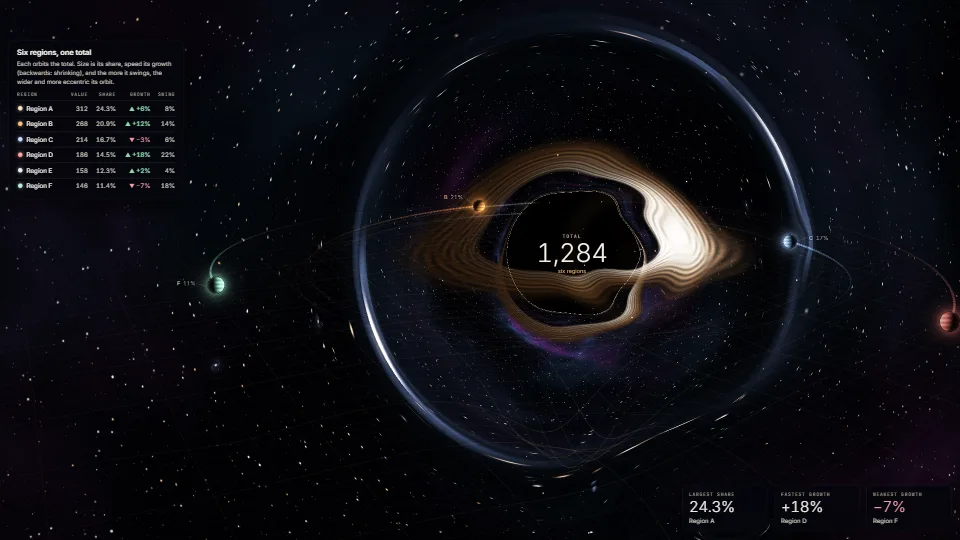
Elements on the page are masses that bend a procedural deep sky behind them.
 Screen effects
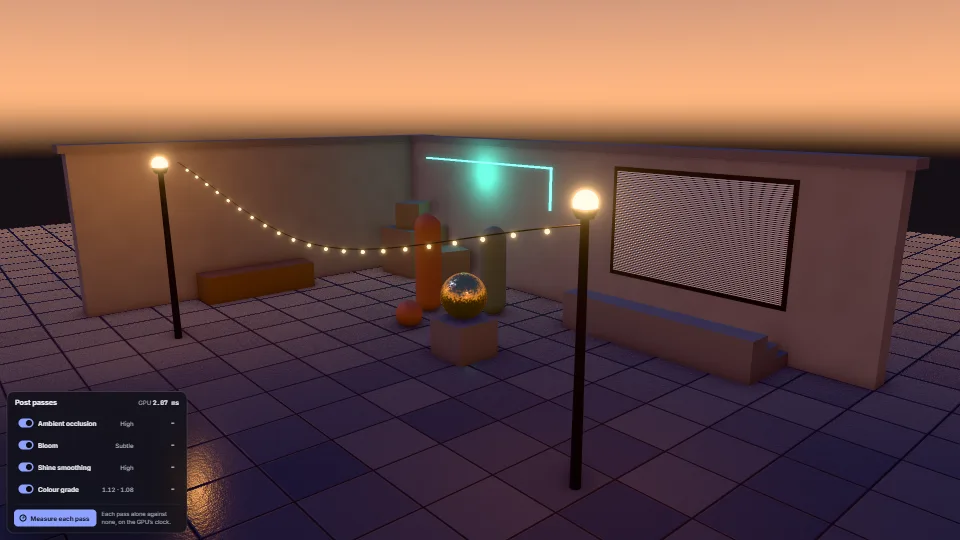
Ambient occlusion (GTAO from the frame’s own depth), bloom that only takes light brighter than lit white, specular anti-aliasing in every lit material and a…
 Screen effects
Volumetric air after the scene, for three.js WebGPU in TSL.