 Screen effects
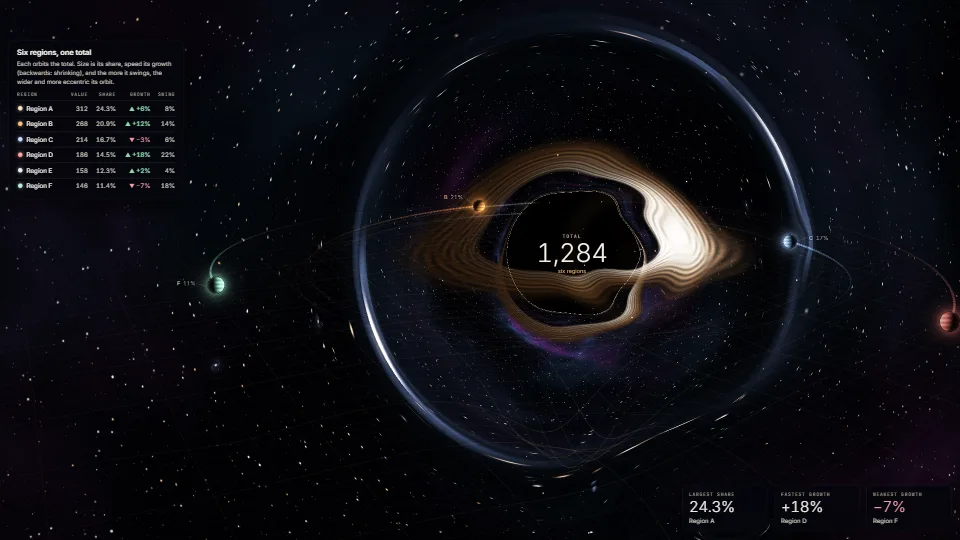
A gravitational lens behind the page
Elements on the page are masses that bend a procedural deep sky behind them.
2.78 GPU · 0.41 CPU ms
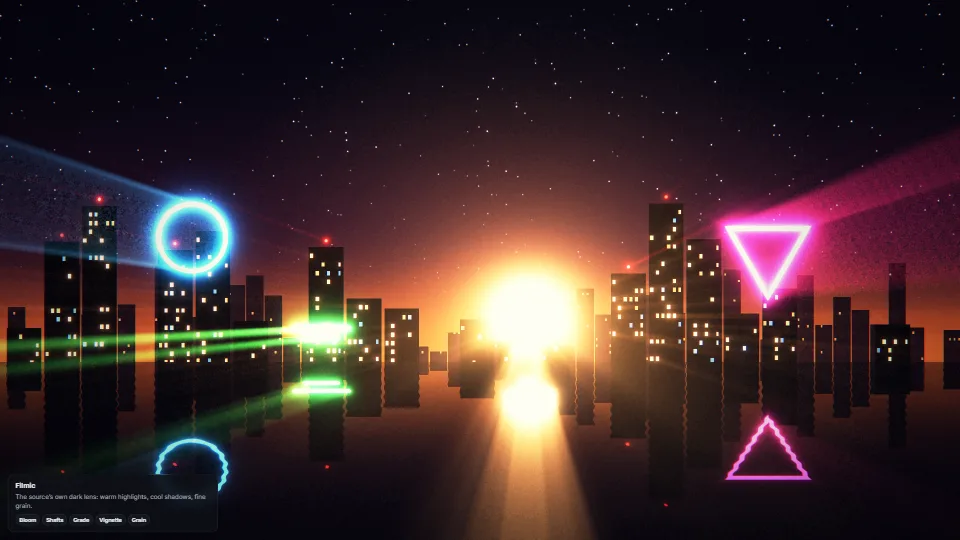
A post chain for any HDR picture on WebGPU (and a WebGL2 twin of it).
Measured 11 November 2026 on 13th Gen Intel(R) Core(TM) i9-13900H, Chrome 157, 1920×1080 at 1×. 600 frames × 3 rounds, median kept. What ran: Measured on the Filmic look with the scene moving and every stage on, the split off: the demo’s scene pass, then the lens (bright parts, five halvings and four doublings, the brightest-spot search, 48-sample shafts at half size, the composite), timed with their own timestamp queries. Phones: tiers are being measured next.
| Machine | GPU ms | CPU ms | CPU p95 |
|---|---|---|---|
| unknown GPU · 13th Gen Intel(R) Core(TM) i9-13900Hreference · measuring tool | 4.81 | 0.14 | 0.23 |
| apple · Apple A19 Proin a browser tab · 16 November 2026 | 9.55 | 0.34 | 0.48 |
| Intel Arc 140V (Xe2-LPG) · Intel Core Ultra 7 258Vin a browser tab · 15 November 2026 | 1.05 | 0.27 | 0.45 |
Bars against one 16.7 ms frame. A browser-tab run is timed in a visible tab without the tool’s scripted input, so read it as close, not exact.
From SpaciousPro. Fully custom code.
Jorge Jimenez, Next-generation post-processing in Call of Duty: Advanced Warfare (SIGGRAPH 2014): The bloom’s 13-tap downsample and the tent upsample chain follow his method.
Kenny Mitchell, Volumetric light scattering as a post-process (GPU Gems 3, 2007): The light shafts are the radial blur toward the light with a decay per sample that this chapter describes.
Inigo Quilez, 2D distance functions: The rounded box distance the occluding rectangles are drawn with (`roundBox` in lens-wgsl.ts), kept with this credit.
Mark Jarzynski & Marc Olano, Hash Functions for GPU Rendering (2020): Their PCG hash drives the grain, the shafts’ jitter and the dither, replacing the source’s hash.
Screen effectsElements on the page are masses that bend a procedural deep sky behind them.
 Screen effects
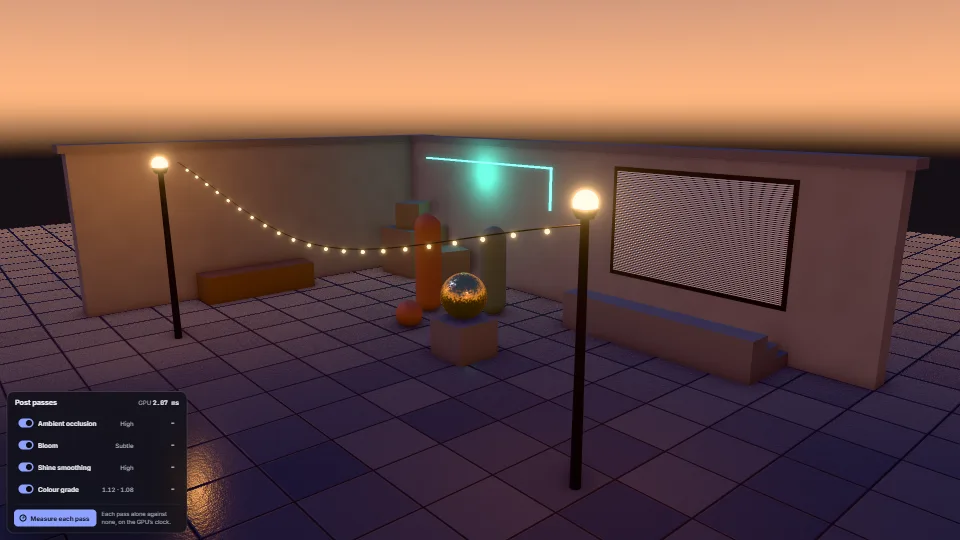
Ambient occlusion (GTAO from the frame’s own depth), bloom that only takes light brighter than lit white, specular anti-aliasing in every lit material and a…
 Screen effects
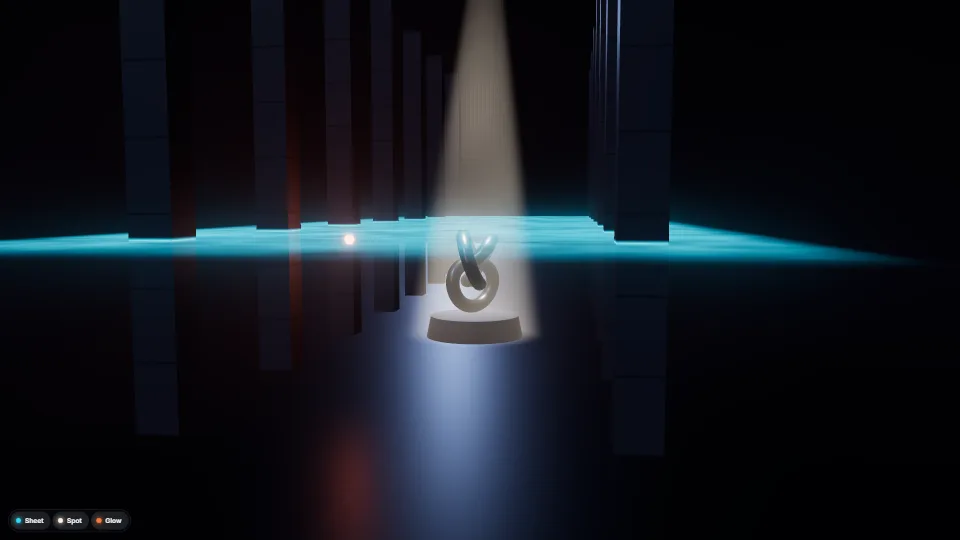
Volumetric air after the scene, for three.js WebGPU in TSL.
 Screen effects
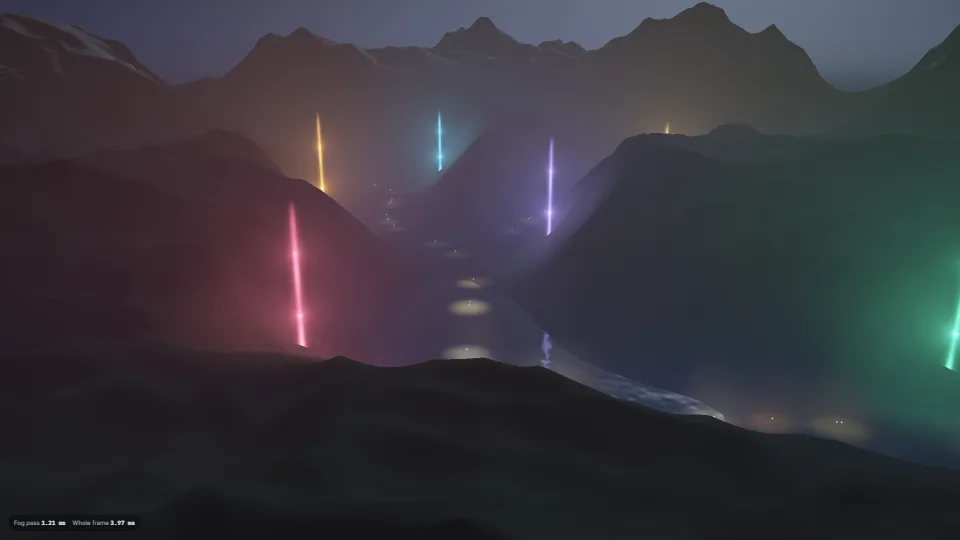
Fog that fills the low ground and glows round the lights in it, in one full-screen pass over any scene with a depth buffer (WebGPU, or WebGL2 where it is missing).