 UI & interaction
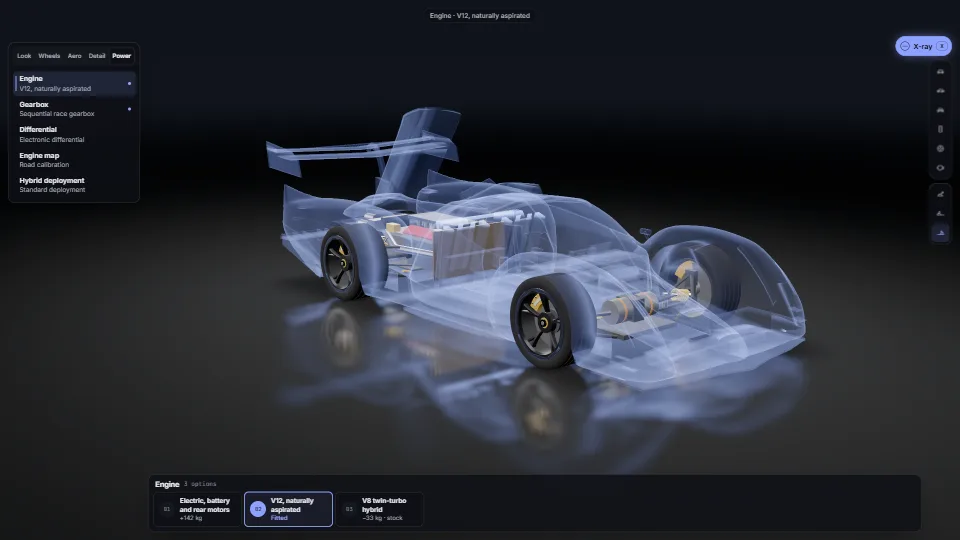
Vehicle showcase with x-ray
A staged bay for any glTF vehicle whose parts are named nodes.
0.87 GPU · 2.21 CPU ms
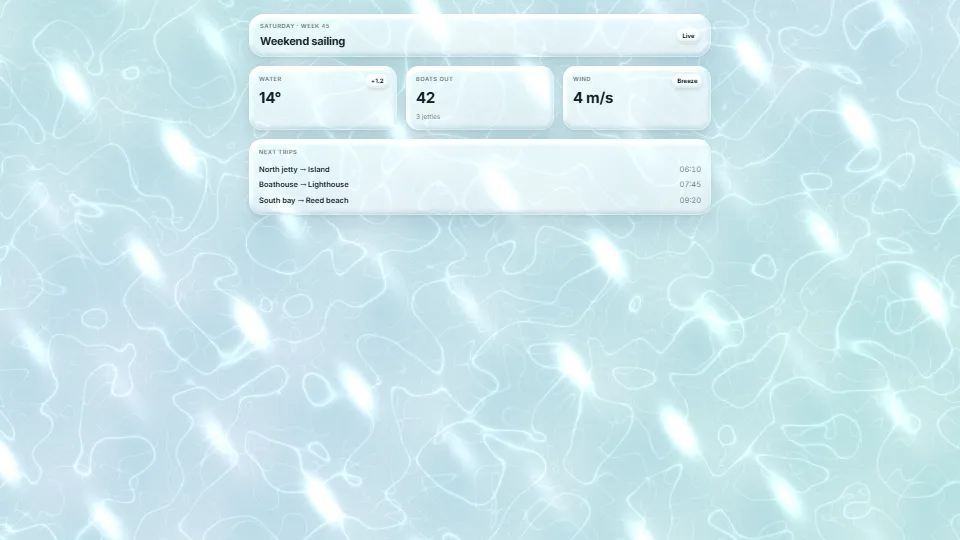
Glass slabs over live water, drawn by WebGPU (or its WebGL2 twin) behind ordinary DOM.
Measured 11 November 2026 on 13th Gen Intel(R) Core(TM) i9-13900H, Chrome 157, 1920×1080 at 1×. 600 frames × 3 rounds, median kept. What ran: Measured with the water moving under five glass panels and three chips: two full-screen passes (water and glass, then the menu blob), timed with their own timestamp queries. Phones: tiers are being measured next.
| Machine | GPU ms | CPU ms | CPU p95 |
|---|---|---|---|
| unknown GPU · 13th Gen Intel(R) Core(TM) i9-13900Hreference · measuring tool | 3.10 | 0.16 | 0.25 |
| apple · Apple A19 Proin a browser tab · 16 November 2026 | 6.88 | 0.30 | 0.38 |
| Intel Arc 140V (Xe2-LPG) · Intel Core Ultra 7 258Vin a browser tab · 15 November 2026 | 1.64 | 0.33 | 0.55 |
Bars against one 16.7 ms frame. A browser-tab run is timed in a visible tab without the tool’s scripted input, so read it as close, not exact.
Frames run on a 60 Hz timer (a page demo), so most frames take about one tick, 16.7 ms: the spread around it is what matters.
tier (GLASS_TIER): low draws at most 1 pixel per CSS px and medium 1.5, where high draws 2; both skip the over pass (the menu blob, a second full-screen pass and canvas) while no menu or drop shows, clearing it once when they go.webgl: false turns it off, and it returns null without WebGL2 too: style the panels so they still read).From HaTac. Fully custom code.
Inigo Quilez, 2D distance functions and smooth minimum: sdRoundBox (every panel’s shape) and the polynomial smin (the menu blob and toasts melting together) follow his published formulas, re-written in WGSL.
Apple, Liquid Glass (2025): The look this answers: a design inspiration, no code.
Kenny Mitchell, Volumetric Light Scattering as a Post-Process (GPU Gems 3, 2007): The demo’s sun shafts over a scene: a radial gather toward the light, here at a quarter of the size and masked by the panels.
Mark Jarzynski and Marc Olano, Hash Functions for GPU Rendering (2020): The PCG hash behind the demo scene’s stars and the shafts’ jitter.
UI & interactionA staged bay for any glTF vehicle whose parts are named nodes.
 UI & interaction
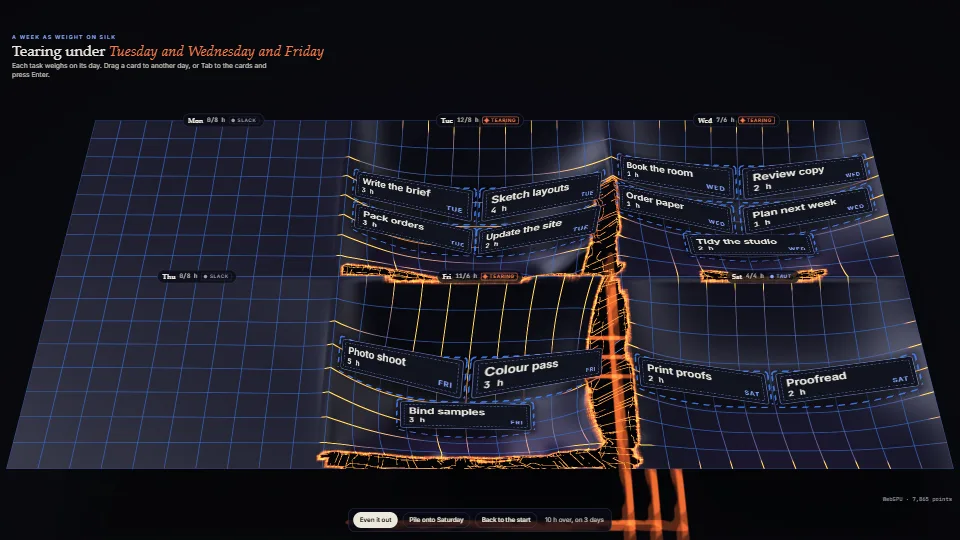
Real, selectable DOM text riding a cloth simulated on the GPU.
 UI & interaction
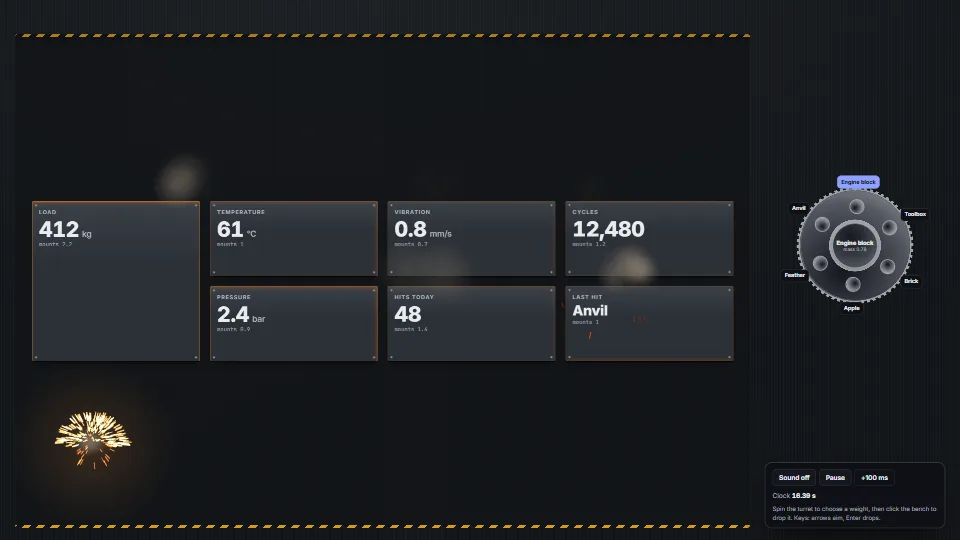
One event, felt everywhere: impact({ x, y, mass }) makes every [data-body] element dip, rock and ring down on its shock mounts by its distance and its own…
 UI & interaction
One distance-field atlas holds a thin and a black cut of a typeface in its red and green channels, every glyph in the same fixed cell, so mixing the channels…