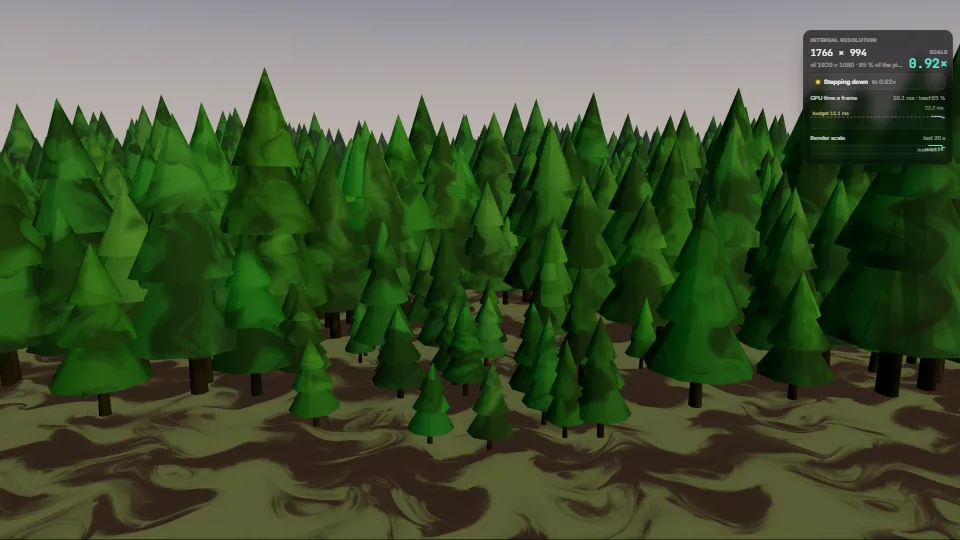
The live demo starts when it’s in view.Raise the GPU load and watch the scale step down to hold the budget · drag to orbit
Holds a frame budget by choosing the render scale once a second from the GPU’s own frame times (WebGPU timestamp queries).
What it costs a frame
GPU
8.84 ms
CPU
0.52 ms
02468101216.7 ms
GPU
8.84 ms
CPU, median
0.52 ms
CPU, 95th pct
0.93 ms
Draw calls
4
Weight
Heavy
Measured 3 November 2026 on RTX 4060 Laptop, 13th Gen Intel(R) Core(TM) i9-13900H, Chrome 156, 1920×1080 at 1×. 600 frames × 3 rounds, median kept. What ran: Measured at a held heavy load (65 %, about 15 ms a frame at full scale on the reference machine) with dynamic resolution on and an 11.1 ms budget: the GPU time is what the controller holds the wood to (it steps the scale down until the frames fit, or reaches its least), not the wood at full resolution. Phones: tiers are being measured next.
apple · Apple A19 Proin a browser tab · 16 November 2026
18.9
1.26
2.18
Intel Arc 140V (Xe2-LPG) · Intel Core Ultra 7 258Vin a browser tab · 15 November 2026
59.4
1.09
1.75
Bars against one 16.7 ms frame. A browser-tab run is timed in a visible tab without the tool’s scripted input, so read it as close, not exact.
What it needs
Renders with
WebGPUNeeds WebGPU: current Chrome and Edge, Safari 26+, Firefox 141+ on Windows.
Your browser
Checking…Looking for WebGPU
Depends on
three.js 0.187.0No other packages
What it’s for
Games that must hold 60 fps on weak GPUs
Heavy scenes on laptops at 150 % scaling
Dense foliage and particle-heavy views
A quality setting that tunes itself
Frame caps for battery
Pitfalls, in brief
A weak GPU can sit at the least scale and still run over (an integrated GPU drew the demo’s held load at 59 ms a frame at 0.67, against an 11.1 ms budget): the controller keeps to its floor, by design.
Only pixel work scales.
Each new scale makes three’s frame buffer again (a short hitch, no shader build): hence two seconds’ rest after a change, a climb only after three calm seconds, and a few big steps rather than many small ones.
A check wants 20 frames a second; the game’s copy then sat still exactly when it was needed most (a scene at 15 fps).
Measure uncapped when tuning: under a frame cap or vsync the GPU clocks down when it has slack and its times can double.
8 more in brief
three keeps one timestamp query set a kind for the whole renderer, and any read-back empties it.
On Safari with an Apple GPU the frame’s passes overlap, so their timestamps can add up to more than the frame’s wall time (an iPhone 17 Pro read 25.7 ms of GPU time a frame while its frames came every 14.2 ms).
Timestamp queries need the timestamp-query feature (Chrome and Edge; Safari 26 and Firefox may not offer it).
Chrome rounds timestamps to 0.1 ms: percentiles over a second’s frames are fine, single frames are not.
It reaches into three r187 internals: Renderer._getFrameBufferTarget and getDrawingBufferSize, NodeManager.getOutputNode and getOutputCacheKey, the backend’s timestampQueryPool.
There must be a frame buffer to scale: three makes one when it tone-maps or converts colour space (the default).
Hook upscaleToCanvas before the first frame: the copy to the canvas compiles at load, and since it is the same shader at every scale, nothing compiles when the scale changes.
Screen-space nodes (screenUV, viewportSharedTexture) follow the frame buffer, but passes that size themselves from the drawing buffer must read frameSize() instead, or they draw at the wrong size.
13 pitfalls in full, the hook-up guide, the module source and its tests come with the part.
Where it comes from
From HaTac. Fully custom code.
Catmull-Rom in bilinear reads (Matt Pettineo; five reads after Jorge Jimenez’s Filmic SMAA, 2016): The idea behind the upscale’s bicubic: weights folded into a few bilinear reads, the corners dropped. Written for HaTac, not copied.
AMD FidelityFX CAS and FSR 1 RCAS: The idea behind the sharpening: less where the local contrast is already high, the result kept within the neighbours’ range. Written for HaTac, not copied.
 Systems & tooling
 Systems & tooling
 Systems & tooling
 Systems & tooling