 Systems & tooling
GPU page runtime
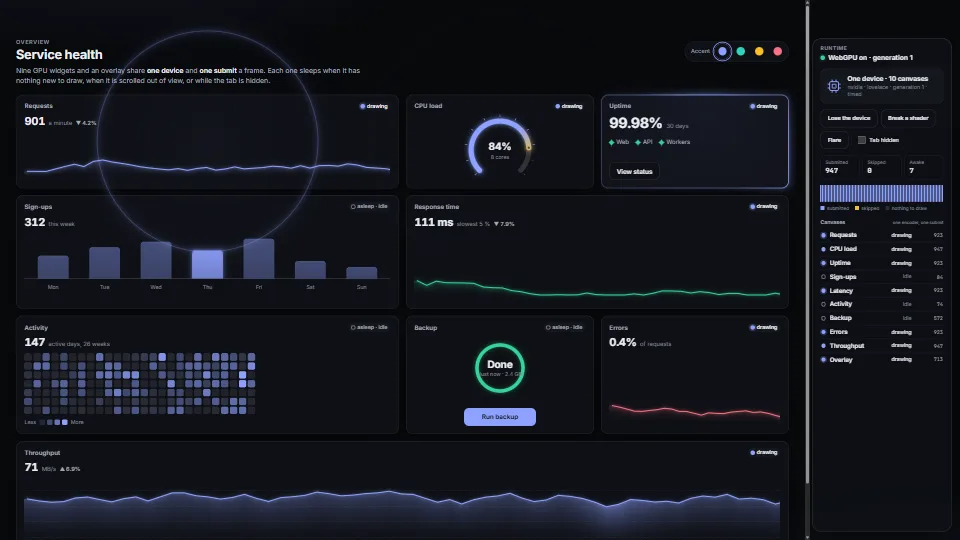
Many small WebGPU widgets on one page share one device, one command encoder and one submit a frame.
0.20 GPU · 1.43 CPU ms
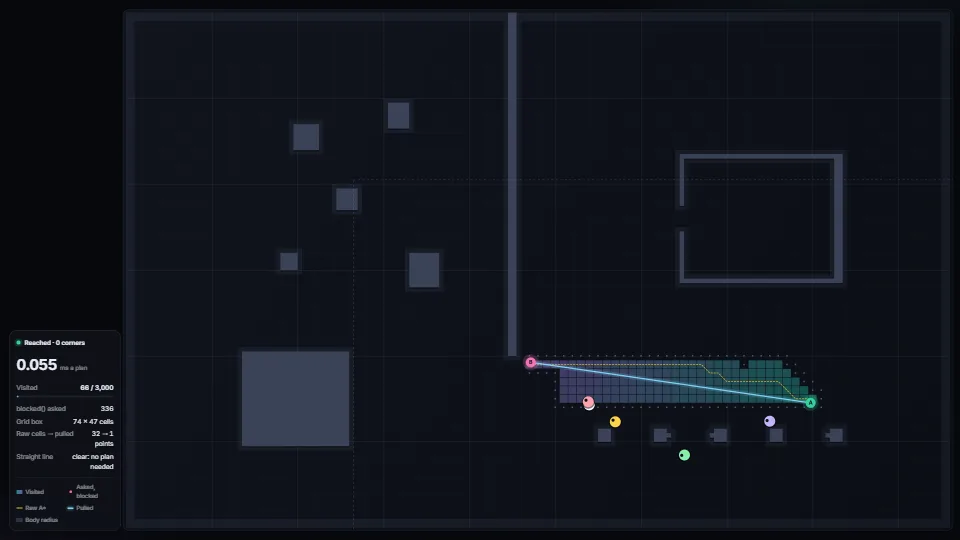
A way round walls and props from one blocked(x, z) question.
Measured 3 November 2026 on 13th Gen Intel(R) Core(TM) i9-13900H, Chrome 156, 1920×1080 at 1×. 600 frames × 3 rounds, median kept. What ran: Measured with the start and goal circling the map: the path is planned again every frame (lazy grid, A*, pulling) and the walkers replan within a shared budget of 6,000 cells a frame. The frame time includes the Canvas 2D drawing. Phones: tiers are being measured next.
| Machine | GPU ms | CPU ms | CPU p95 |
|---|---|---|---|
| unknown GPU · 13th Gen Intel(R) Core(TM) i9-13900Hreference · measuring tool | not timed | 1.37 | 3.71 |
| apple · Apple A19 Proin a browser tab · 16 November 2026 | not timed | 1.96 | 3.34 |
| Intel Arc 140V (Xe2-LPG) · Intel Core Ultra 7 258Vin a browser tab · 15 November 2026 | not timed | 1.81 | 4.34 |
Bars against one 16.7 ms frame. A browser-tab run is timed in a visible tab without the tool’s scripted input, so read it as close, not exact.
From HaTac. Fully custom code.
Hart, Nilsson and Raphael, A* search (1968): The search is A*, with the octile distance as its heuristic for eight-way moves. The algorithm, not code.
Line-of-sight path smoothing (“string pulling”): The well-known technique of joining each point to the furthest later one in sight. The idea, not code.
Systems & toolingMany small WebGPU widgets on one page share one device, one command encoder and one submit a frame.
 Systems & tooling
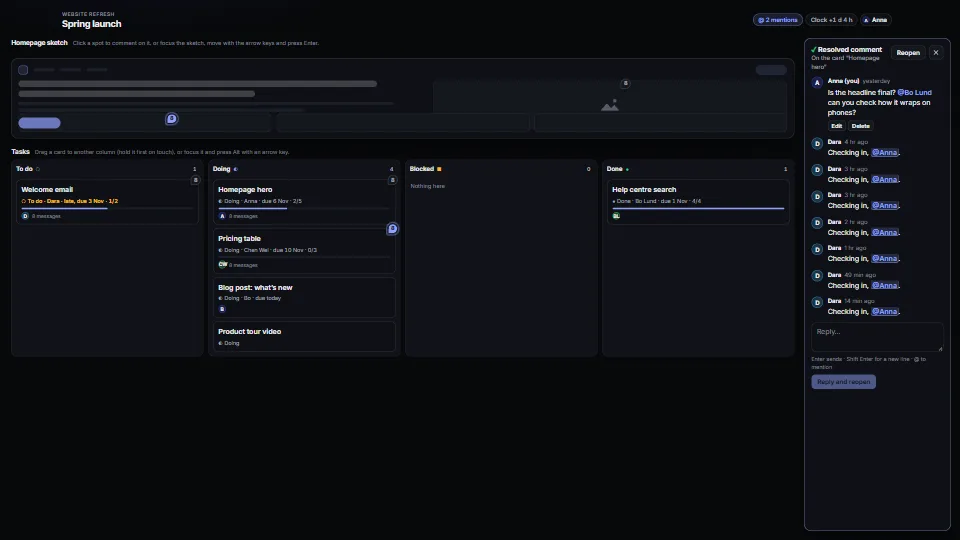
Comment threads pinned to items or to spots, with replies, @mentions (the longest name wins), edit, resolve and reopen; task cards with a status, an assignee…
 Systems & tooling
 Systems & tooling