The live demo starts when it’s in view.Switch each shaping pass on or off · choose a close view · drag to orbit
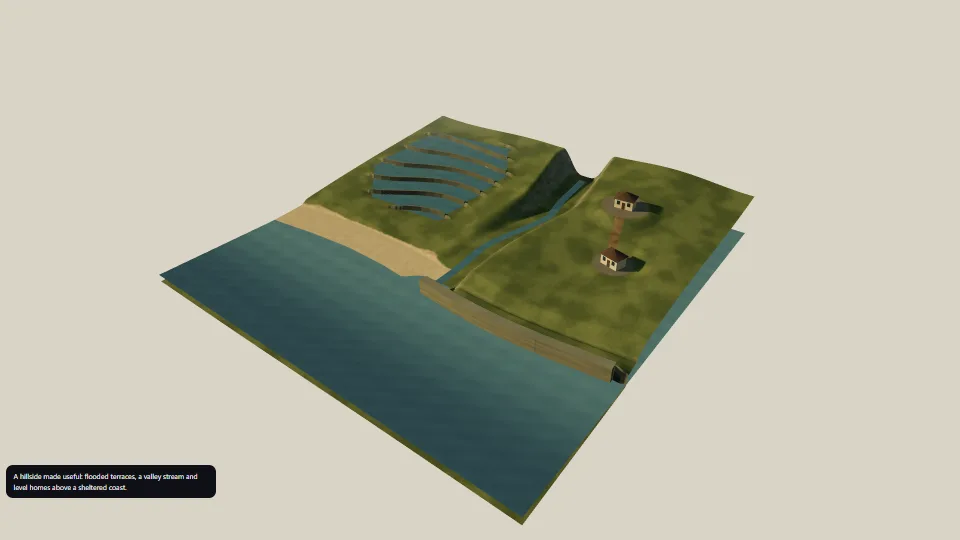
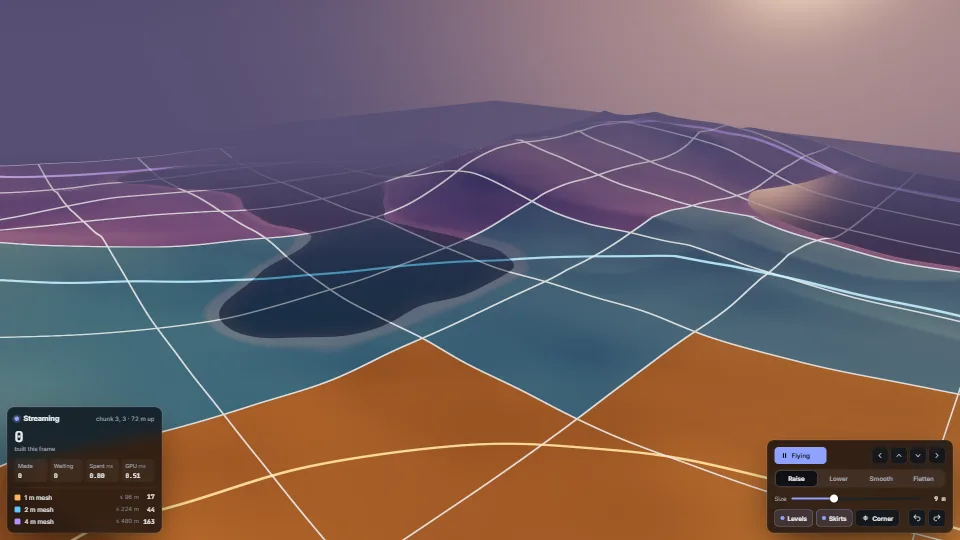
Pure height-function transforms for contour terraces, a carved valley, level pads and a coastline of cliffs and beaches.
Retaining walls and cliff chains return abstract placements; wet benches return shallow pool cells. Compose the functions, then sample once onto your terrain lattice.
What it costs a frame
GPU
1.06 ms
CPU
0.28 ms
02468101216.7 ms
GPU
1.06 ms
CPU, median
0.28 ms
CPU, 95th pct
0.41 ms
Draw calls
33
Weight
Moderate
Measured 19 November 2026 on RTX 4060 Laptop, 13th Gen Intel(R) Core(TM) i9-13900H, Chrome 157, 1920×1080 at 1×. 600 frames × 3 rounds, median kept (rounds ranged GPU 1.06–1.11, CPU 0.28–0.31 ms). What ran: Default shaped coastal hillside: 160 × 160 m at 0.5 m spacing, relief and baked hollow shade, shadow-casting walls, cliffs and two houses, terrace pools, a stream and gently moving sea. No comparison view or control changes. Planners and hollow baking run only on load or edits, outside the measured render frames. Phones: tiers are being measured next.
How steadily it runs on RTX 4060 Laptop · 13th Gen Intel(R) Core(TM) i9-13900H · reference
Typical frame ?
3.22 ms
1% low ?
152 fps
Varies by ?
±0.87 ms
All metricsRTX 4060 Laptop · 13th Gen Intel(R) Core(TM) i9-13900H · referenceHow long each frame took. Most frames sit in the tall bars; a long tail to the right is hitching.
Frames run back to back, each starting once the GPU has finished the last, so frame times show the work itself. They have a floor of about 4–5 ms from the browser’s own scheduling: GPU and CPU ms stay the measure of cost.
Frames
Median (p50) ?
3.22 ms
p95 ?
5.33 ms
p99 ?
6.18 ms
Slowest ?
7.11 ms
Mean ?
3.67 ms
Standard deviation ?
0.87 ms
1% low ?
152 fps
0.1% low ?
141 fps
Hitches ?
3 of 600
Over budget ?
0 of 600
Main thread
Long tasks ?
0
Long frames ?
0
Event-loop delay ?
0.0 / 0.5 / 0.5 ms
Input
No input during this run.
Memory
JavaScript heap ?
75.7 → 83.5 MB
Growth ?
+7.75 MB
Browser
JavaScript a frame ?
0.01 ms
All tasks a frame ?
0.46 ms
Layout / style ?
0.00 / 0.00 ms
Main thread busy ?
13%
Garbage collection
Collections ?
1 (1 minor, 0 major)
Pauses ?
0.5 ms in all, longest 0.5
What it needs
Renders with
WebGPU or WebGLWebGPU where there is one, WebGL2 where there is not.
Your browser
Runs hereNo WebGPU needed
Depends on
three.js 0.187.0No other packages
With an agent
install("terrain-shaping")Your coding agent reads its pitfalls and installs it through the library’s MCP server. Set it up
What it’s for
Cut and fill a hillside into level terraces
Carve a flat valley floor with eased sides
Level circular building footprints
Join a coastal heightfield to cliff walls and gentle beaches
Pitfalls, in brief
All coordinates are Y-up metres; height functions receive X and Z.
Build planners once when inputs change, then sample the final function onto your lattice.
Use finite coordinates and dimensions, positive widths, wavelengths, wall half-thickness and blend distances, and a nondegenerate polygon/path.
Keep hillside slope below step / minWidth where possible (about 0.3 at defaults).
The order of transforms matters.
6 more in brief
A valley sets its floor exactly, including filling land below it inside the floor.
Wall placements retain a 4 m chord profile, 0.8 m thickness and 0.5/1 m nominal heights; scale.y stretches that nominal height.
Cliff placements retain fixed reference ports for 4/6 m profiles, 8 m straights and 90-degree corners.
Coast shaping keeps a 3 m shelf and ground 0.08 m below cliff caps; base defaults to seaLevel - 0.6.
Sample pool depths against the stored/interpolated bed your renderer actually uses, not a different analytic height.
The core has no renderer or three dependency.
11 pitfalls in full, the hook-up guide, the module source and its tests come with the part.
Where it comes from
From HaTac. Adapted from published work, named below.
Hannes Andersson: Source terrain transforms, contour tracing, wall and cliff fitting, pool generation and regression tests.
 Techniques
 Techniques
 Techniques
 Techniques