 Techniques
Compile without stalls
Shaders and pipelines built ahead, never on the frame that first draws something.
0.16 GPU · 0.24 CPU ms
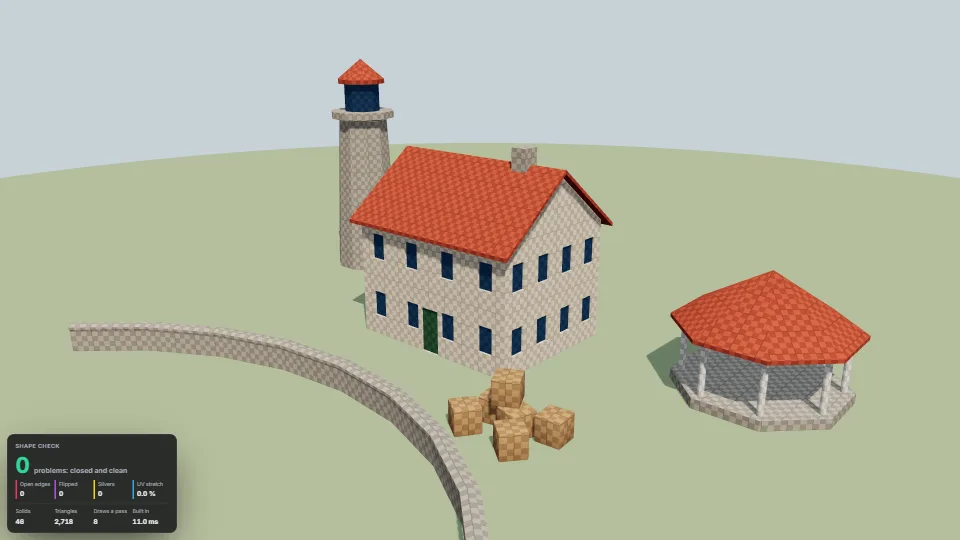
Closed shapes from a few numbers, so a scene made in code never needs a hand-built mesh.
Closed shapes from a few numbers, so a scene made in code never needs a hand-built mesh: bevelled boxes, blocks over any footprint with windows and doors set in as recesses with a pane, roofs (gable, hipped over any convex footprint, shed, flat) that are a slab of even thickness and build their own gable walls, so nothing is left open under the slope, a lathe, a sweep with mitred joints, and a sphere to roughen into rocks. Every solid is closed and wound outward, normals split at creases by an angle and are smooth elsewhere, UVs are in world metres (a texture keeps its size from wall to roof to post) and every part has a material slot: a built scene is one draw per slot, and a shape placed many times becomes instances. check() finds open seams, flipped faces, solids inside out, slivers and stretched UVs in any triangles, and draws them as lines. The core is plain arrays and imports nothing; a small adapter makes three meshes.
Measured 19 November 2026 on RTX 4060 Laptop, 13th Gen Intel(R) Core(TM) i9-13900H, Chrome 157, 1920×1080 at 1×. 600 frames × 3 rounds, median kept (rounds ranged GPU 0.22–0.23, CPU 0.24–0.26 ms). What ran: The default yard: a two-storey house with 28 windows and a door, a gable roof and chimney, a turned tower, a pavilion on eight instanced posts, a curved garden wall and six instanced crates, with the check overlay on. Built once at start; the frame cost is drawing it, about a dozen draws. Phones: tiers are being measured next.
Frames run back to back, each starting once the GPU has finished the last, so frame times show the work itself. They have a floor of about 4–5 ms from the browser’s own scheduling: GPU and CPU ms stay the measure of cost.
install("shape-kit")Your coding agent reads its pitfalls and installs it through the library’s MCP server. Set it upWritten for the library. Fully custom code.
Petr Felkel and Štěpán Obdržálek, “Straight Skeleton Implementation” (1998): the wavefront idea behind the hipped roofs: edges move inward at one speed and an edge that shrinks away leaves a node. Written here for convex footprints only (edge events, no splits)
Martin Newell: the polygon normal from summed edge cross terms, used to face every polygon the right way
David Eberly, “Triangulation by Ear Clipping” (Geometric Tools, 2002): ear clipping; here the fullest ear is taken first, and points on straight edges are set aside and put back by splitting, so no flat triangle is made
TechniquesShaders and pipelines built ahead, never on the frame that first draws something.
 Techniques
Any stroke icon (or filled one) as a solid you can light and turn.
 Techniques
WebGPU drawing (WebGL2 where it is missing) that stays locked to DOM panels tilted in CSS 3D.
 Techniques
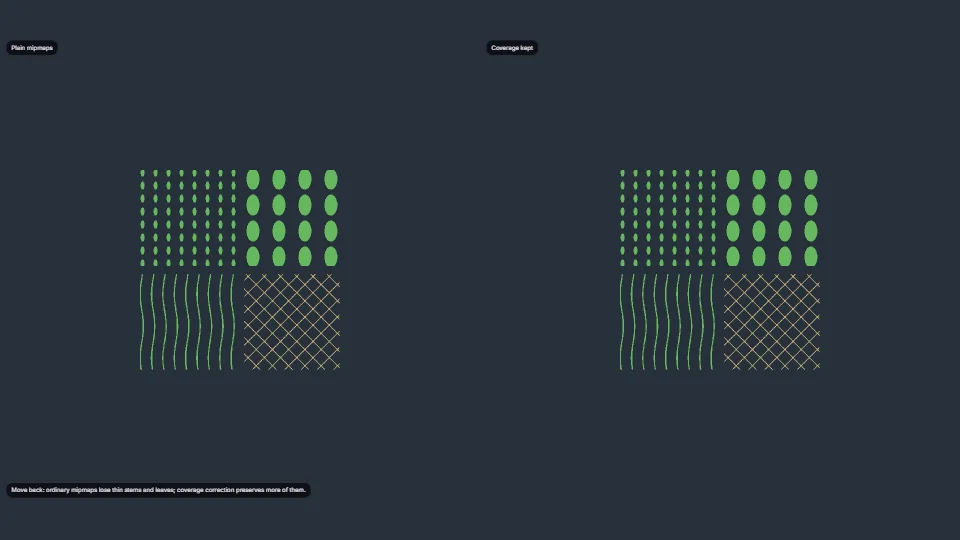
Build explicit RGBA mipmaps for alpha-tested atlases so thin leaves, stems and fence wire survive minification.