 Particles
GPU particles with collisions and emitters
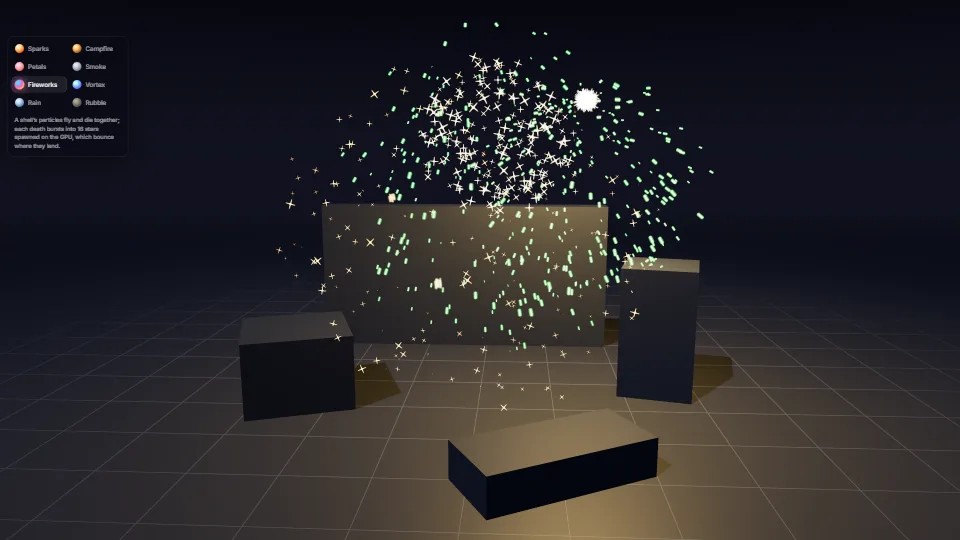
A general compute-particle core: emitters as plain data, noise turbulence, buoyancy and vortex forces, particles that bounce, slide or stick on floors and…
0.69 GPU · 0.23 CPU ms
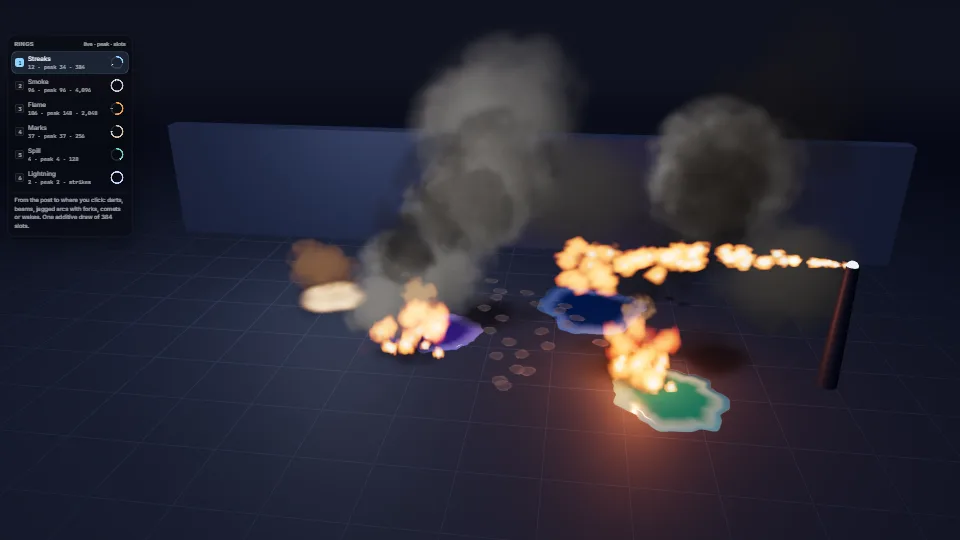
Five effects that each live in a fixed ring of instance slots and never allocate in play.
Measured 13 November 2026 on RTX 4060 Laptop, 13th Gen Intel(R) Core(TM) i9-13900H, Chrome 157, 1920×1080 at 1×. 600 frames × 3 rounds, median kept (rounds ranged GPU 0.82–1.03, CPU 0.21–0.48 ms). What ran: Measured with the show reel at a busy pace: an effect fired every 0.35 s in turn (streaks with forks, a smoke column, a flame stream and its burning spill, marks, a spreading spill, a lightning bolt), so all five rings and the bolts draw at once. About 100 to 300 puffs, 150 to 250 flame gobs and 60 streaks are alive at a time. Phones: tiers are being measured next.
| Machine | GPU ms | CPU ms | CPU p95 |
|---|---|---|---|
| RTX 4060 Laptop · 13th Gen Intel(R) Core(TM) i9-13900Hreference · measuring tool | 0.82 | 0.30 | 0.47 |
| apple · Apple A19 Proin a browser tab · 16 November 2026 | 1.80 | 0.08 | 0.14 |
| Intel Arc 140V (Xe2-LPG) · Intel Core Ultra 7 258Vin a browser tab · 15 November 2026 | 5.05 | 0.91 | 1.37 |
Bars against one 16.7 ms frame. A browser-tab run is timed in a visible tab without the tool’s scripted input, so read it as close, not exact.
From HaTac. Fully custom code.
Ken Perlin, improved noise (2002): The arcs’ wander, the smoke’s edges, the flames’ tongues, the marks’ shapes and the spills’ shores read three.js’s MaterialX noise nodes (mx_noise_float, mx_fractal_noise_float, mx_cell_noise_float): imported from three, not copied.
PCG random (Melissa O’Neill): Each mark’s seed is three’s TSL hash node of its slot, a PCG hash: imported from three, not copied.
Chris Wellons, hash-prospector (lowbias32): The strike hash’s finishing steps are his lowbias32 constants (public domain), after MurmurHash3’s multipliers (Austin Appleby, public domain).
ParticlesA general compute-particle core: emitters as plain data, noise turbulence, buoyancy and vortex forces, particles that bounce, slide or stick on floors and…
 Particles
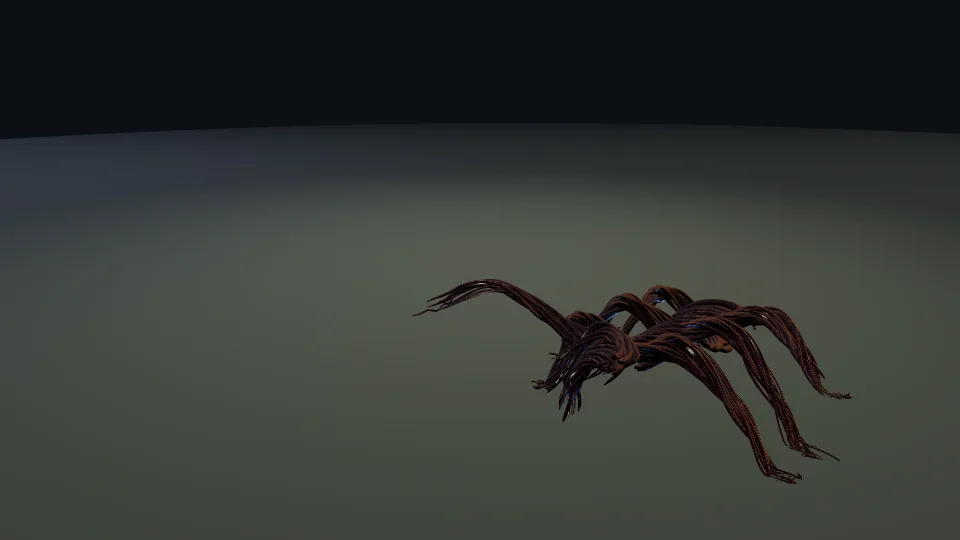
Creatures made of living lines: hundreds of Verlet strands pulled into a form, wound round its limbs, squirming, sagging and flinching from hits, two compute…
 Particles
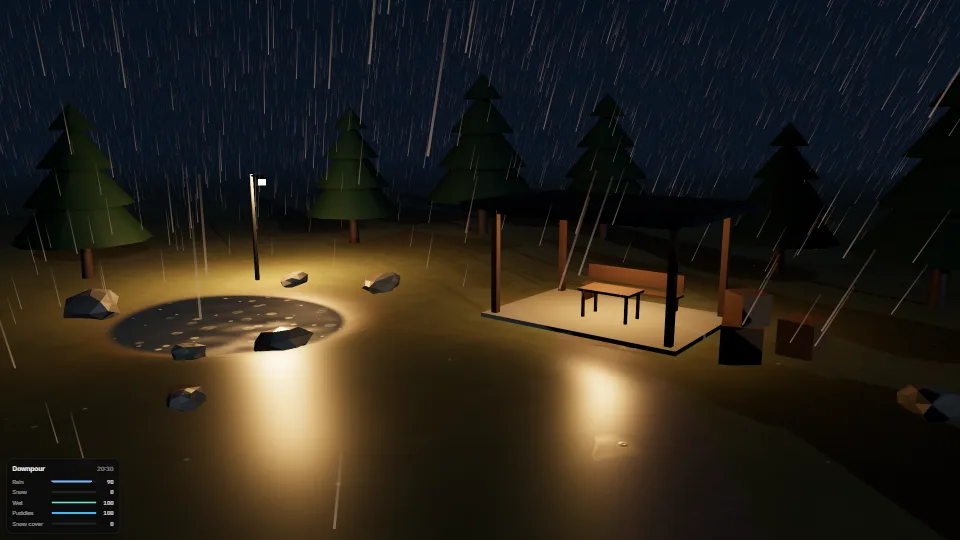
Every drop and flake placed by its index alone, so the CPU only writes a few uniforms (about 0.01 ms a frame).
 Particles
Birds, butterflies, fireflies, drones or darts that flock freely on the GPU, then each fly to their own point of a word or a shape, hold it and let go again.