 Particles
Swarm that writes words
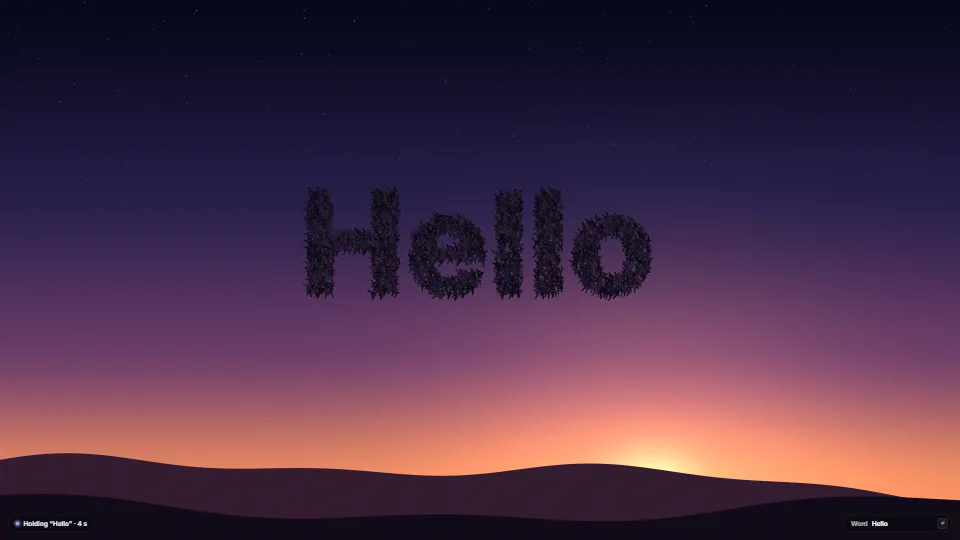
Birds, butterflies, fireflies, drones or darts that flock freely on the GPU, then each fly to their own point of a word or a shape, hold it and let go again.
1.42 GPU · 0.10 CPU ms
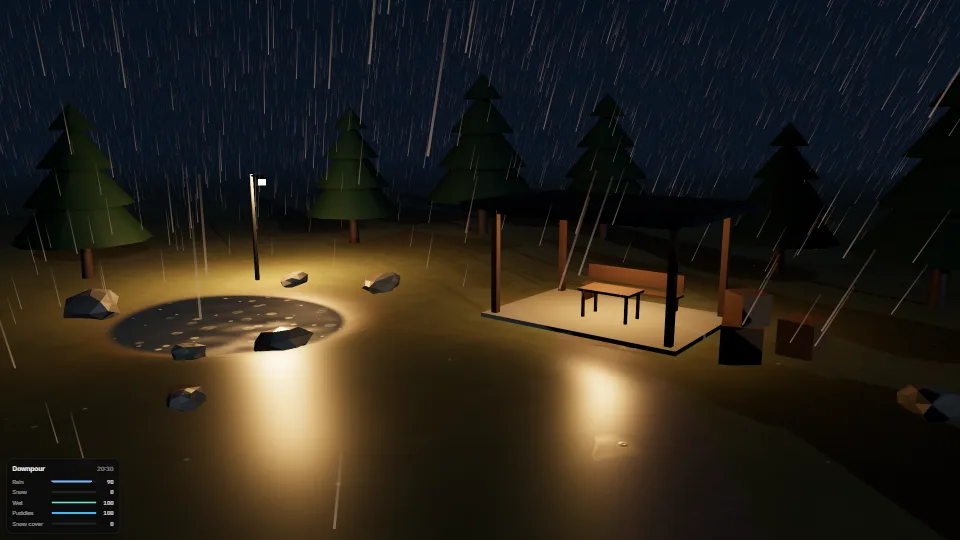
Every drop and flake placed by its index alone, so the CPU only writes a few uniforms (about 0.01 ms a frame).
Measured 3 November 2026 on RTX 4060 Laptop, 13th Gen Intel(R) Core(TM) i9-13900H, Chrome 156, 1920×1080 at 1×. 600 frames × 3 rounds, median kept. What ran: Runs a downpour whatever the controls say (rain 0.9, wind 4 m/s, 20:30, the ground soaked): some 30,000 streaks and 17,000 splashes (more on a wider stage), one instanced draw each, with the rings on the pond and puddles and the wet, glossy ground. The CPU writes a few uniforms and the instance counts a frame. Phones: tiers are being measured next.
| Machine | GPU ms | CPU ms | CPU p95 |
|---|---|---|---|
| RTX 4060 Laptop · 13th Gen Intel(R) Core(TM) i9-13900Hreference · measuring tool | 1.33 | 0.33 | 0.52 |
| apple · Apple A19 Proin a browser tab · 16 November 2026 | 6.37 | 1.00 | 1.36 |
| Intel Arc 140V (Xe2-LPG) · Intel Core Ultra 7 258Vin a browser tab · 15 November 2026 | 9.31 | 1.13 | 1.58 |
Bars against one 16.7 ms frame. A browser-tab run is timed in a visible tab without the tool’s scripted input, so read it as close, not exact.
warm), or the first shower stalls a frame.setLook({ width }), setSnowLook({ size })).From HaTac. Fully custom code.
Jarzynski and Olano, “Hash Functions for GPU Rendering” (JCGT, 2020): The PCG hash that places each drop, splash, flake and ring (it replaces the game’s Dave Hoskins “hash without sine”).
FNV-1a (Fowler, Noll and Vo), MurmurHash3’s finaliser (Austin Appleby) and lowbias32 (Chris Wellons): Public-domain integer hashes whose constants seed the world and roll each day’s weather and each lightning slot.
ParticlesBirds, butterflies, fireflies, drones or darts that flock freely on the GPU, then each fly to their own point of a word or a shape, hold it and let go again.
 Particles
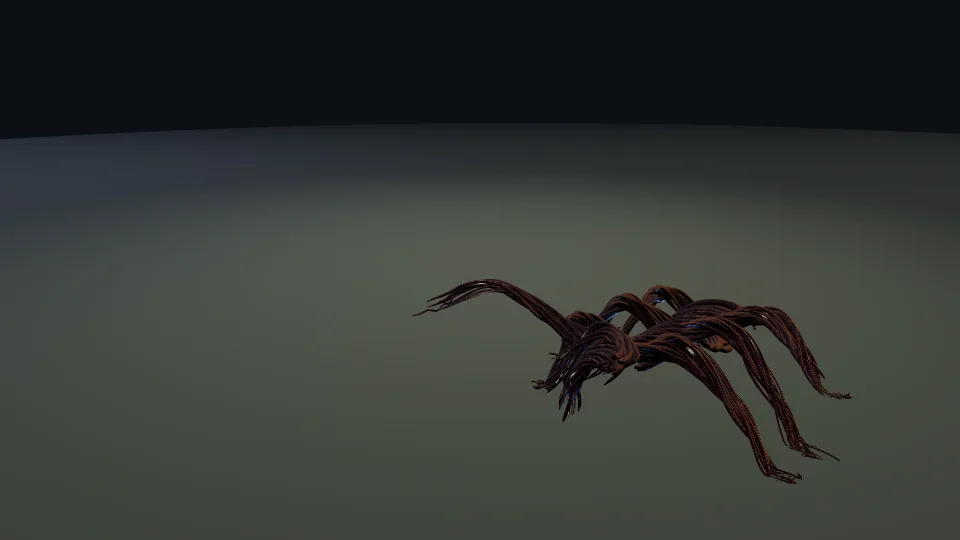
Creatures made of living lines: hundreds of Verlet strands pulled into a form, wound round its limbs, squirming, sagging and flinching from hits, two compute…
 Particles
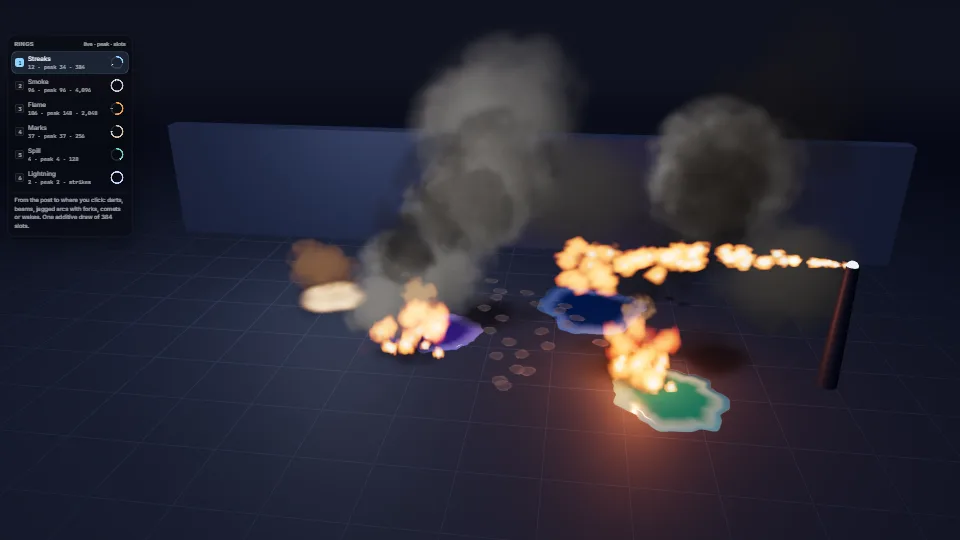
Five effects that each live in a fixed ring of instance slots and never allocate in play.
 Particles
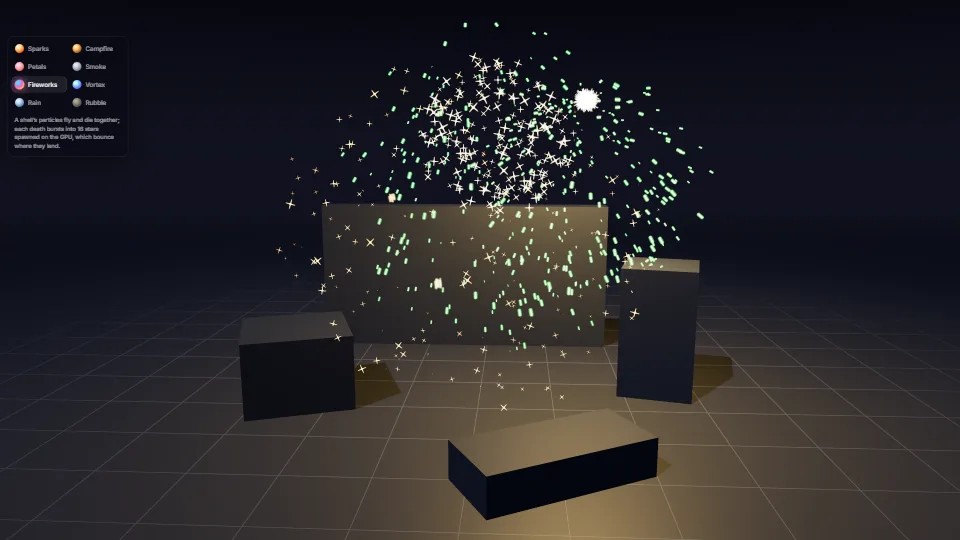
A general compute-particle core: emitters as plain data, noise turbulence, buoyancy and vortex forces, particles that bounce, slide or stick on floors and…