 Particles
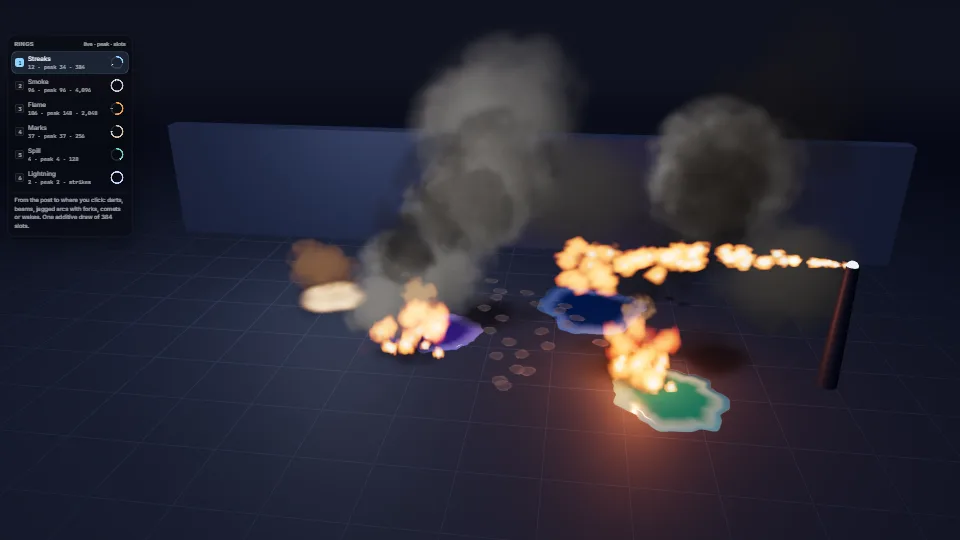
Ring-buffer effects: streaks, smoke, flame, marks, spills and lightning
Five effects that each live in a fixed ring of instance slots and never allocate in play.
0.82 GPU · 0.30 CPU ms
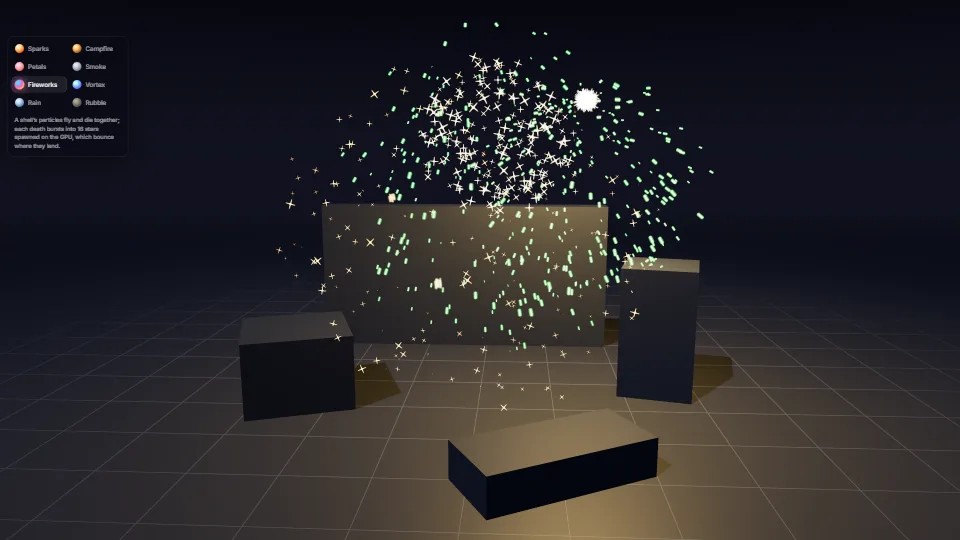
A general compute-particle core: emitters as plain data, noise turbulence, buoyancy and vortex forces, particles that bounce, slide or stick on floors and…
Measured 3 November 2026 on RTX 4060 Laptop, 13th Gen Intel(R) Core(TM) i9-13900H, Chrome 156, 1920×1080 at 1×. 600 frames × 3 rounds, median kept. What ran: Measured on the Fireworks preset at rate ×3: a shell about every 0.3 s, each shell’s 12 particles bursting into 192 stars on the GPU (a sub-emitter on death) that bounce on the floor and boxes, and a flash light timed to each burst. Only the glow layer is alive, so only it simulates and draws. Phones: tiers are being measured next.
| Machine | GPU ms | CPU ms | CPU p95 |
|---|---|---|---|
| RTX 4060 Laptop · 13th Gen Intel(R) Core(TM) i9-13900Hreference · measuring tool | 0.69 | 0.23 | 0.39 |
| apple · Apple A19 Proin a browser tab · 16 November 2026 | 2.10 | 0.08 | 0.10 |
| Intel Arc 140V (Xe2-LPG) · Intel Core Ultra 7 258Vin a browser tab · 15 November 2026 | 2.56 | 0.82 | 1.30 |
Bars against one 16.7 ms frame. A browser-tab run is timed in a visible tab without the tool’s scripted input, so read it as close, not exact.
If(cond, () => x.assign(y)) arrow that returns a node is a return and ends the whole pass.+ 0.5) before toInt(): 0.99999 truncates to the style before, and particles draw as another effect.forceSinglePass): either, added on the first burst, built a new pipeline then (about 250 ms on D3D).warm(renderer, camera, scene) shows them for the compile and draws them empty for a quarter second.fogPosition to hand each corner’s world position to a fog node of your own.From HaTac. Fully custom code.
Ken Perlin, improved noise (2002): The turbulence and the smoke’s edges read three.js’s MaterialX noise nodes (mx_noise_vec3, mx_noise_float): imported from three, not copied.
PCG random (Melissa O’Neill): Per-particle randomness is three’s TSL hash node, a PCG hash: imported from three, not copied.
Rodrigues’ rotation formula: Debris tumbles about its own axis by it. The formula, not code.
ParticlesFive effects that each live in a fixed ring of instance slots and never allocate in play.
 Particles
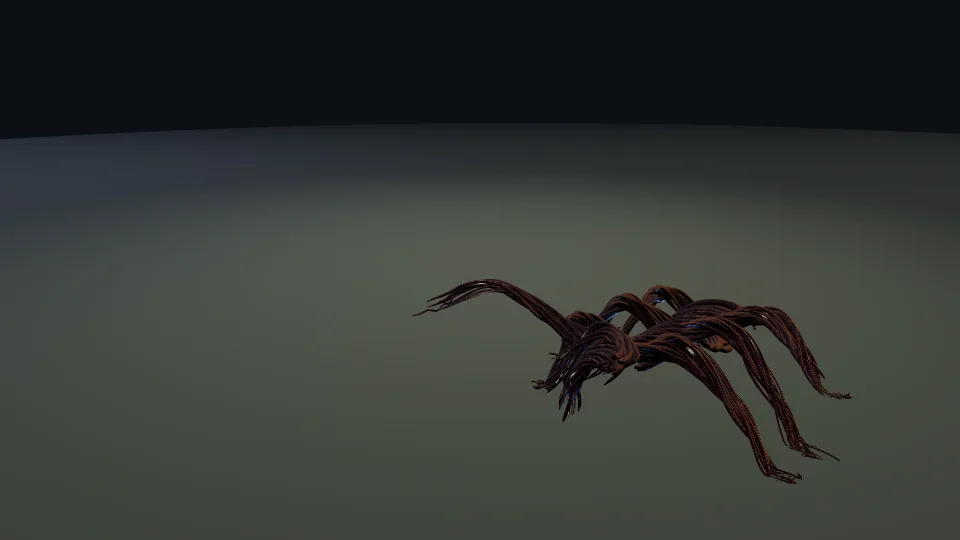
Creatures made of living lines: hundreds of Verlet strands pulled into a form, wound round its limbs, squirming, sagging and flinching from hits, two compute…
 Particles
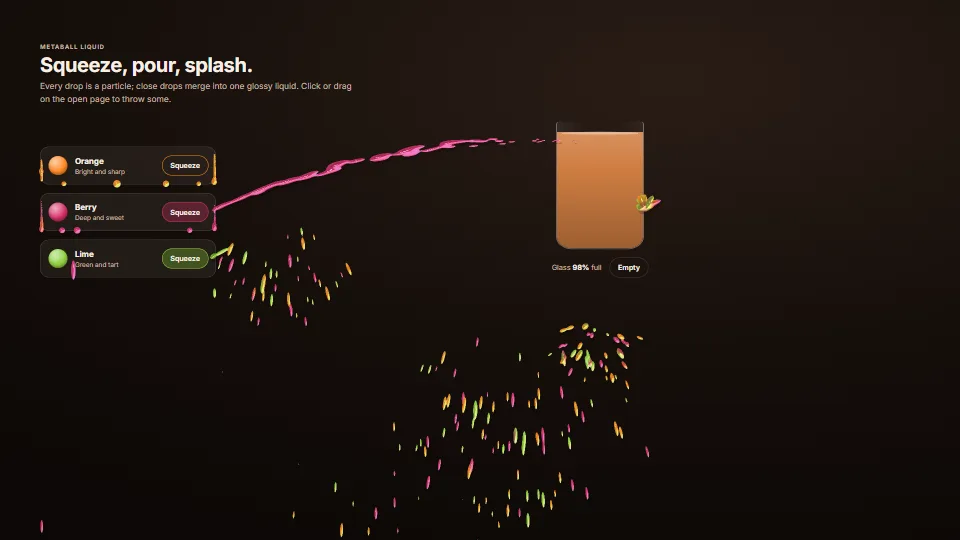
Liquid as GPU particles that merge like metaballs, in raw WebGPU.
 Particles
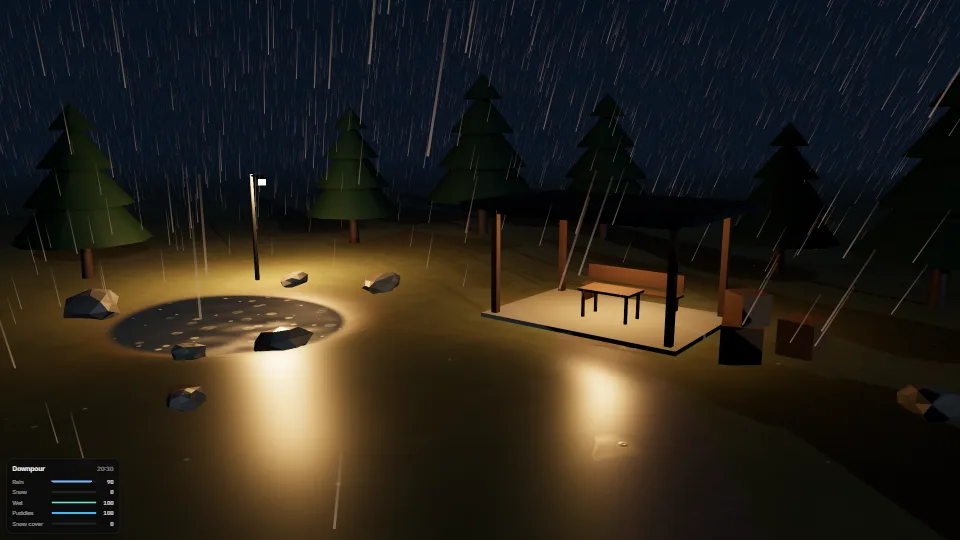
Every drop and flake placed by its index alone, so the CPU only writes a few uniforms (about 0.01 ms a frame).