 Surfaces & materials
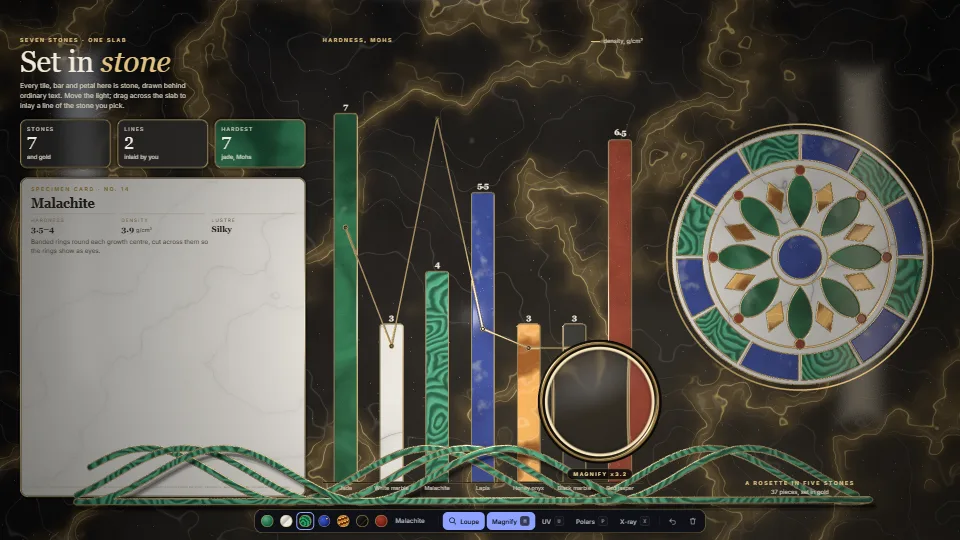
Stone inlay: the page as a polished slab
The whole page becomes one slab of polished stone behind ordinary DOM.
1.94 GPU · 0.52 CPU ms
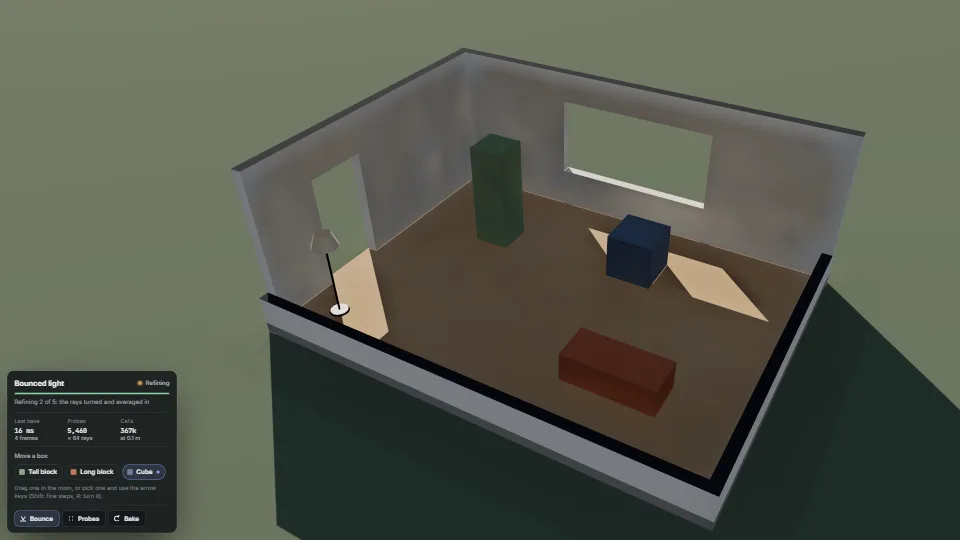
Light that comes in through a window, lands on the floor and bounces round the room, worked out on the GPU in a few frames instead of the half a minute…
Measured 13 November 2026 on RTX 4060 Laptop, 13th Gen Intel(R) Core(TM) i9-13900H, Chrome 157, 1920×1080 at 1×. 600 frames × 3 rounds, median kept (rounds ranged GPU 2.31–2.46, CPU 0.41–0.65 ms). What ran: Measured with the cube gliding round the room by itself and the grid re-baked as each bake ends (voxelize, then one pass from the last result over 5,460 probes, a quarter of them a frame, 32 rays each). The sun at 16:00 through a window and a door, shadows on. Phones: tiers are being measured next.
| Machine | GPU ms | CPU ms | CPU p95 |
|---|---|---|---|
| RTX 4060 Laptop · 13th Gen Intel(R) Core(TM) i9-13900Hreference · measuring tool | 2.32 | 0.45 | 0.68 |
| apple · Apple A19 Proin a browser tab · 16 November 2026 | 4.04 | 0.10 | 0.20 |
| Intel Arc 140V (Xe2-LPG) · Intel Core Ultra 7 258Vin a browser tab · 15 November 2026 | 6.75 | 1.43 | 2.63 |
Bars against one 16.7 ms frame. A browser-tab run is timed in a visible tab without the tool’s scripted input, so read it as close, not exact.
cpu: !bakesOnGpu(renderer), decided before construction: three builds the grid’s node round its atlas on the first compile, and the CPU’s atlas is a Data3DTexture, not the GPU’s storage texture).adopt() the hemisphere light before anything is compiled.warm() and wait for it before the first bake.place() with the same key and the same object does nothing.reference.ts can check it on the CPU (voxelize, then march through the opening).reach from inside reads the sky at its far end.gridBounds does), or the floor reads the probes inside its slab.adapt) lifts each probe darker than the open sky toward it in the publish pass only: changing it costs one publish of the result on screen, not a bake (while a bake’s own passes run, none: their publish takes it).From HaTac. Fully custom code.
three.js LightProbeGrid, LightProbeGridNode and LightProbeGridHelper (MIT): used from three’s own addons, not copied: the module fills the grid’s atlas in three’s own packing and L2 basis
Amanatides and Woo, “A Fast Voxel Traversal Algorithm for Ray Tracing” (1987): the cell-by-cell ray march
Ramamoorthi and Hanrahan, “An Efficient Representation for Irradiance Environment Maps” (2001): irradiance from nine spherical-harmonic coefficients, as three’s getShIrradianceAt evaluates it
Fibonacci sphere (golden-angle spiral): the rays round each probe
Majercik, Guertin, Nowrouzezahrai and McGuire, “Dynamic Diffuse Global Illumination with Ray-Traced Irradiance Fields” (JCGT 2019): the idea behind the refining passes: rays turned by a random rotation each update and blended into the last result
Shoemake, “Uniform Random Rotations” (Graphics Gems III, 1992): the random rotation
Surfaces & materialsThe whole page becomes one slab of polished stone behind ordinary DOM.
 Surfaces & materials
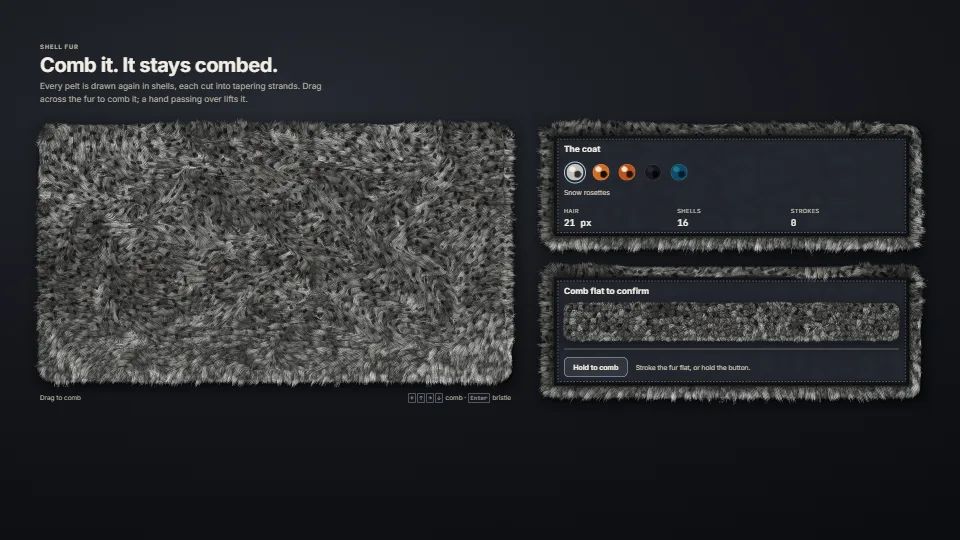
Fur on the page’s own panels, in raw WebGPU (a WebGL2 twin draws the same fur where WebGPU is missing).
 Surfaces & materials
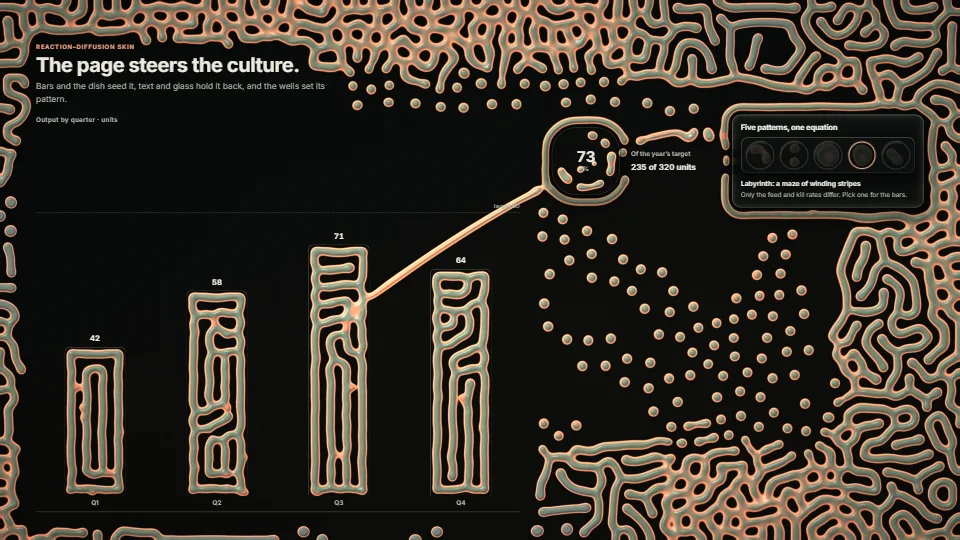
A Gray–Scott reaction–diffusion culture under a page, in raw WebGPU, steered by the DOM.
 Surfaces & materials
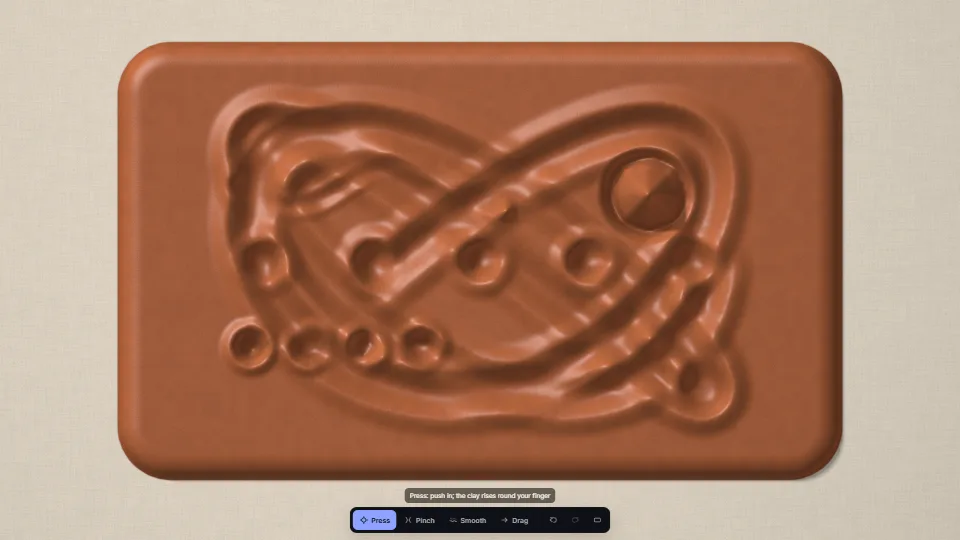
A slab of clay on a linen board that keeps every touch.