 Techniques
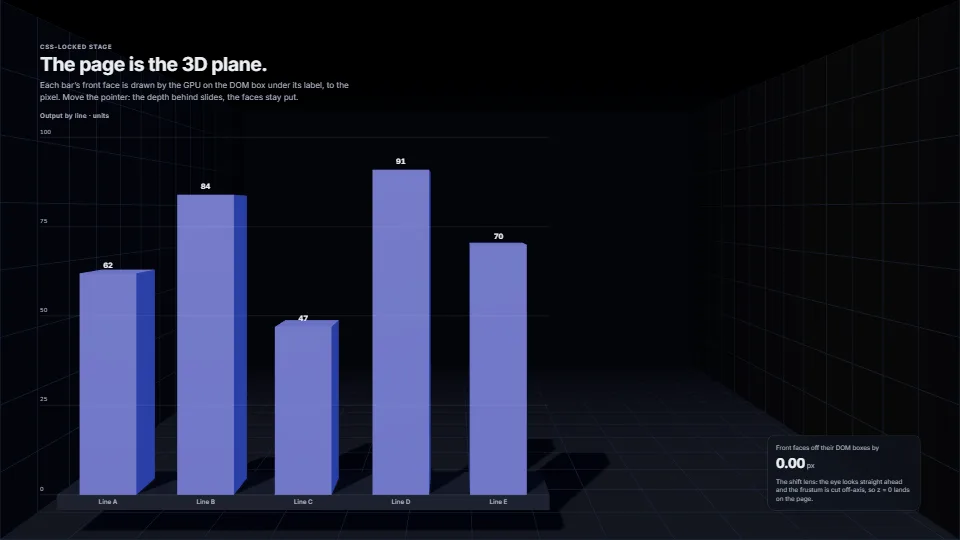
A 3D stage locked to CSS pixels
A shift-lens camera for a three.js canvas behind the DOM.
0.46 GPU · 0.27 CPU ms

A wall of words that becomes one line.
Measured 13 November 2026 on RTX 4060 Laptop, 13th Gen Intel(R) Core(TM) i9-13900H, Chrome 157, 1920×1080 at 1×. 600 frames × 3 rounds, median kept (rounds ranged GPU 0.38–0.61, CPU 0.43–0.46 ms). What ran: Measured playing the whole timeline on a loop (wall, flight, hold) in the Flock style with the Light look: 48 words, about 4,000 glyphs in one instanced draw, the line’s rim and glow, and the backdrop under the veil. Phones: tiers are being measured next.
| Machine | GPU ms | CPU ms | CPU p95 |
|---|---|---|---|
| RTX 4060 Laptop · 13th Gen Intel(R) Core(TM) i9-13900Hreference · measuring tool | 0.52 | 0.45 | 0.59 |
| apple · Apple A19 Proin a browser tab · 16 November 2026 | 1.80 | 0.32 | 0.46 |
| Intel Arc 140V (Xe2-LPG) · Intel Core Ultra 7 258Vin a browser tab · 15 November 2026 | 3.08 | 0.82 | 0.99 |
Bars against one 16.7 ms frame. A browser-tab run is timed in a visible tab without the tool’s scripted input, so read it as close, not exact.
time) drives the cloud’s turn, the threads’ light and the line’s breath: hold it still when paused or under reduced motion, and the frame holds still too.From My other apps. Fully custom code.
Felzenszwalb & Huttenlocher, Distance Transforms of Sampled Functions (2012): the exact Euclidean distance transform behind the glyph and line fields (from the library’s sdf-text)
PCG hash (Jarzynski & Olano, Hash Functions for GPU Rendering, 2020): the integer hash for the per-glyph seeds, in place of the source’s sine hash (three’s TSL hash is the same family)
Numerical Recipes (Press et al.) linear congruential generator: the constants 1664525 and 1013904223 of the seeded shuffle
TechniquesA shift-lens camera for a three.js canvas behind the DOM.
 Techniques
A contract that lets one simulation wear any number of looks.
 Techniques
Cinematic camera moves between stations in a 3D world, with shots as data.
 Techniques
Pre-recorded video inside a WebGPU scene and in the page, stage-grade.