 Particles
Lightspeed and shockwave
A title moment for a stage or a launch: the camera races in at lightspeed behind falling lights, the stars streaking past, brakes hard into their trails and…
5.56 GPU · 0.14 CPU ms

Shells launched by kind and colour to burst where you point.
Measured 11 November 2026 on 13th Gen Intel(R) Core(TM) i9-13900H, Chrome 157, 1920×1080 at 1×. 600 frames × 3 rounds, median kept. What ran: Measured with the automatic show running at its defaults (about a shell a second, low quality): compute steps over the live shells’ slots, the backdrop, the sparks and their reflection, and the pass out, timed with timestamp queries. Phones: tiers are being measured next.
| Machine | GPU ms | CPU ms | CPU p95 |
|---|---|---|---|
| unknown GPU · 13th Gen Intel(R) Core(TM) i9-13900Hreference · measuring tool | 6.54 | 0.13 | 0.22 |
| apple · Apple A19 Proin a browser tab · 16 November 2026 | 6.89 | 0.26 | 0.40 |
| Intel Arc 140V (Xe2-LPG) · Intel Core Ultra 7 258Vin a browser tab · 15 November 2026 | 3.60 | 0.27 | 0.43 |
Bars against one 16.7 ms frame. A browser-tab run is timed in a visible tab without the tool’s scripted input, so read it as close, not exact.
frame() skips while the last one is still on the GPU and the steps catch up next frame (up to eight).calm: no strobes, glitter or crackle flashes, the burst’s flash swells in instead of popping, and time runs at 0.7.From SpaciousPro. Fully custom code.
Mark Jarzynski and Marc Olano, “Hash Functions for GPU Rendering” (JCGT 2020): The PCG hash every spark’s own numbers come from, on the GPU and (for the word’s points) on the CPU.
Planck’s law: Trails, charcoal stars and dying stars take a blackbody’s colour at their temperature, worked out from the law at three wavelengths.
Christophe Schlick, Fresnel approximation (1994): How much of the sky the water mirrors at each angle.
Miles Macklin, “Faster fog” (2010): The haze round each burst is the closed-form (atan) integral of a point light’s inverse-square in-scattering along the ray, the result he writes up.
The parametric heart curve (16 sin³t, 13 cos t − 5 cos 2t − 2 cos 3t − cos 4t): The heart shell’s outline: a well-known curve.
ParticlesA title moment for a stage or a launch: the camera races in at lightspeed behind falling lights, the stars streaking past, brakes hard into their trails and…
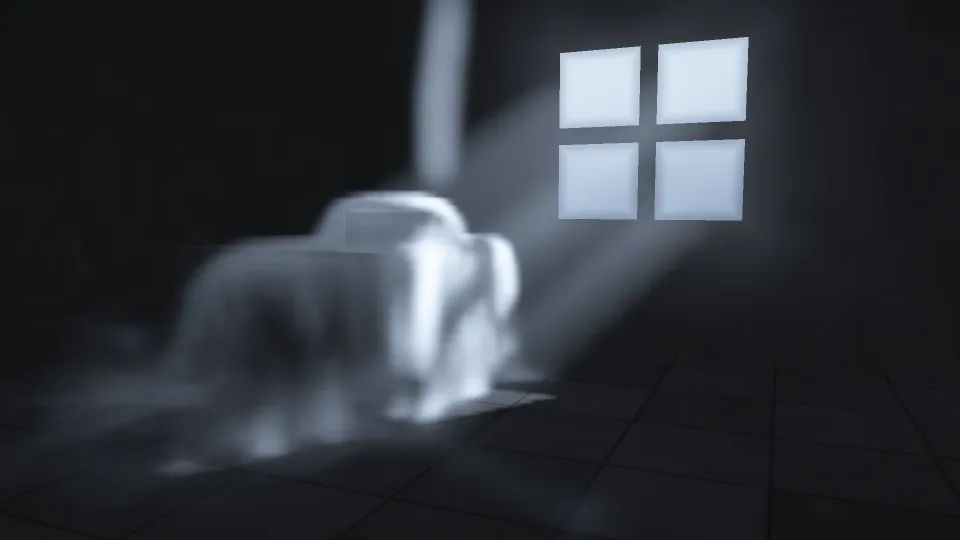 Particles
Cold mist from a quarter of a million GPU particles.
 Particles
A field of characters wakes: every glyph lifts off its cell, rises on a curl flow into a few rivers of light, runs along them and pours into a word, where one…
 Particles
Birds, butterflies, fireflies, drones or darts that flock freely on the GPU, then each fly to their own point of a word or a shape, hold it and let go again.