 Techniques
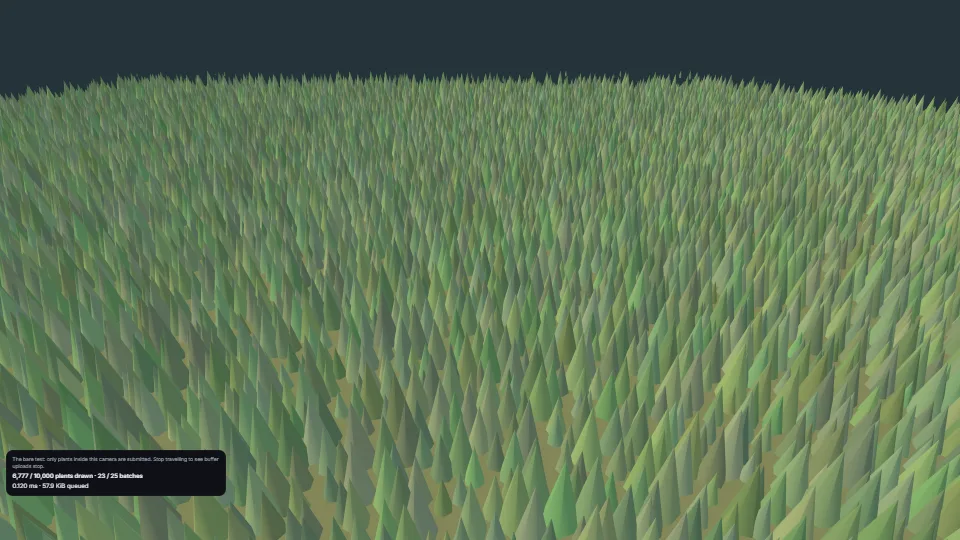
CPU culling for instanced batches
Cull spatial batches with one enclosing sphere, test individual instances only at the view edge, and pack visible rows in stable source order.
Not measured yet
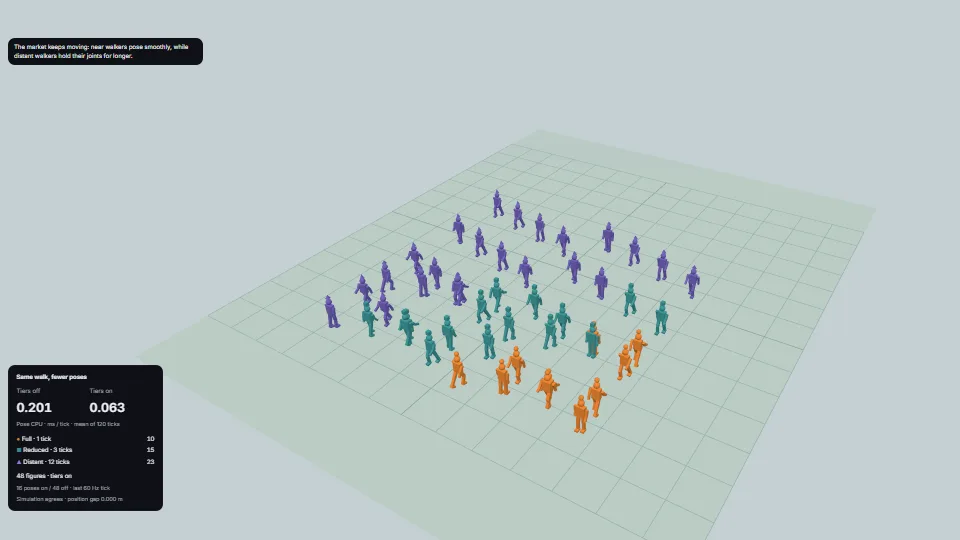
Keep crowd simulation running while posing less important bodies every third or twelfth tick.
Rank by distance with immediate promotion, demotion slack and a forced-full override; optionally slow small figures further. PosedRoot skips a second matrix walk after a published pose and transports unchanged joints rigidly between poses. A walking crowd compares live pose CPU with tiers on and off.
Not measured yet.
install("pose-tiers")Your coding agent reads its pitfalls and installs it through the library’s MCP server. Set it upFrom HaTac. Adapted from published work, named below.
Hannes Andersson: The source game’s crowd pose budgets, staggered cadence, rank hysteresis and published-pose matrix optimization.
TechniquesCull spatial batches with one enclosing sphere, test individual instances only at the view edge, and pack visible rows in stable source order.
 Techniques
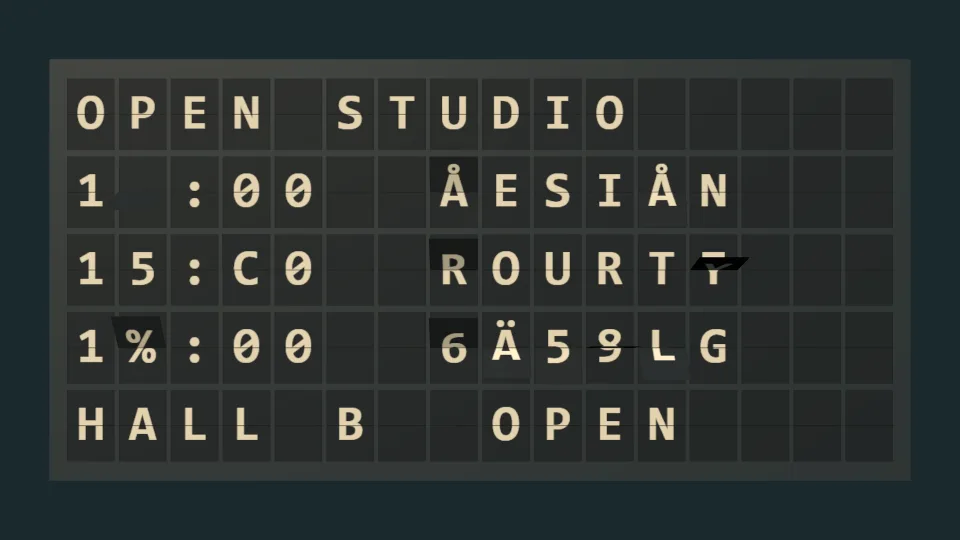
A three-piece GPU flap drum for text, countdown digits and pictures quantised to colour shades.
 Techniques
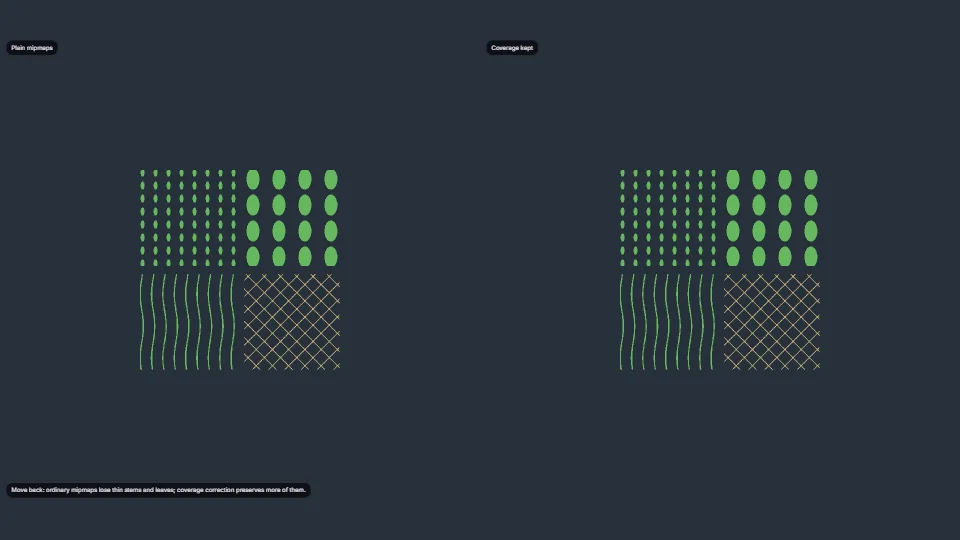
Build explicit RGBA mipmaps for alpha-tested atlases so thin leaves, stems and fence wire survive minification.
 Techniques
Any stroke icon (or filled one) as a solid you can light and turn.