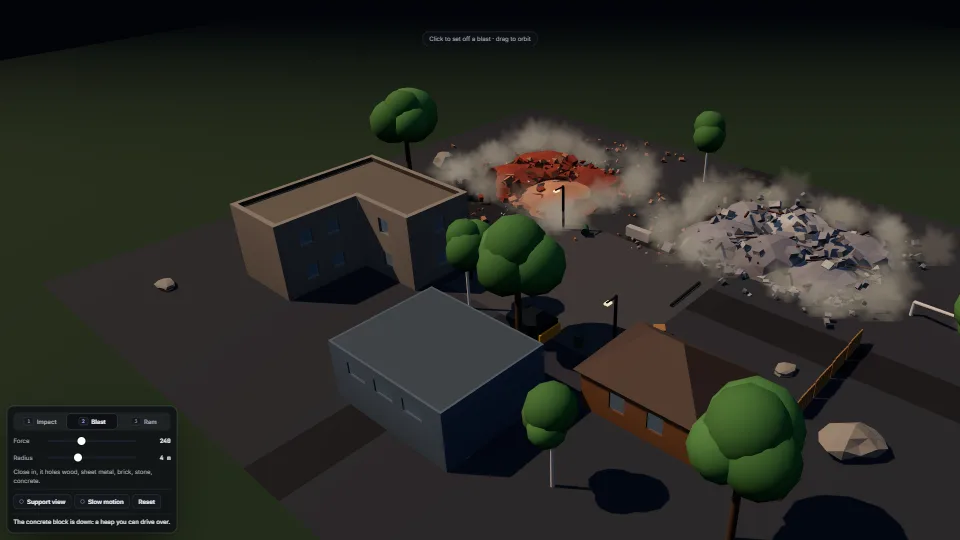
 Simulation
Breakable world
Walls that take ragged holes, buildings that come down, and rubble that stays.
0.56 GPU · 1.07 CPU ms
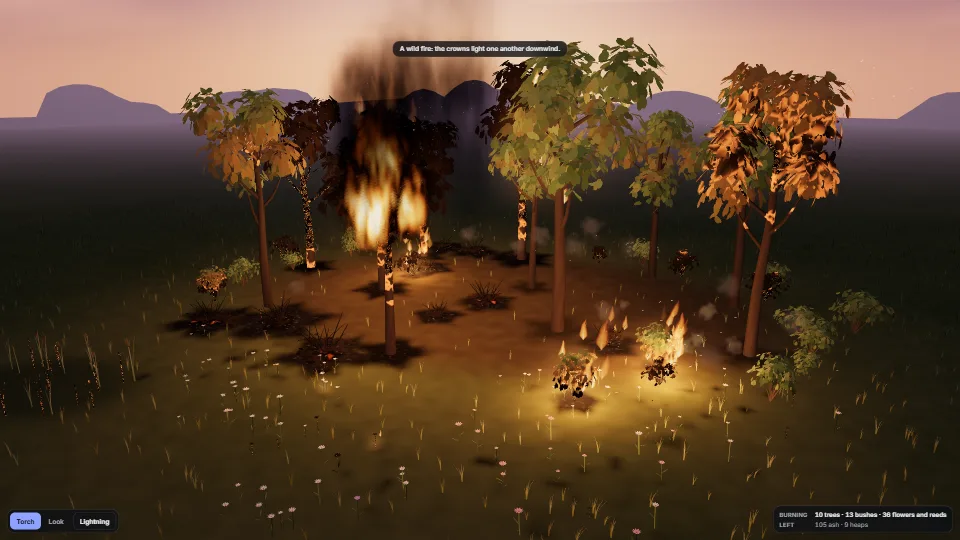
Plants that catch, burn and leave something behind, one at a time by a stable key.
Measured 15 November 2026 on RTX 4060 Laptop, 13th Gen Intel(R) Core(TM) i9-13900H, Chrome 157, 1920×1080 at 1×. 600 frames × 3 rounds, median kept (rounds ranged GPU 1.32–1.32, CPU 0.53–1.09 ms). What ran: Measured from a lightning strike on frame one: the upwind tree of the copse catches in its crown, with a 2.2 m/s wind and the crown run on, stepped a 60th of a second a frame (so the uncapped run burns as at 60 Hz). By the measured frames the fire has run into the neighbouring crowns: the nearest as the fluid box (36 × 46 × 36 cells, 56 ray steps), the rest with flame licks, embers, glows and smoke, the warm light of eight fires on every material, and the fire stepped on the CPU four times a second. The preview is posed: the copse ablaze in the crowns, held still. Phones: tiers are being measured next.
| Machine | GPU ms | CPU ms | CPU p95 |
|---|---|---|---|
| RTX 4060 Laptop · 13th Gen Intel(R) Core(TM) i9-13900Hreference · measuring tool | 1.32 | 1.09 | 2.03 |
| apple · Apple A19 Proin a browser tab · 16 November 2026 | 10.7 | 0.12 | 0.32 |
| Intel Arc 140V (Xe2-LPG) · Intel Core Ultra 7 258Vin a browser tab · 15 November 2026 | 9.31 | 1.03 | 1.81 |
Bars against one 16.7 ms frame. A browser-tab run is timed in a visible tab without the tool’s scripted input, so read it as close, not exact.
BurnRows.flush): a copse is hundreds of plants, and their rows change four times a second at most.burnNoise into burnSurface’s coarse): a leaf card is a few pixels to a few hundred, and four noises per pixel of a burning crown, with overdraw, were most of its cost.edgePoint), not at random in a fixed shape round it: flames placed in a ball round a bush or at a flower’s head look like candle flames stamped on the plant.from (a reserved word), nor several other plain words; the CPU interpreter in the tests accepts them, so a name that passes there can still fail on the GPU.tongues (a feed and detail noise stretched upward, more contrast, a later start to the glow and a thinner hot core) so flames lick up out of the crown, and hand a falling crown to the licks, since the box does not turn with the tree.remainsOf does), or the branches vanishing mid-fire reads as a pop.showAll) so its pipeline is built before the first remains appear.From HaTac, and in the garden walk showcase. Fully custom code.
Tommy Ettinger, mulberry32 (public domain): The seeded random numbers the fire, the copse and the particles are drawn with (`seeded` in plant-fire.ts).
Glenn Fowler, Landon Curt Noll and Kiem-Phong Vo, FNV-1a (public domain): The key hash behind each piece’s own turn and shape (`keyNoise` in remains.ts), with a final multiply–xorshift mix.
Mark Jarzynski and Marc Olano, Hash Functions for GPU Rendering (2020): The PCG hash the char’s noise is built on (`pcg` in char-front.ts), the same bits on the CPU and the GPU.
Jos Stam, Stable Fluids (1999): The fluid crowns step the stable-fluids scheme (fire-volume.ts, from the library’s fluid-fire). The algorithm, not code.
SimulationWalls that take ragged holes, buildings that come down, and rubble that stays.
 Simulation
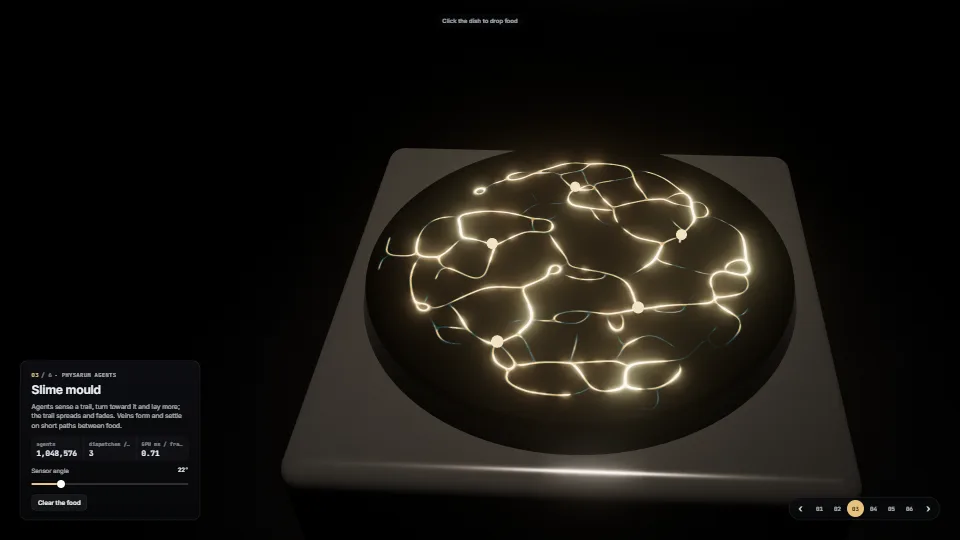
A dark exhibition of six WebGPU compute techniques, each a reusable module on its own plinth.
 Simulation
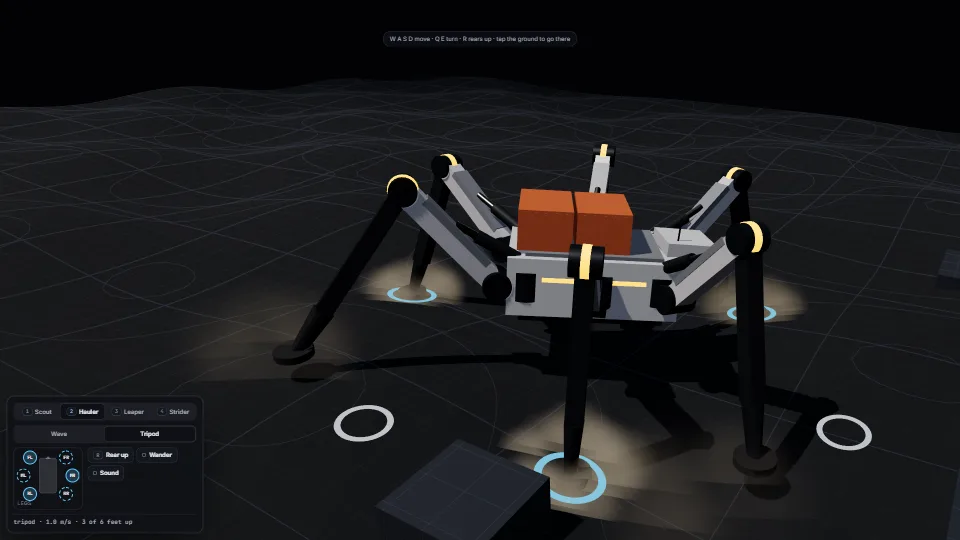
Legged machines that walk from code: a radial walker on any number of legs and a two-legged strider on reverse-jointed legs.
 Simulation
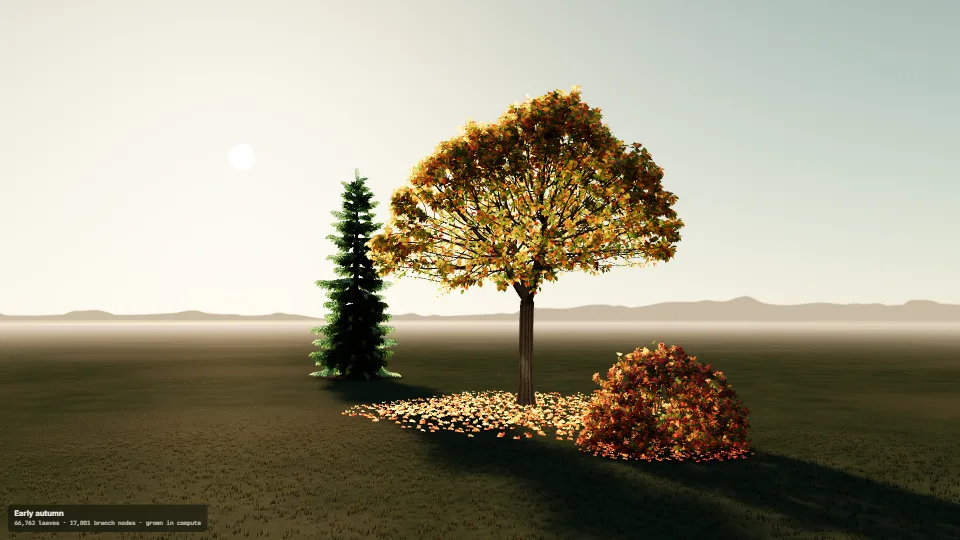
A broadleaf tree, a spruce and a flowering bush grown on the GPU.