 Techniques
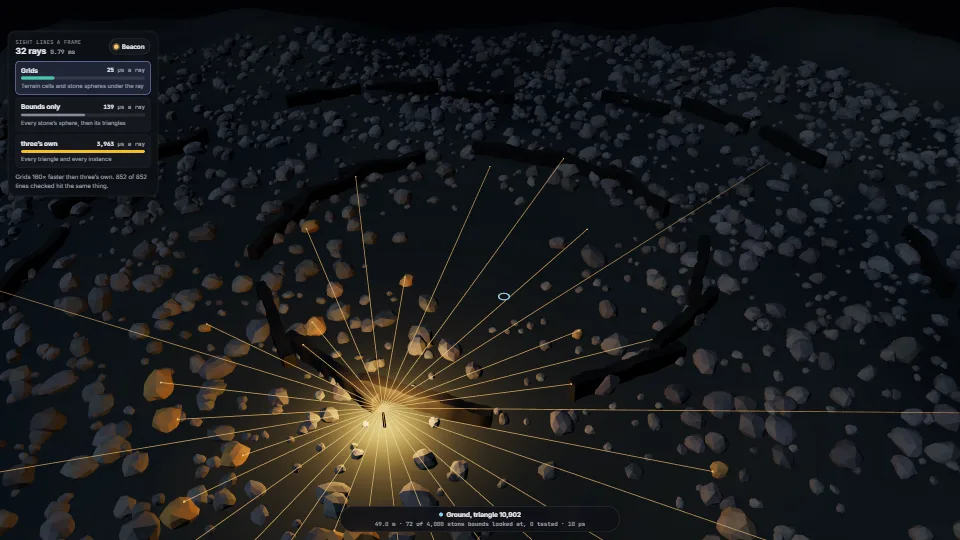
Fast rays through big meshes and many instances
Picking and line of sight that stay cheap when the scene is big.
0.72 GPU · 1.07 CPU ms
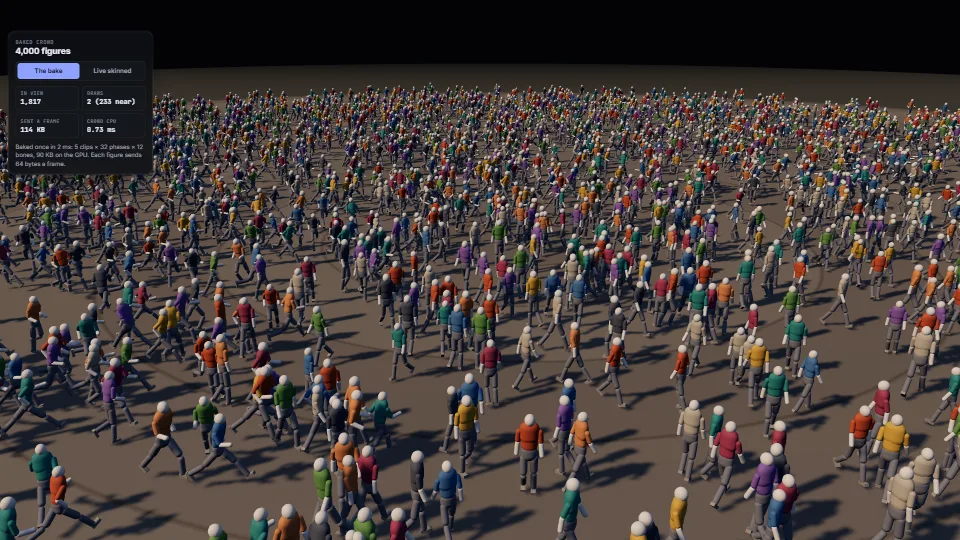
Thousands of animated figures for the price of a few draws.
Measured 13 November 2026 on RTX 4060 Laptop, 13th Gen Intel(R) Core(TM) i9-13900H, Chrome 157, 1920×1080 at 1×. 600 frames × 3 rounds, median kept (rounds ranged GPU 0.88–1.29, CPU 0.71–0.88 ms). What ran: Measured with 4,000 figures in the bake, two kinds (near and far), shadows on: they wander, and every 6 s the crowd is called to a point or scattered, so clips switch and cross-fade throughout. Phones: tiers are being measured next.
| Machine | GPU ms | CPU ms | CPU p95 |
|---|---|---|---|
| RTX 4060 Laptop · 13th Gen Intel(R) Core(TM) i9-13900Hreference · measuring tool | 1.07 | 0.71 | 0.90 |
| apple · Apple A19 Proin a browser tab · 16 November 2026 | 7.57 | 2.34 | 3.28 |
| Intel Arc 140V (Xe2-LPG) · Intel Core Ultra 7 258Vin a browser tab · 15 November 2026 | 7.93 | 1.94 | 2.33 |
Bars against one 16.7 ms frame. A browser-tab run is timed in a visible tab without the tool’s scripted input, so read it as close, not exact.
textures: CrowdBatch.needsTextures(renderer) (after renderer.init()): three’s WebGL2 backend cannot read the two storage buffers at computed indices in the vertex stage (the figures simply do not draw, with no error), so the bones and records go into float DataTextures instead.place, and keep the batch out of your own bounds checks.batch.compile(renderer, camera, scene) shows every kind for one compile in the renderer’s one queue.cycle), or figures moon-walk at any speed but the one the clip was made at.tilt instead), and reactions.From HaTac. Fully custom code.
Jarzynski and Olano, Hash Functions for GPU Rendering (2020): The PCG hash the demo uses for its figures’ colours and wandering.
TechniquesPicking and line of sight that stay cheap when the scene is big.
 Techniques
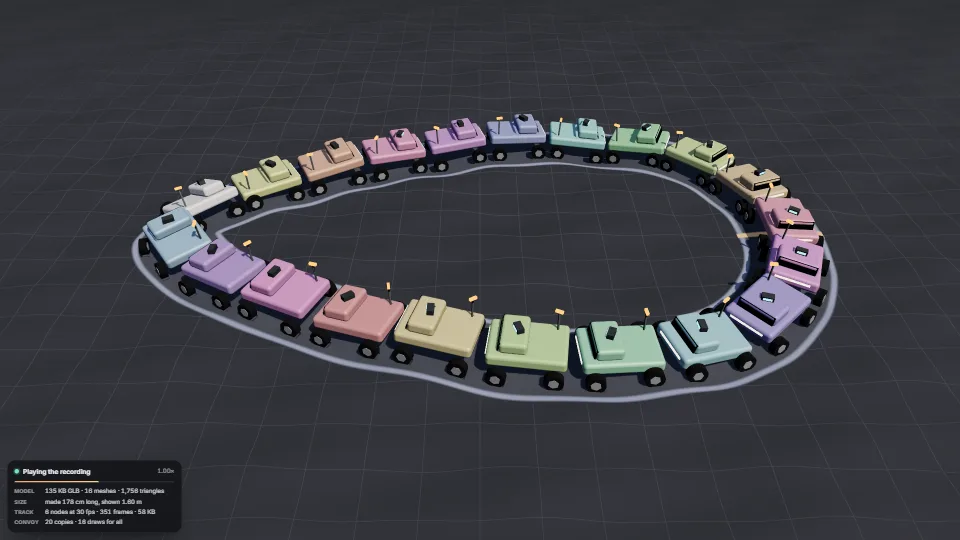
GLB models ready for a stage: gated before loading (header, size and count budgets, allowed extensions, nothing outside the file, each refusal with a plain…
 Techniques
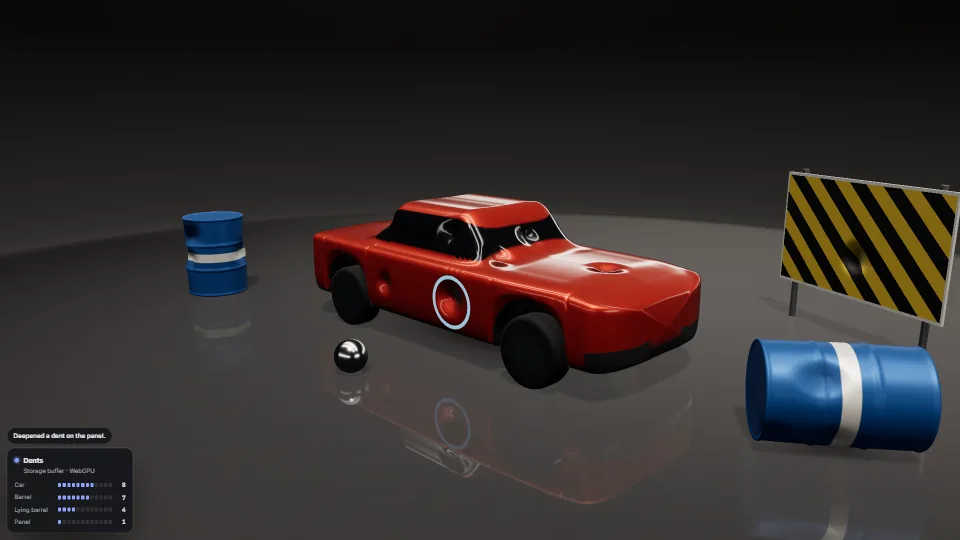
Crash dents on car bodies, barrels, panels and props, drawn by the GPU from one small table of objects × dent slots.
 Techniques