 Simulation
Procedural planets from a seed
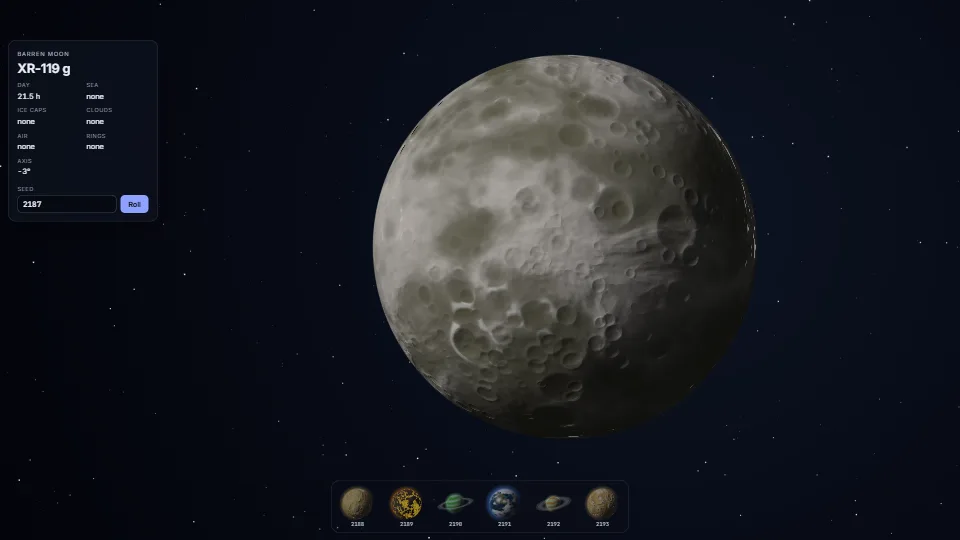
A whole planet from one number: a seed picks the kind (temperate, ocean, desert, ice, lava, gas giant or barren moon), its palette, its axis, and how much sea…
3.47 GPU · 0.20 CPU ms
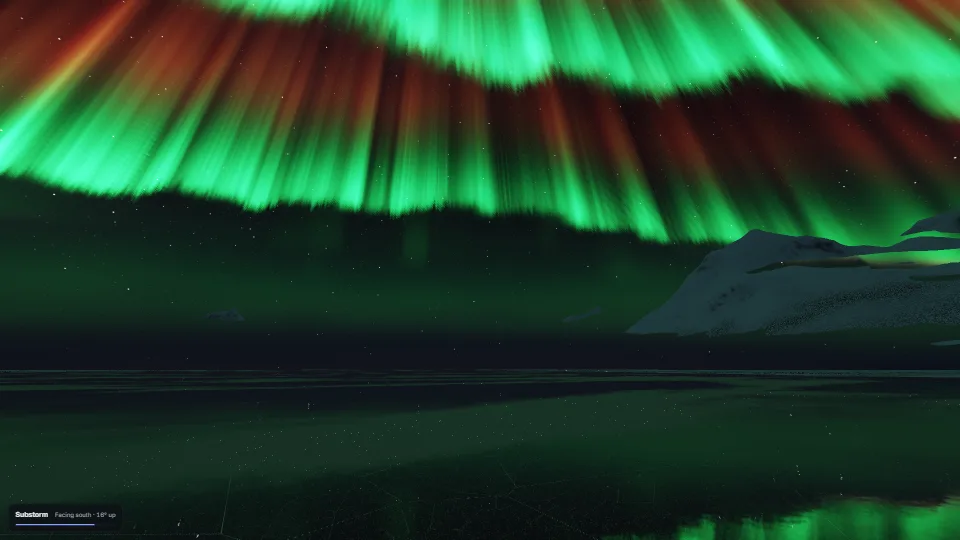
An aurora worked out as physics on WebGPU, seen from a frozen fjord.
Measured 11 November 2026 on 13th Gen Intel(R) Core(TM) i9-13900H, Chrome 157, 1920×1080 at 1×. 600 frames × 3 rounds, median kept. What ran: Looking round the sky with a substorm every 20 s: the sheets’ Biot–Savart step, 65,536 electrons and the light they leave, the oval, the aurora marched at about 0.45 MP and the fjord traced at the full stage, timed with its own timestamp queries. Phones: tiers are being measured next.
| Machine | GPU ms | CPU ms | CPU p95 |
|---|---|---|---|
| unknown GPU · 13th Gen Intel(R) Core(TM) i9-13900Hreference · measuring tool | 3.16 | 0.12 | 0.20 |
| apple · Apple A19 Proin a browser tab · 16 November 2026 | 14.7 | 0.30 | 0.42 |
| Intel Arc 140V (Xe2-LPG) · Intel Core Ultra 7 258Vin a browser tab · 15 November 2026 | 18.4 | 0.21 | 0.42 |
Bars against one 16.7 ms frame. A browser-tab run is timed in a visible tab without the tool’s scripted input, so read it as close, not exact.
tier option) it draws at low quality: a third of the electrons, the aurora marched at about 0.25 MP and fewer steps over the fjord.auroraDrawSize: about 1 MP at most, stretched by the canvas.From SpaciousPro. Fully custom code.
Robert Krasny, desingularised vortex sheet roll-up (1986): The sheets’ regularised Biot–Savart sum (a blob of radius δ in place of each point vortex’s core) is his method.
T. J. Hallinan & T. N. Davis, small-scale auroral arc distortions (1970): Curls and folds in auroral arcs as a Kelvin–Helmholtz-like roll-up of a sheet of current: the idea the sheets follow.
M. H. Rees, auroral excitation by energetic electrons (1963): The deposition height against electron energy (about 150 km at 1 keV, 110 at 10) is a fitted line after his curves.
Mark Jarzynski & Marc Olano, Hash Functions for GPU Rendering (2020): The PCG hash under every random number and noise, in the shaders and on the CPU.
Jorge Jimenez, interleaved gradient noise (2014): The march’s per-pixel start offset, which keeps its steps from banding.
Krzysztof Narkowicz, ACES filmic tone mapping curve (2015): The tonemap is his fit, kept as published.
Fritz Kasten, relative optical air mass (1965): The extinction near the horizon uses his air-mass formula.
Steven Worley, cellular texture basis (1996): The ice’s cracks are the distance between the nearest two cells (F2 − F1).
F. Kenton Musgrave, ridged multifractal terrain: The mountains’ ridged, weighted octaves follow his ridged multifractal.
SimulationA whole planet from one number: a seed picks the kind (temperate, ocean, desert, ice, lava, gas giant or barren moon), its palette, its axis, and how much sea…
 Simulation
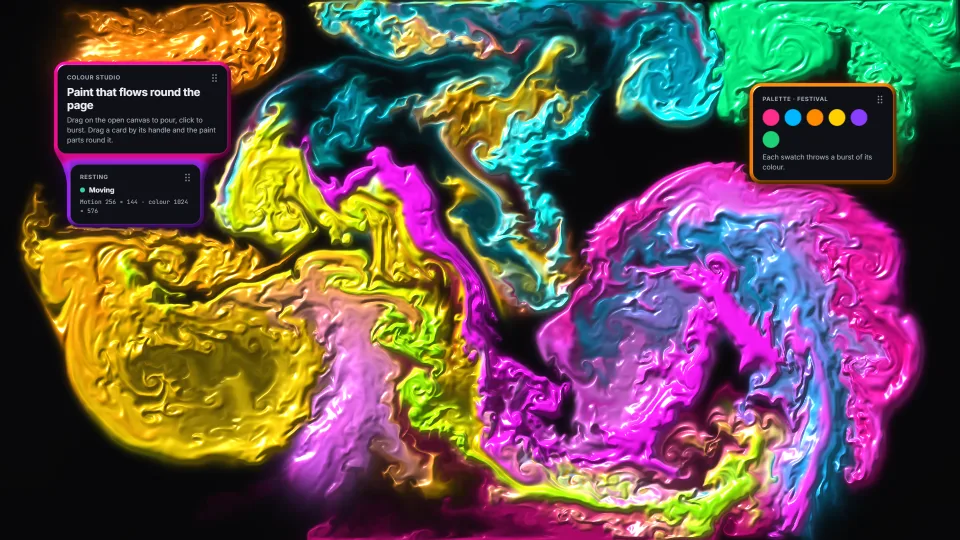
A stable-fluids simulation in WebGPU compute, nothing read back, with the page’s own panels as obstacles the paint flows round and a moving panel pushing it aside.
 Simulation
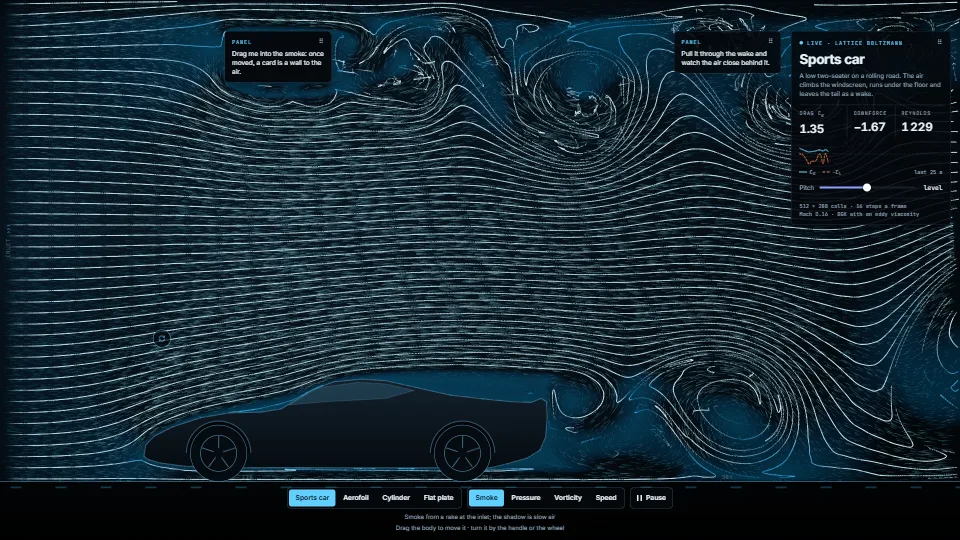
A real-time lattice Boltzmann (D2Q9) flow in WebGPU compute around solids you describe as plain shapes.
 Simulation
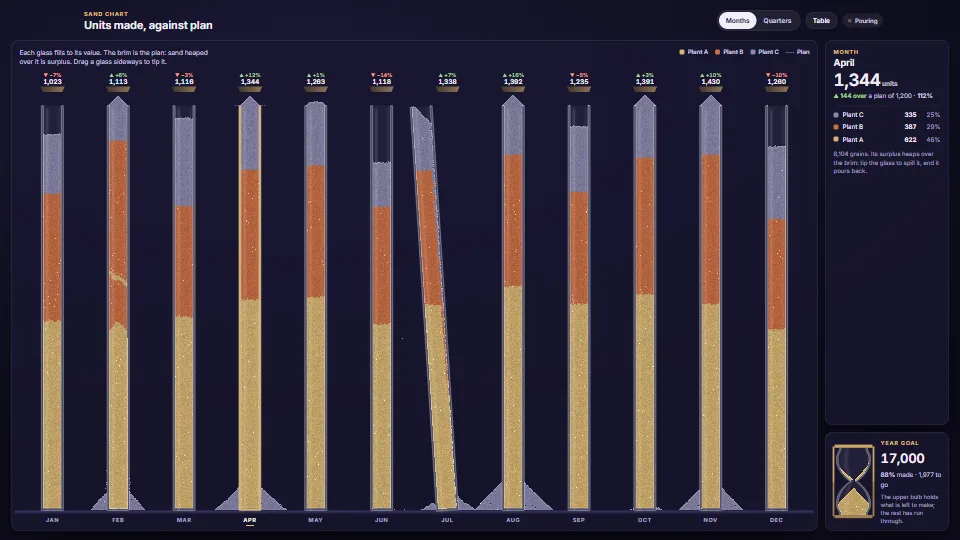
Charts made of falling sand: page elements become glasses that fill with real grains to each value, the brim at the plan and the surplus heaped over it, in…